So, you have a baby in Canada. You start thinking, as parents do, about where he or she will go to school. You and your spouse may have a preference based on your own education and upbringing; your opinion may evolve as your child grows, maybe special needs emerge. Maybe you want your child to be educated in your faith community, to nurture a special skill or talent, or to learn the classics. Or maybe you just want to make sure your kid can focus on learning in a smartphone-free school.
In B.C., Alberta, Saskatchewan, Manitoba and Quebec, even if you’re not wealthy, even if your school doesn’t offer a financial support program, there are policy tools that mean you have options.
But if you live in Ontario, especially if you’re one of the many struggling to put food on the table or gas in your car, real school choice feels like a pipe dream. It doesn’t have to be this way.
Indeed, despite the fact that the province does not fund independent schools, close to 7 percent of students are educated in independent schools. And the growth rate of independent schools in Ontario is staggering.
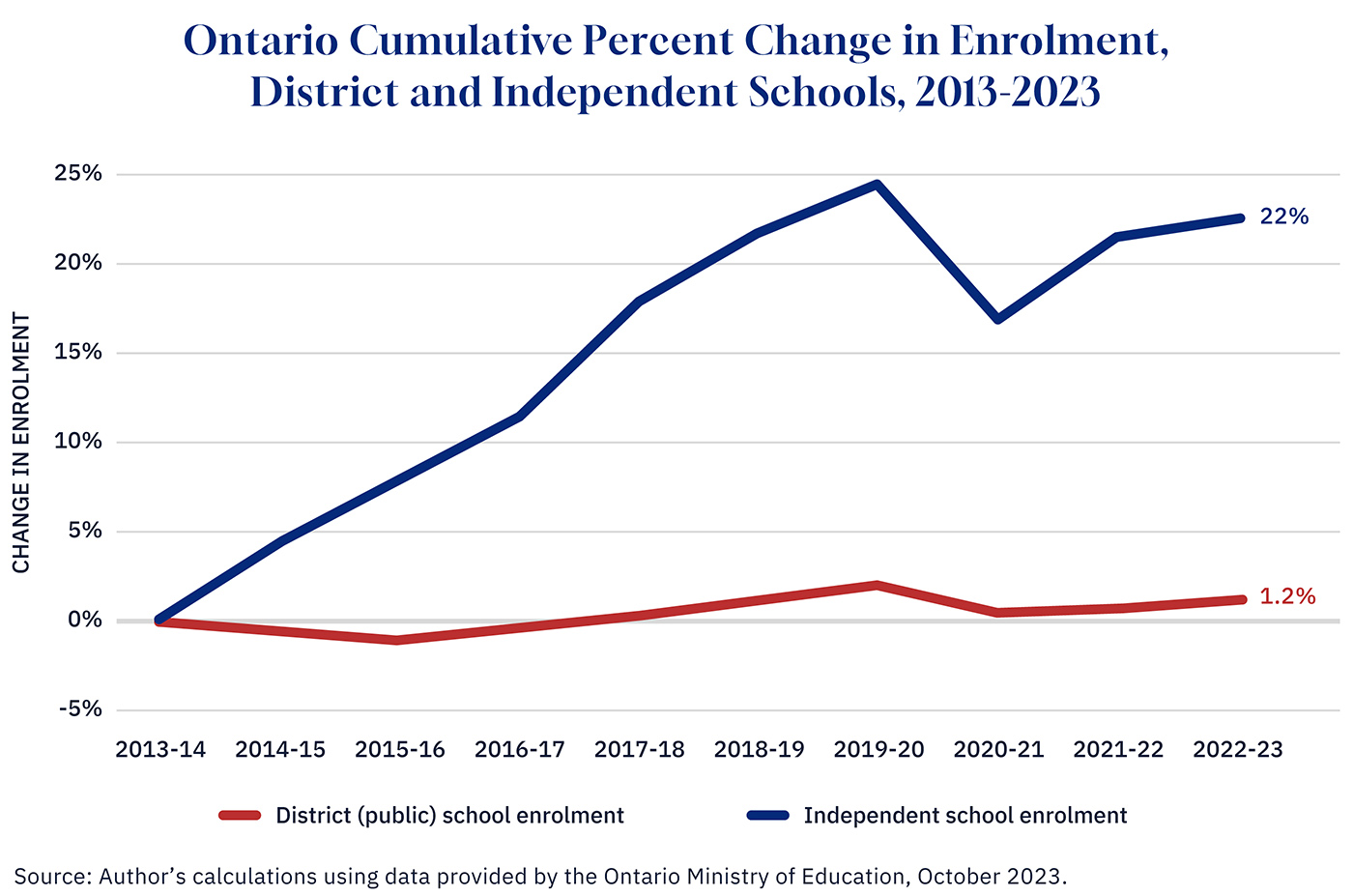
Graphic credit: Janice Nelson
Despite the expense, Ontario parents are (trying to) vote with their feet. And it’s not just wealthy families. Of the over 1,445 independent schools in the province, only a minority (some 4.2 percent) are schools typically associated with elite private education. In fact, the vast majority of schools either serve special needs students, provide Montessori education, are nature schools, or have a religious emphasis. Ontario’s median annual independent school tuition, while a stretch for many families, is $13,525—far from the exorbitant cost many envision when they think of private school.
Two things are clear: that parents are unsatisfied with the public school system and are willing to pay out of pocket if it means more choice around how their child is educated. The challenge is to ensure there is equal access to these choices for all families in Ontario. A true conservative approach to education policy should support the freedom of parents to choose schooling that is best for their children by funding a plurality of options, beyond the largely homogeneous, state-run public system or the publicly funded Catholic school system.
Learning from peer provinces
Especially post-pandemic, the government-run Ontario’s public education system has faced challenge after challenge—including declining test scores, violence in schools, and financial mismanagement.
While the solutions to these problems are complex, more funding is not the silver bullet to fix the systemic problems within large school boards. Indeed, as student enrolment has been declining , government spending on education has only been going up. This status quo is not working for most families who want more engagement, flexibility, and responsiveness to student needs.
Independent schools provide more options to families who are looking for them, and other provinces are excellent models for how to begin funding these schools. B.C. funds independent schools at various levels and has done so for decades under both right and left-leaning governments.
In general, independent schools that cost the same to run as other public schools in the area can receive 50 percent of per-student funding. Schools that exceed this amount receive 35 percent of per-student funding. Imagine if, in Ontario, some portion of the amount of taxpayer money spent in the school system on your child’s behalf could follow your child, funding whatever school you think is best.
Other types of independent schools do not receive funding if they don’t meet certain eligibility requirements. In Alberta, most independent schools receive 70 percent of operating funding and are subject to certain regulations. Notably, Alberta requires that accredited, funded independent schools operate as non-profits. These jurisdictions provide helpful models that could be emulated in Ontario to allow more families access to educational options they might not otherwise be able to afford.
Quality and oversight
Of course, the government can and should play an oversight role. Public funding for independent education should come with a degree of accountability to maintain both the quality and legitimacy of education in Ontario. This would also help avoid the further proliferation of credit mills, which have been subject to stricter enforcement in recent years.
If Ontario begins funding independent schools, it must strike a delicate regulatory balance that allows them to innovate while holding them accountable for the quality of the education they provide. This means setting basic standards for student outcomes and requiring membership in school associations that impose certain requirements. This dynamic interaction between governments, associations, schools, local communities, and, most importantly, parents would be a creative approach to regulation and accountability in the sector.
Equal support for vulnerable students
While Ontario considers education reform, it should also correct a historic inequity that disadvantages its students with special needs. Students with disabilities and other learning needs who attend independent schools are eligible for funding from the Ministry of Health, but are ineligible for supports from the Ministry of Education. In practice, this means that a child with a hearing impairment, for example, who attends an independent school will not receive the supports that the same child would receive in a public school. Limiting this support to the public system clearly discriminates against these students and fails to recognize the complex reasons why parents choose to send them to independent schools. Students with special needs should be supported regardless of the school they attend. This injustice should be corrected to help the most vulnerable students in Ontario achieve their full potential.
The time is now
For far too long, the conversation about school choice in Ontario has felt like one we’re not allowed to have, with Liberals pursuing a bigger role for the state in education and Progressive Conservatives quietly blaming teachers’ unions and a twenty-year-old bungled campaign commitment. Those who carry the scars of the 2007 provincial election forget that their political PTSD deceives them. John Tory’s ill-fated faith-based schools announcement happened almost 20 years ago, and the reasons for its political impact had little to do with the principle at the core of the policy commitment.
For conservatives, education policy doesn’t have to be the third rail, and greater pluralism in education and school choice doesn’t have to be an unattainable fantasy. Put positively, the question for voters should be: who is more likely to have the best interests of your child at heart: the bureaucratic structures of government and public school boards, or you?
The provincial government itself, by taking over some of the largest school boards in the province, has acknowledged that boards have lost touch and are far removed from parents. And scholars who study the state of the system describe Ontario’s school system as “a centralized, bureaucratic fortress.” It’s time for the kids to break out of that fortress.
It’s time for Ontario to support all forms of education that parents choose. This would make Ontario as competitive as its provincial peers. It would also put Ontario in a position to compete with global leaders like the Netherlands, Singapore, and Finland. If Ontario truly wants to be the best place in Canada to live, work, and raise a family, a great “retention bonus” it could offer to families is funding for independent education. This shift in education policy would help ensure that every child in Ontario receives the best education for their needs, setting them up for a meaningful and productive life in the province they call home.