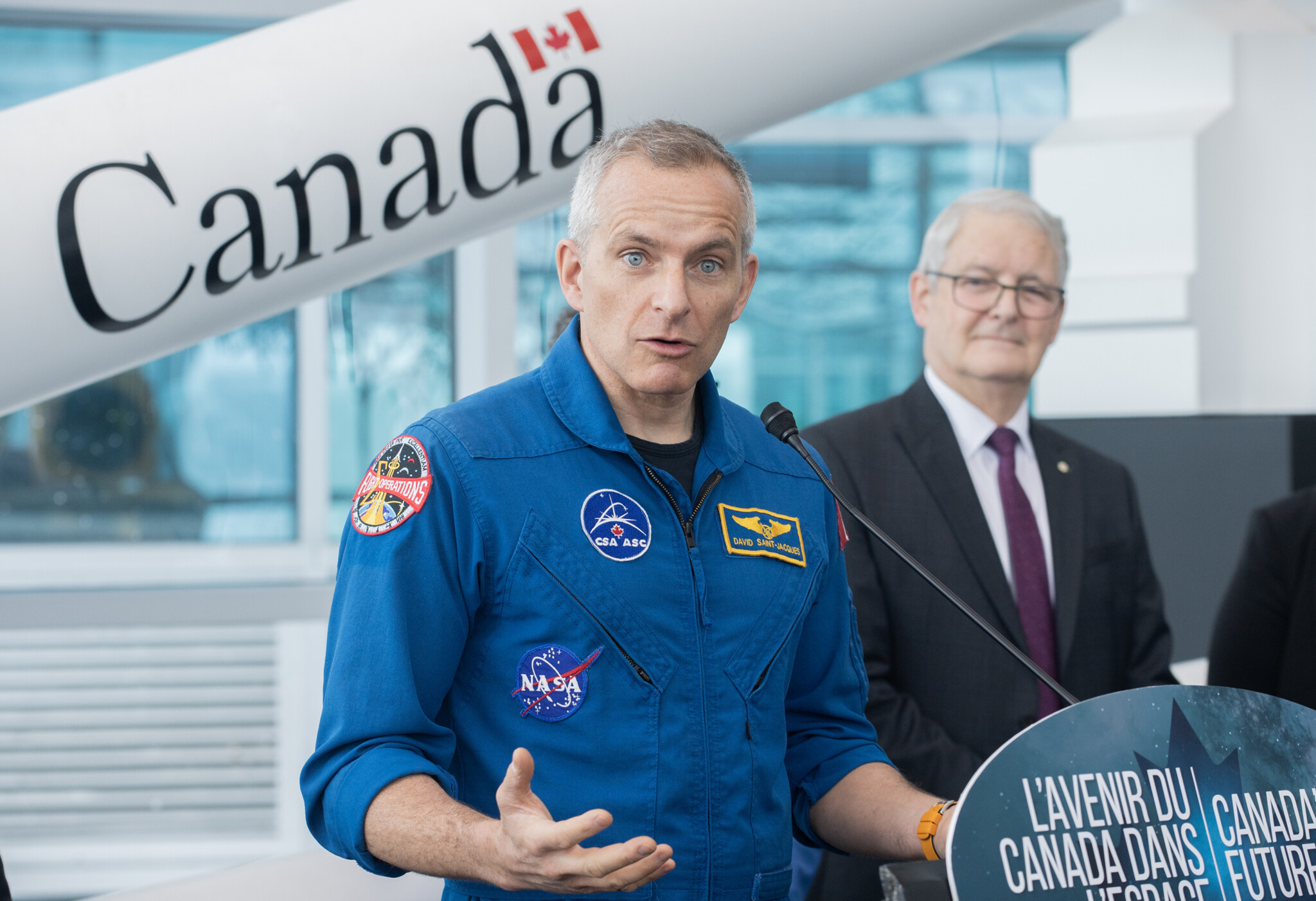
The United States is undergoing a quiet exodus from its space industry. As NASA faces nearly 25 percent in budget cuts, the Trump administration has introduced a “Deferred Resignation Program” that’s already seen upwards of 4,000 top engineers, scientists, and mission specialists opt for voluntary buyouts. At a time when global action on space exploration is accelerating, the world’s premier space agency is losing talent faster than ever.
For Canada, this represents a rare opportunity and a test of ambition. If we’re serious about transforming the Canadian Space Agency (CSA) from an important supporting actor into a global leader, then this is the moment to get ahead: by attracting disaffected American experts into our booming space industry and proving that Canada can be a home for world-class space science, engineering, and innovation.
But is Canada ready? A CSA media representative told The Hub in an exclusive interview that the agency is laying substantive groundwork for a thoughtful and strategic expansion of its space capabilities. “The Government of Canada is dedicated to helping unlock the full potential of the country’s space sector,” the CSA representative affirmed, pointing to Canada’s long legacy of innovation—from “pioneering satellite communications technologies to building the Canadarm”—and our unmatched ability to “foster and strengthen international collaboration” in space.
Encouragingly, the CSA also recognizes Canada’s growing appeal to global experts. Their representative told The Hub that “Canada is increasingly attractive to global talent seeking meaningful contributions to future space missions,” and that “the broader Canadian space ecosystem—including our innovative companies, research institutions, and universities—continues to welcome experienced space professionals.” These signals indicate a clear understanding of the evolving global talent landscape and a willingness to adapt to it. Still, there remains room for greater ambition. While the CSA’s message is forward-looking, it stops short of announcing specific recruitment programs, streamlined immigration pathways, or a targeted pitch to recently disillusioned NASA talent. The foundation is there, but now is the time to build on it boldly and on the double. Compare that to what’s happening in the U.S. According to reporting from NPR, NASA’s formal buyout program has resulted in thousands of voluntary resignations, many of them in high-skilled technical and scientific roles. A Politico investigation found that morale is plummeting at NASA’s Jet Propulsion Laboratory, located in La Cañada, California, and the Goddard Space Flight Center, based just northeast of Washington, D.C., in Greenbelt, Maryland, where projects have been paused, mission funding has been slashed, and early retirements are on the rise. This is a highly trained, mission-oriented, and now underutilized workforce. Many of them are already considering whether their skills might find a better home in Europe, Australia, or, potentially, Canada. So where’s our pitch? In a piece for The Hub earlier this year, I argued that Canada’s moment to get ahead in the global space economy had arrived. With Trump’s cuts creating chaos at NASA and commercial space firms like SpaceX drawing talent into narrower, profit-driven ventures, Canada could differentiate itself as a destination for meaningful public space science and global collaboration. Our strengths—university-led innovation, international trust, deep government-industry partnerships—are the very things now eroding in America. Canada has an already well-established and robust private space sector, with companies like MDA Space and Telesat. Former NASA scientists and engineers may choose to work in what Deloitte concluded will be a $40 billion industry by 2040. In its interview with The Hub, the CSA emphasized Canada’s “trusted spacefaring nation” status and its long-standing partnerships with space agencies like NASA, the European Space Agency (ESA), and the Japan Aerospace Exploration Agency (JAXA), which the CSA says “continue to create new opportunities for collaboration across both public and private sectors.” It also gestured to recent efforts to promote commercial opportunities for the Canadian space sector. The CSA also underscored that “Canada remains well positioned to play a significant role in the rapidly expanding global space economy.” However, what is desperately needed is urgency; a Canadian “giv’er” attitude. We should establish a new federal visa program—akin to the Global Talent Stream—specifically tailored for foreign, primarily American, space industry professionals and scientists. We should offer competitive grants to Canadian universities and aerospace firms that can quickly hire these scientists and integrate them into our ecosystem. And we should be sending Canadian delegations to areas surrounding NASA centres to make the case, in person, that Canada is open for business in the space industry. This isn’t about turning Nova Scotia into Cape Canaveral overnight. But it is about recognizing a historic inflection point. The post-Cold War space order, dominated by American and Russian state agencies, is collapsing. What’s replacing it is a messy, multipolar mix of commercial space entrepreneurs, international coalitions, and emerging spacefaring countries like India and South Korea. Canada has long punched above its weight in this domain. However, if we want to be more than a subcontractor to American missions, we need to start acting like a country with enough ambition to take a moonshot, in both the literal and figurative senses. That means not just welcoming foreign talent passively, but actively recruiting it as well. Not just citing the Canadarm as proof of past brilliance, but imagining the Canadian space economy of the future—led by a binational team of engineers from Toronto, Vancouver, and Houston, Texas, Cape Canaveral, Florida, La Cañada, California, and Greenbelt, Maryland. We should not limit ourselves to just being a faithful and important partner to NASA, but also build the capacity to go it alone. We don’t need to outspend the Americans or reinvent our bureaucracy overnight. However, we do need to send a signal to the world and ourselves that “our top objective is to maintain forward momentum for Canada’s space program,” as the CSA assures, and that Canada will not be just along for the ride; we need to have the ambition necessary to land a moonshot. Generative AI assisted in the writing of this article
Aiden Muscovitch is a student at the University of Toronto studying Ethics, Society and Law. He is The Hub’s Assistant Editor. He has also worked as an intern for Conservative Member of Parliament and Shadow Minister for Foreign Affairs Michael Chong.