
It’s tough to get a job right now if you’re young and in Alberta. In August, unemployment for those aged 15 to 24 hit an extraordinary 17 percent. Barring the early months of the pandemic, youth unemployment has never been higher, going all the way back to 1976 when this data was first collected.
To be sure, this isn’t just an Alberta problem. Youth unemployment is rising across Canada. But nowhere has it increased as much as it has in Alberta. Nationally, the youth unemployment rate stood at 14.5 percent in August, with Ontario the only other large province coming close at 16.5 percent.
The province is understandably concerned. Just recently, the Government of Alberta announced a new initiative to incentivize employers to hire younger workers by subsidizing their wages for a set number of hours.
That’s a smart move. Getting a good start in the labour market matters. Research shows that entering a weak job market early on in your career can weigh on lifetime earnings. Just ask anyone who graduated during a recession.
And there are growing signs that that’s where we are now.
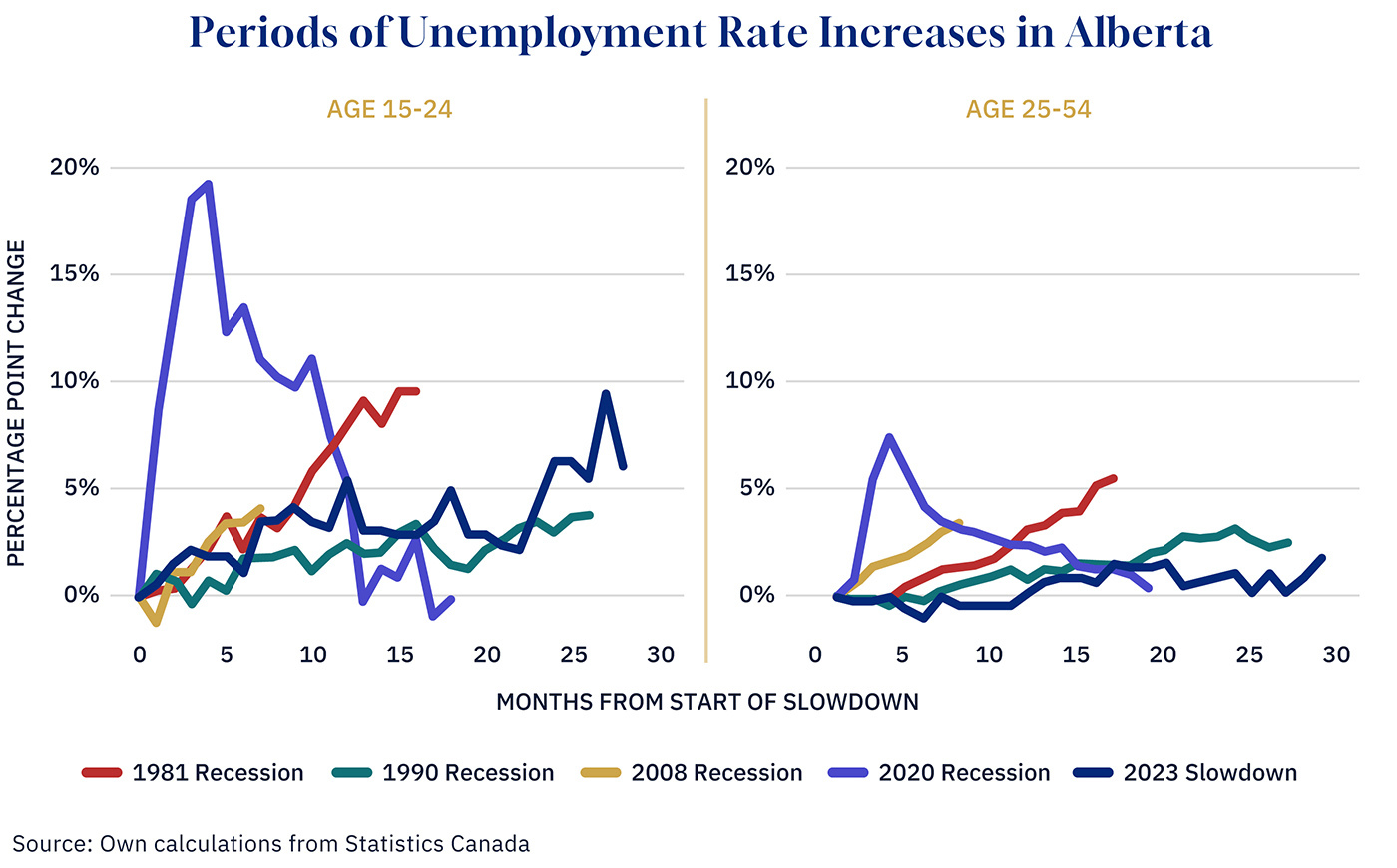
Graphic Credit: Janice Nelson.
In a way, young workers are the canary in the coal mine for the labour market. When the economy slows, they’re usually the first to feel it. You can’t get a job after graduating if companies aren’t hiring. And if they start letting people go, it’s often the least senior and least experienced people that take the first hit.
The question is, when will other workers start to feel it?
There are early signs that it’s starting to happen. The unemployment rate for core-age workers (25-54) is creeping up, both in Alberta and across the country. Provincially, it reached 6.9 percent and nationally 6.1 percent in August. In both cases, that’s the highest it’s been in four years. And this isn’t just because more people are actively looking for work—participation in the labour force has fallen too.

So why is Alberta particularly affected? It’s surprising considering most major banks consistently forecast it to be among the provincial leaders in economic growth. And Alberta is relatively unaffected by the direct impact of U.S. tariffs, especially compared to Ontario or Quebec.
But it’s worth recalling the relative economic weakness Alberta faced before the pandemic, driven in part by federal government regulations and policies which have limited growth and investment prospects for the province’s largest sector. Back in 2019, the province’s unemployment rate was about 1 percentage point higher than the national average. While Alberta has shown strong economic growth since then, much of it has been fueled by population increases rather than productivity gains.
Whatever the cause, high unemployment of teens and young adults in Alberta is a real problem. And it looks like it’s starting to spill over to other age groups. That’s a troubling sign for where the economy may be headed.
A version of this post was originally published by the Business Council of Alberta. To learn more, read the commentary here.

Alicia Planincic is the Director of Policy & Economics at the Business Council of Alberta. She regularly provides insight and analysis on…