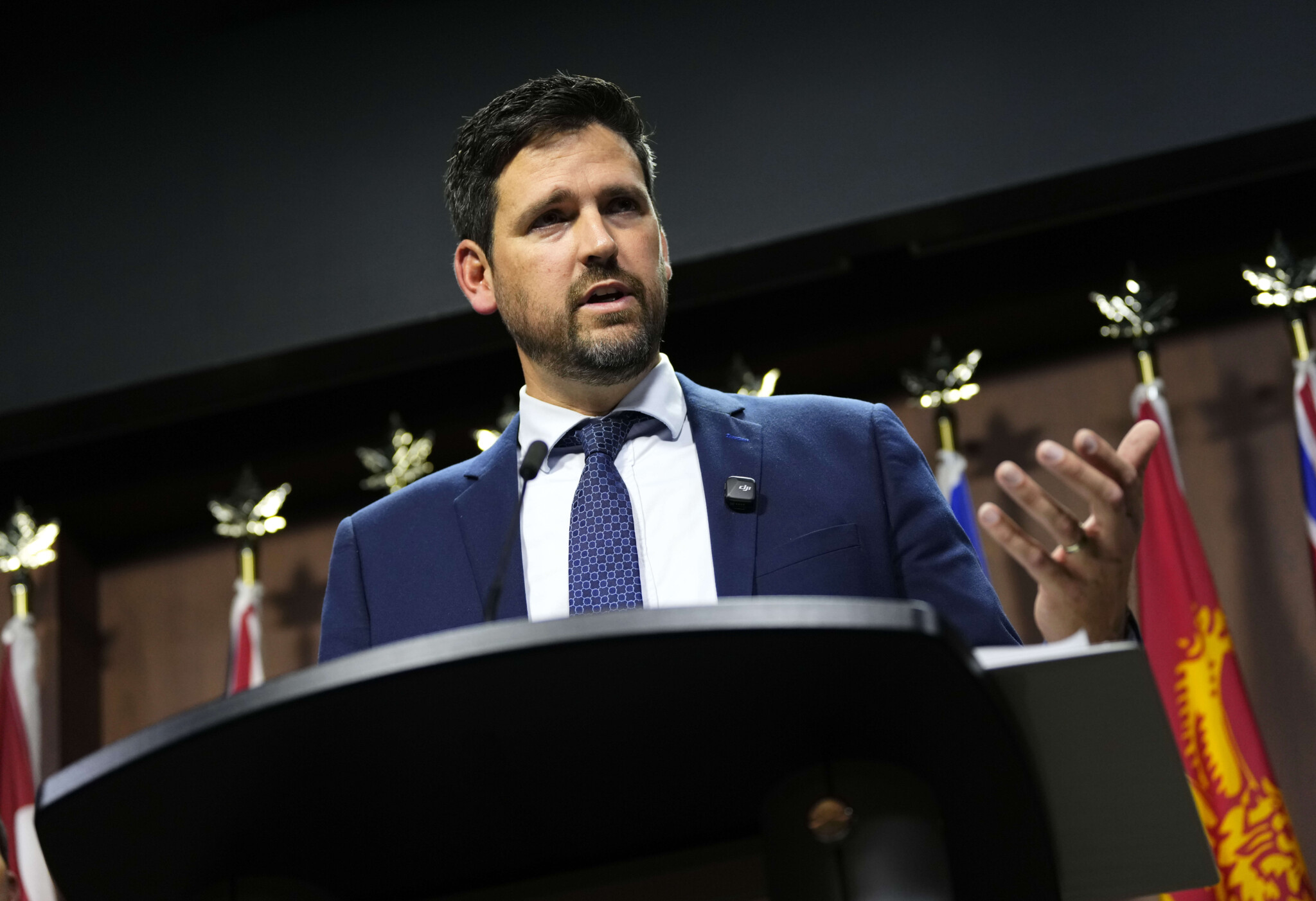
In particular, federal Justice Minister Sean Fraser has asked the Supreme Court to invent a new principle of constitutional interpretation which would give the courts the power to nullify the use of notwithstanding clause. The Charter, says the government, “necessarily prohibits any use of s. 33 that would lead to an irreparable impairment of the rights and freedoms guaranteed by the Constitution.”
Perhaps the first thing to note about this submission is that it is simply made up: invented out of whole cloth. The language of section 33 of the Charter places no restrictions on the number of renewals, or the underlying factual circumstances in which the clause may be invoked to override the specified rights.
The government’s submission, that the notwithstanding clause “cannot be used to cause an irreparable impairment of the rights and freedoms guaranteed” by the Charter, does not cite a single case in support of this proposition. One might expect a government advocating a radical re-writing of the constitutional order to be able to find a fig leaf or two in existing jurisprudence, but not here.
So let’s be clear: there is no such limitation on when a legislature can invoke the notwithstanding clause. The Charter does not condition the validity of the clause’s invocation on the consequences of that invocation.
The reason is perhaps obvious: because the whole point of the notwithstanding clause is to allow elected legislators to override unelected judges when they disagree about certain fundamental issues. What’s the point of the clause if the last word still goes to the courts? Do you think that a court that has found a Charter violation that is not saved by section 1 is going to have a hard time saying that the same violation causes “irreparable impairment” of a right?
The feds know this too. They are inviting the Supreme Court to fashion a new three-part test for “irreparable impairment”—because if we can invent a new constitutional principle we sure as heck can invent a three-part test—in the full and certain knowledge that such a test in the hands of Canada’s Supreme Court presents absolutely no obstacle to striking down whatever invocation of the notwithstanding clause happens to offend the liberal consensus du jour.
Let’s look at what the federal government suggests should constitute the test for irreparable impairment. An upside-down understanding 1. Is the use of the notwithstanding clause repeated? “Repeated declarations,” the government states, “could amount, at a certain point, to abolishing the very right or freedom in question…which can be done only through a constitutional amendment.” Did you catch that neat rhetorical trick? The Charter explicitly permits the repeated invocation of the notwithstanding clause. The government is suggesting that courts should be able to nullify repeated invocations as they see fit—something that should properly require an amendment to section 33—something for which there is an established, albeit difficult, process. Instead, the federal government asks the Court to treat a legislature acting in strict accordance with the letter of the Constitution as in effect amending the Constitution. The federal government stands reality on its head, and then asks the Supreme Court to rewrite the Constitution based on this upside-down view of the world. Charter alarmism 2. Does the invocation have the effect of impairing the rights or freedoms in such a way that they cannot be fully and concretely restored if the declaration expires? The use of the notwithstanding clause, the government argues, “could produce effects that would subsist beyond the expiry of any declaration.” Well, of course it could. One would hope that that’s the point: If a legislature is going to override the courts’ expected or actual interpretation of the Charter, one would hope that it would be for some significant, long-term purpose. It is at this point in its written brief that the government’s argument devolves into something of a caricature of Charter alarmism. The government invents straw men so absurd, it is a wonder that they don’t throw in Dorothy and Toto for the ride. Imagine, the government intones, “freedom of the press…could disappear if independent newspapers and media were prohibited from carrying on business for a prolonged period. Similarly, freedom of religion…could disappear if places of worship were declared illegal for prolonged period.” Are readers supposed to nod gravely at these preposterous scenarios? Banning newspapers and religious worship? What country, exactly, does the federal government think it is governing? A nation of sectarian would-be dictators, just waiting for the chance to throw their neighbours into the gulag? Get a grip. For the sake of argument, let’s imagine an invocation of the notwithstanding clause that “could produce effects that would subsist beyond the expiry of any declaration.” In its 2015 Carter decision, the Supreme Court (reversing a 1993 ruling for no other reason than that the elite consensus had changed) found a constitutional right to medical assistance in dying for adults suffering a “grievous and irremediable medical condition that causes enduring and intolerable suffering”—but did not limit this right to those suffering a physical ailment. MAiD for individuals suffering from mental illness is expected to arrive in 2027. Ahead of that, a province declares a prohibition on MAiD for mental illness, preventing the physician-assisted suicide of hundreds or thousands of people suffering from serious mental illnesses that are not terminal, but that are incurable with present medical treatment. As treatments improve, many of those people go on to live long, happy lives. A subsequent government declines to renew the declaration, but those people keep on living. This is not the sort of scenario that should meet a test for “irreparable impairment” of a Charter right, but on its face it does. And that’s the problem: While the government uses implausible scenarios to justify the creation of its proposed test, there would be little to stop a court from finding that the test is met not only in truly extreme situations, but in situations where reasonable people disagree about the meaning of the Charter and the court’s interpretation of rights. Extreme hypotheticals 3. “Does the statute, by its exorbitant nature, result in an immediate and irreparable negation of the minimum conditions for maintaining the free and democratic society….?” This is where it really gets good. Forget about the dangers of repeated invocations. The federal government now asks the Supreme Court to define a category of declarations “fundamentally irreconcilable with human dignity [and which] could cause, from the outset, an impairment of a right or freedom that could not be could not be remedied by the subsequent lifting of a declaration under s. 33.” And forget about banning papers or religions; the government now asks the Supreme Court to imagine a law permitting “arbitrary executions or slavery.” I have two questions. First, what were they on when they wrote this factum? And, second, have they ever read a history book? Do they think that if our society ever devolved to the point that our legislatures were passing laws authorizing arbitrary executions or slavery that whatever secret police force was carrying out these orders would be stopped by a court striking down the invocation of the notwithstanding clause? The reason that the government is content to trade in such absurd hypotheticals is that its concern is not to prevent the establishment of slavery or the creation of roving government death squads. Its aim is to create examples extreme enough to give the Supreme Court cover to radically re-interpret the courts’ role under section 33—to move from judging the form of the declaration to being able to judge the substance of the declaration—secure in the knowledge that once the Supreme Court creates this power based on hypothetical legislative extremism, the courts will use it to strike down the use of the notwithstanding clause whenever they damn well please. Because if you think that words like “fundamentally irreconcilable with human dignity” or “irreparable impairment” will act as serious checks on judges overruling legislatures, you haven’t been paying close enough attention to Canadian courts. The stakes are high The federal government may not like the notwithstanding clause. The Supreme Court judges may share that opinion. It doesn’t matter. It’s part of our Constitution, and possibly the only thing standing in the way of the complete judicialization of our public policy. (We have come a long way since 1982, when I doubt any politician would have thought that the Charter they were enacting would lead to judges micromanaging the placement of bike lanes on city streets.) The notwithstanding clause was central to the constitutional bargain struck when Pierre Trudeau moved the country’s constitutional order with respect to civil rights away from our British roots of parliamentary supremacy and much closer to the American model of judicial supremacy. The Charter was acceded to by the provinces only because the notwithstanding clause preserved the last vestiges of parliamentary supremacy. If the Supreme Court is reckless enough to take the federal government up on its proposal to effectively rewrite the Charter by judicial fiat, it will plunge this country into a constitutional crisis the likes of which we have not seen in 30 years. This time, the country might not survive.