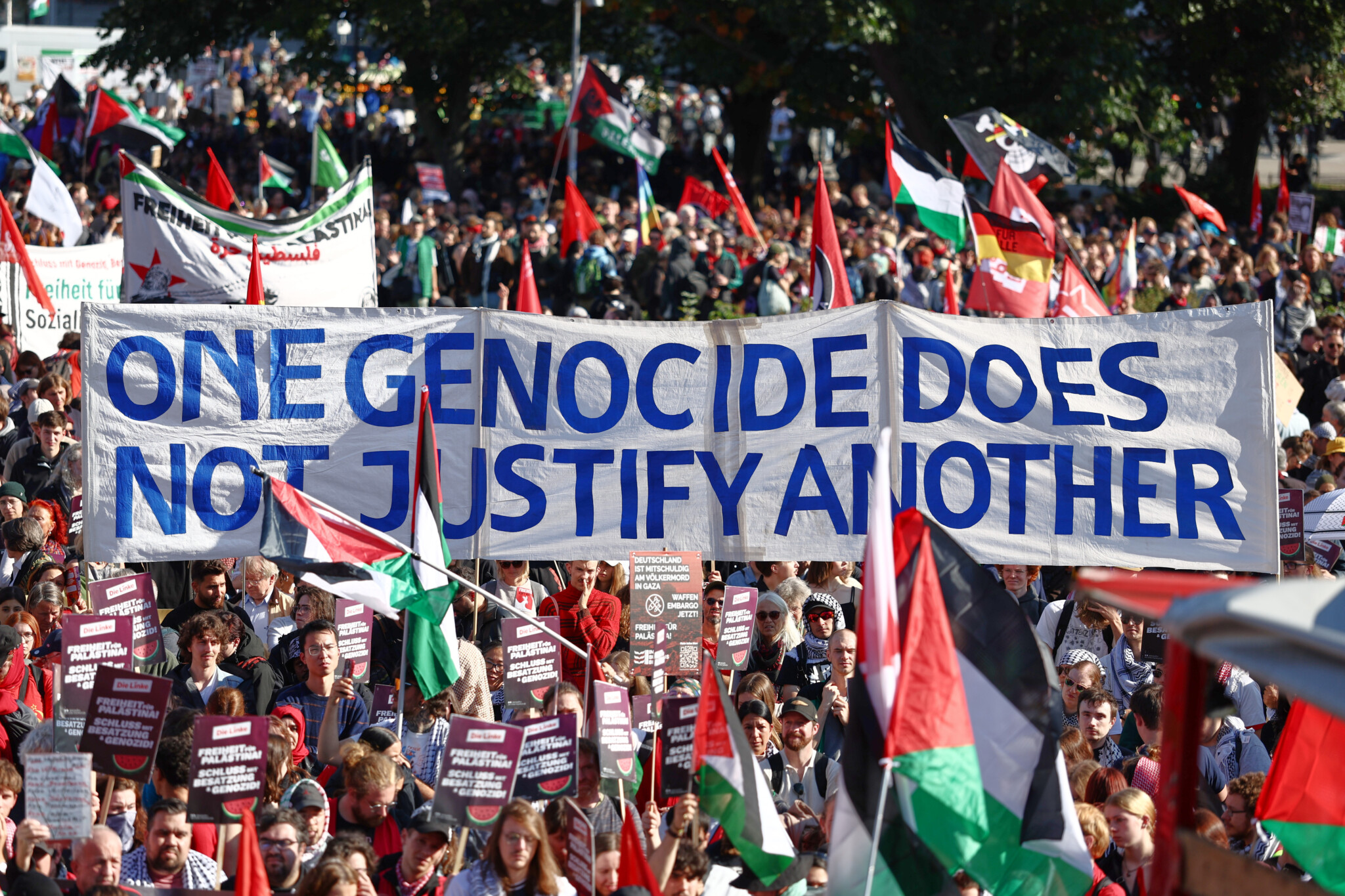
With the American peace plan now seemingly agreed to by all sides, an end to the fighting between Israel and Hamas appears closer than ever. Yet sadly, Palestinian civilians have endured immense suffering in Gaza over the course of this terrible war. The appalling devastation and loss of life demand both compassion and accountability. But accountability must be grounded in law, not politics, ideology, or emotion. That’s why the recent report from the three-person UN Human Rights Council commission accusing Israel of genocide should alarm anyone who values the integrity of international law.
When it comes to international law, genocide is the sin of all sins. Yet, it’s also one of the most precise. The 1948 Genocide Convention requires proof of a “specific intent” to destroy a group, in whole or in part. International courts, most notably the International Court of Justice in the Bosnia v. Serbia case, have held that massive civilian deaths or catastrophic humanitarian consequences, however shocking, aren’t sufficient to prove genocide unless supported by clear evidence of this special intent. That evidentiary threshold is extraordinarily high, and for good reason.
Once the term “genocide” is drained of its meaning and used as shorthand for any large-scale tragedy, it risks becoming a political slogan rather than a legal judgment.
However, the Pillay commission’s report does exactly that. It counts casualties, highlights incendiary rhetoric, and assumes intent, but it provides no evidence of an operational plan or directive aimed at the destruction of the Palestinian people. For example, the report notes such things as “…Israeli security forces were aware that their military operations since 7 October 2023 would cause the deaths of Palestinians in Gaza.” Is this now the bar for genocide? If so, every military conflict and war in history meets that threshold.
In effect, it redefines genocide downward, and dangerously so.
Comments (5)
Peter Morgan
10 Oct 2025 @ 10:05 am
Well argued. Intent was never established mainly because Hamas used civilians and civilian infrastructure throughout Gaza as shields. If anything, Hamas is guilty of intentionally putting civilians between them and the IDF, knowing full well many would die as Hamas was attacked. They in essence “genocided” their own people.
What makes this even more troubling is that the commission brands Israel’s military operations as genocidal when those operations were a direct defensive response to Hamas’s October 7 invasion and massacre—a massacre it completely whitewashes throughout its 72 pages. To equate a defensive war against a terrorist onslaught with genocide not only mislabels the conflict, but it also sets a precedent that will haunt every Western democracy. If Israel’s counter-terror operations can be called genocide, then NATO or any Western alliance responding to aggression could be accused of the same in future conflicts—and terrorists know this. There is another serious flaw in this debate: the dismissal of Israel’s own system of accountability. Israel has one of the world’s most independent and robust legal systems. Its Supreme Court has a long record of ruling against the government and military, even in matters of national security. Israeli courts investigate allegations of misconduct by the Israel Defense Forces and prosecutes cases of abuse and unlawful conduct. That is the very definition of a system “willing and able” to hold its own accountable, a standard recognized in international law as a bar to outside intervention. And yet, instead of recognizing Israel’s judiciary, critics turn to international courts and tribunals. But here, too, the law is being stretched for politics and ideology. Consider the International Court of Justice (ICJ). South Africa’s case accusing Israel of genocide was not a neutral attempt to clarify the law but a politically motivated effort to weaponize the Genocide Convention. Even the ICJ, while allowing the case to proceed procedurally, has not found that Israel is committing genocide. To date, its provisional measures have been limited to general obligations already binding on all states under international humanitarian law. In other words, the Court hasn’t validated South Africa’s sweeping accusations because the evidence simply isn’t there. The same distortion is at play at the International Criminal Court (ICC). Israel isn’t a party to the Rome Statute that created the ICC, and even if it were, it has demonstrated that it is willing and able to prosecute every situation that might arise out of the current conflict. The principle of complementarity, built into the Rome Statute itself, reserves ICC jurisdiction for cases where national courts are unwilling or unable to act. That isn’t the case with Israel. The jurisdiction question should have been resolved at the outset, and it should have ended the matter. To proceed despite this fundamental flaw undermines the credibility of the Court and reinforces the perception of politicization and double standards. This is part of a broader trend often described as “lawfare,” the strategic misuse of international law and legal institutions as weapons of political warfare. Instead of advancing justice, lawfare exploits courts, commissions, and conventions to delegitimize democratic states and constrain their ability to defend themselves. Russia, for example, has repeatedly used legal rhetoric to justify its invasion of Ukraine, accusing Kyiv of “genocide” in Donbas while committing blatant violations of international law itself. Iran and its allies invoke humanitarian law when condemning Israel, but are silent on their own sponsorship of terrorism and indiscriminate attacks on civilians. South Africa’s ICJ case fits the same pattern: it’s less about legal principle than about scoring political points against a democratic state under attack. The danger is clear. If lawfare succeeds, the international legal order itself will be hollowed out—the edifice will crumble. Genocide will no longer mean the deliberate destruction of a people, but any military response that powerful blocs choose to condemn. International courts will no longer be forums of justice, but battlegrounds for political campaigns. And Western democracies, whenever they defend themselves or their allies, will face a steady drumbeat of accusations of genocide or war crimes, regardless of the facts or the law. Words matter in international law. “Genocide” carries a unique legal and moral weight because it names the crime of crimes, the deliberate destruction of a people. To fling the word loosely at Israel is to erode its meaning and to undermine the cause of justice for real genocides past, present, and future. Worse still, it exposes every Western military alliance to weaponized accusations any time they respond to terrorist attacks or acts of aggression. While Gazan civilians have certainly suffered amidst the fighting of these past few years, and while alleged violations of humanitarian law must be investigated, the correct forum is Israel’s own courts, backed if necessary by impartial international review, not politicized UN reports, opportunistic ICJ litigation, or overreaching ICC proceedings. If we want the term genocide to retain its meaning, and if we want Western democracies to defend themselves without fear of being branded genocidal, we must resist the dangerous dilution of international law we now see unfolding.
Alan H. Kessel is the former Assistant Deputy Minister Legal Affairs and Legal Adviser at Global Affairs Canada and is a senior fellow at the Macdonald-Laurier Institute.
Dr. Casey Babb is Director of the Promised Land Project at the Macdonald-Laurier Institute, an International Fellow with the Institute for National Security Studies in Tel Aviv, and an Advisor to both Secure Canada and Doctors Against Racism and Antisemitism, in Toronto.


Comments (5)
Well argued. Intent was never established mainly because Hamas used civilians and civilian infrastructure throughout Gaza as shields. If anything, Hamas is guilty of intentionally putting civilians between them and the IDF, knowing full well many would die as Hamas was attacked. They in essence “genocided” their own people.