
The productivity of Canadian public sector workers declined over the last decade at a loss of 0.3 percent annually, while private sector employees’ productivity grew by 0.5 percent per year on average, according to a new research paper published by the Macdonald-Laurier Institute (MLI).
The study also found that if the productivity of government workers (federal and provincial) matched that of the private sector, Canada’s GDP in 2024 would have been $32 billion more or 1.5 percent higher.
“Essentially what we’re seeing through the data is that the size of government is growing, but a variety of different measures that you look at, for its overall performance and outputs and efficiency, [they’ve] been going down over time,” said Stephen Tapp, the author of the MLI study—“The Growing Government Gap”—and chief economist at the Centre for the Study of Living Standards. “So [public sector productivity is] obviously lagging behind and dragging [GDP] down.”
Tapp found that public sector worker productivity went from being slightly higher on average than private sector counterparts in 2015, then dropped 4 percentage points lower by 2024.
Despite this marked dip in productivity, government workers still earn an average of 27 percent more per hour worked than Canadians in the private sector. The MLI study mirrors a recent Fraser Institute study, which showed government employees in Canada make an average of 4.8 percent more, as well as receive more generous pensions and retire two years earlier on average.

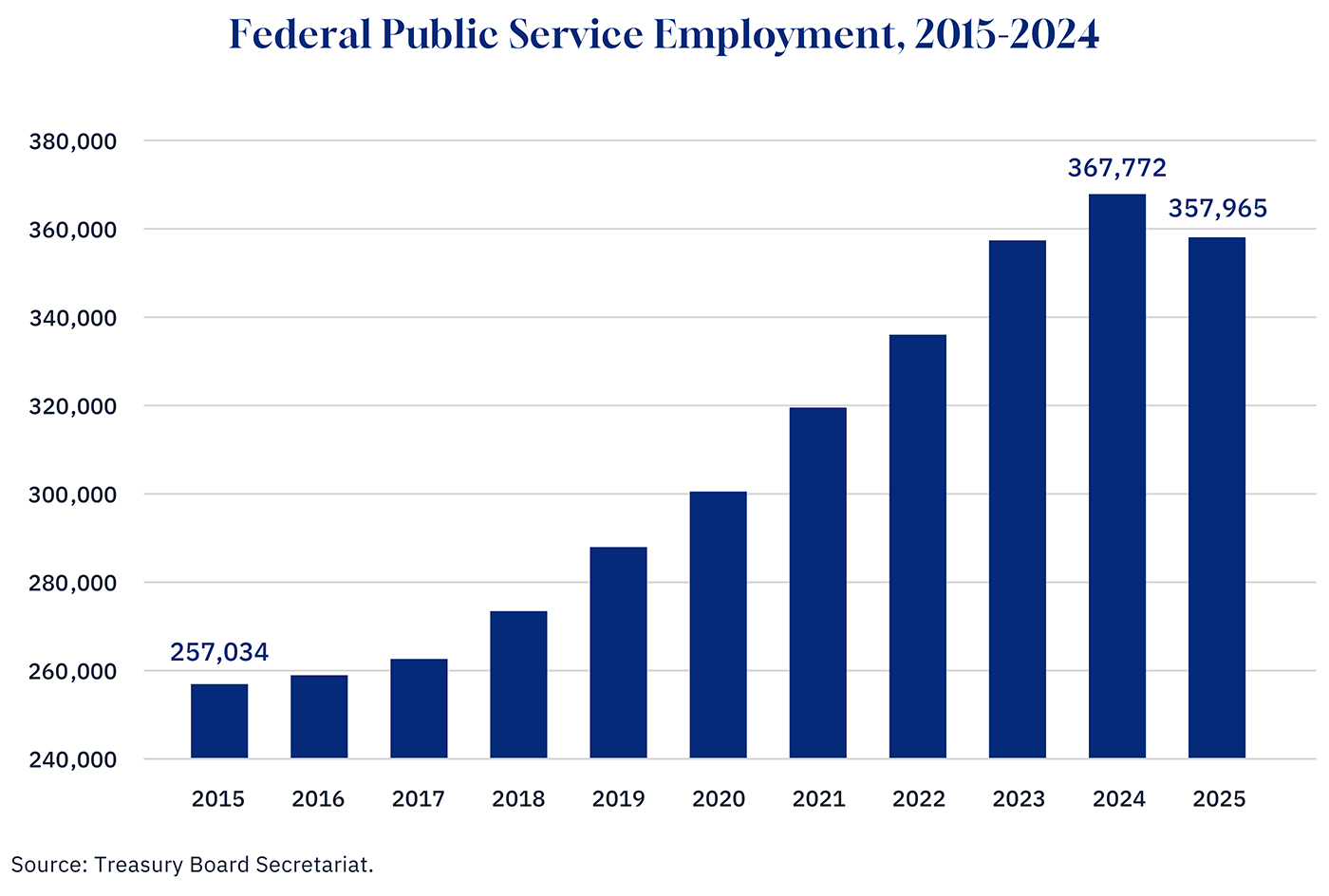
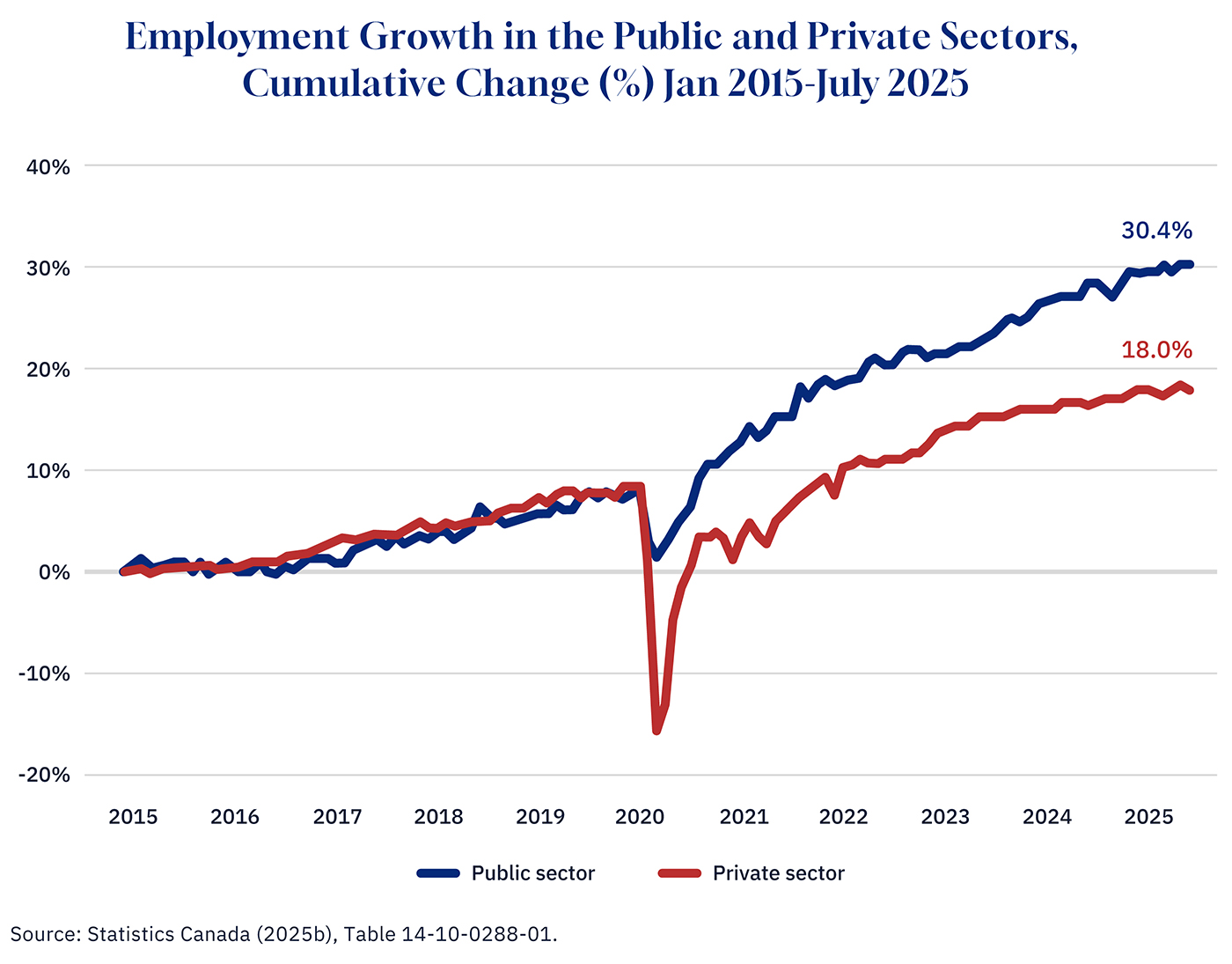
Since 2015, public sector employment has jumped 30 percent compared to the private sector, which has grown by 18 percent. During the nearly 10-year tenure of then-prime minister Justin Trudeau, the federal public service added 110,000 jobs—going from 257,034 employees to 367,772 in 2024—for an average annual job growth of 4.1 percent.
Graphic credit: Janice Nelson
After winning the 2025 federal election, Prime Minister Mark Carney highlighted that government spending increasing by 7 percent year-over-year and was “not a sustainable situation.” Earlier this year, the prime minister gave a directive to his federal ministers to find 15 percent cuts in departments’ operational spending, including cutting personnel. The Carney government’s first budget, set to be released tomorrow, is expected to cut billions from the public service in an attempt to return spending to pre-pandemic levels.
Tapp is skeptical that Finance Minister François-Philippe Champagne will make deep cuts immediately, saying it’s more likely he’ll choose to spread them out over several years.
“The government will look to attrition, so looking for people that are either about to retire and then not replacing them, or people that are up on contract or temporary work, and effectively just not renewing those jobs,” Tapp said.

“My view is that the current toolkit is biased and skewed. The cuts will fall hardest on the newest, youngest workers,” Michael Wernick, a former Clerk of the Privy Council, told the Globe and Mail in a recent interview regarding the strategy of cutting through hiring freezes or dropping temporary positions.
Public sector unions are calling the proposed cuts part of an “austerity” budget, claiming they will lead to the expanded use of private consultants. The Professional Institute of the Public Service of Canada has been calling the government to permit voluntary departures before cutting deeply.
Prior to the Carney government preparing to make significant cuts to the public service, the Public Budget Officer projected that Ottawa’s average full-time compensation per employee would hit $172,000 a year by 2030.
Tapp found that for 88 percent of government subsectors, job growth outpaced the private sector; the same was true in eight of 10 provinces, and 78 percent of federal government organizations. He believes the Carney government’s reported plan to cut 15 percent across all government departments may be the wrong approach because some outlier government departments actually have a higher productivity rate.
Graphic credit: Janice Nelson
The MLI paper concludes that lower government worker productivity has “real consequences for fiscal policy, the quality of government services, and Canadians’ long-term living standards.”

Graeme Gordon is The Hub's Senior Editor and Podcast Producer. He has worked as a journalist contributing to a variety of publications, including CBC,…
Given the reported productivity gap, what policy changes could the government implement to boost public sector efficiency?
How might a sustained decline in public sector productivity impact the average Canadian's quality of life and economic well-being?
With public sector employment growing significantly, what are the long-term fiscal implications for Canadian taxpayers?







Comments (3)
As a former public service executive, retired for 3 years now, none of this is a surprise to me. But it’s good to have facts to confirm my suspicions. Expectations for staff performance in the public service are very low. Meetings are plentiful at at all levels, but execution is very poor or non-existent. So sad. And Canadians have grown to accept this a normal.