A couple of weeks ago, the National Post reported that Canada now boasts its own chapter of the “Patriotic Millionaires”—a club of wealthy citizens eager to pay higher taxes. Their theory: Canada’s woes stem from the rich not paying enough.
In related news, the Macdonald Laurier Institute estimates that total government spending in Canada already constitutes 44 percent of GDP. This swells to an astonishing 64 percent of GDP if we include tax expenditures and price regulations in the calculation.
It’s a seductive illusion: the idea that we can improve our quality of life if only the government would get more involved! On the other hand, anybody who has ever dealt with Canada Post, applied for a passport, tried to access Canada’s dysfunctional single-payer health-care system, or called the Canada Revenue Agency (which answered 17 percent of inquiries correctly in a recent audit) has seen the reality: more money doesn’t fix incompetence. It feeds it. We don’t need to pay more—we deserve a refund.
And yet…after 10 years of progressive governance during which the leviathan of the state grew, taxes were raised, capital was driven away, productivity stagnated, and household debt climbed to historic levels, Canadians doubled down. They voted for more of the same. Like Kevin Bacon in Animal House, we take our economic paddling and ask, “Please, sir, may I have another?”
Except not everyone did. Alberta and Saskatchewan voted for a platform based on reduced spending, lower taxes, increased freedom for entrepreneurs, and more resource development, by margins that dwarf the national result. Canada re-elected the status quo by two points; Alberta rejected it by 40. That’s not a rounding error—it’s a philosophical divide. Our new solitudes are not English and French, but central planning and economic freedom.

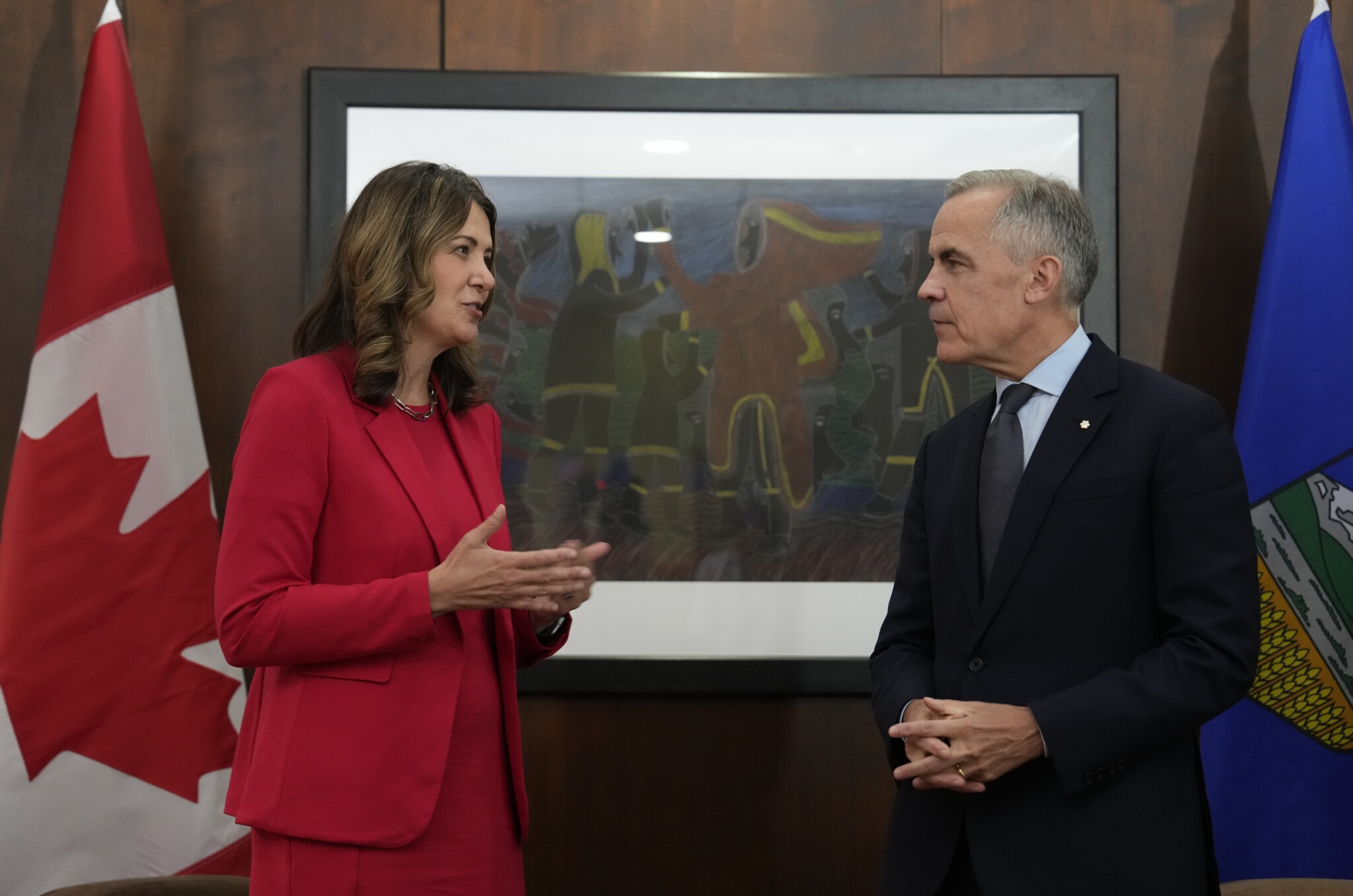
Of course, the result was heavily influenced by a strong media-driven narrative around the portrayal of Mark Carney as the “Trump Whisperer,” a man uniquely equipped to manage the unpredictable dictums emanating from the White House. Eight months into Carney’s tenure, this slogan has proven to be as facile as it always appeared. Carney has achieved little of substance apart from adopting a few CPC ideas and missing his self-imposed deadlines. There is no deal with the Americans. Provincial frictions, if anything, are escalating. So much for the bold sense of urgency he promised.
The thing is, if your strategy is “Elbows Up!”—projecting strength and independence—you had better be able to back it up with a dynamic economy that is capable of competing globally, that isn’t reliant on a single trading partner, and that can attract and retain private investment. The way to make this happen is through entrepreneurial thinking. Governments cannot create wealth; they can only confiscate and redistribute wealth created by others. But they can do plenty to thwart the entrepreneurs in our midst.
Alas, in Carney’s Canada, the machinery of centralization hums along. We don’t invest anymore; we subsidize. The Major Projects Office, not the market, will decide what gets built. Build Canada Homes will bulldoze through barriers that government itself erected. The federal budget will be split into “operating” and “capital” accounts, as though creative bookkeeping could disguise the metastasis of the state. Billions flow to politically fashionable industries—EV batteries, green infrastructure—while our obvious areas of competitive advantage are left fallow due to climate ideology that even Bill Gates doesn’t believe anymore.
The polls suggest that, electorally speaking, not much has changed in the last six months. Canadians, apparently, want a cradle-to-grave nanny state—one that taxes productivity and rewards dependency. A country where you can pay tax at the top marginal rate and still not afford a house. Alberta, meanwhile, wants to drill, mine, and build—to sell energy and resources the world needs. For this, it is labelled as ungrateful and traitorous.
Two incompatible visions now share a flag. One believes prosperity is planned; the other knows it must be earned. Canada’s ruling class treats entrepreneurship and free markets as grubby anachronisms—something best left to other countries while we import their finished goods.
Our comparative advantage was never in bureaucratic innovation or industrial subsidies. It lies beneath our feet. Oil, natural gas, critical minerals, etc.: the resources the world needs and Canada refuses to develop. Instead, we spend tens of billions subsidizing foreign car companies to build electric vehicles for a market that is already oversupplied. We call it strategy. It is self-sabotage dressed as virtue.
Soon, Albertans will face a referendum. It may ask whether Alberta should leave Canada or remain, but that’s the wrong question. The real question is whether Canada still believes in itself—in work, enterprise, and freedom—or whether it has permanently surrendered to the narcotic comfort of the nanny state.
Most Albertans don’t want to separate. They want respect. They want the autonomy envisioned under Canada’s Constitution that lets them build without Ottawa throwing up roadblocks. The cultural divide between Alberta and the rest of the country is stark, and as the calls for more independence grow louder, so does the contempt from the Laurentian elite. When they think of Alberta at all, it is to tell us to stay quiet, be grateful, and keep sending cheques. The situation is untenable. Something will have to give.
For now, the country drifts. The tools to change course still exist, but the will seems to have evaporated. A nation that once built railways and pipelines now builds new government agencies. The Patriotic Millionaires will keep congratulating themselves for paying more into a machine that doesn’t work.
Canada doesn’t need higher taxes. It needs to wake up.

Derrick Hunter is the CEO of Bluesky Equities Ltd. a private diversified investment management company. He was named Canadian Angel Investor of…
Does government spending, even when high, guarantee improved quality of life?
What fundamental philosophical divide does the article highlight in Canada?
How does the article contrast Canada's approach to economic development with Alberta's?




Comments (13)
This article adds clarity to the most significant underlying cause of our moribund GDP per capita performance. Reduced the scope of government control, edicts, regulation and soft influence on the economy.