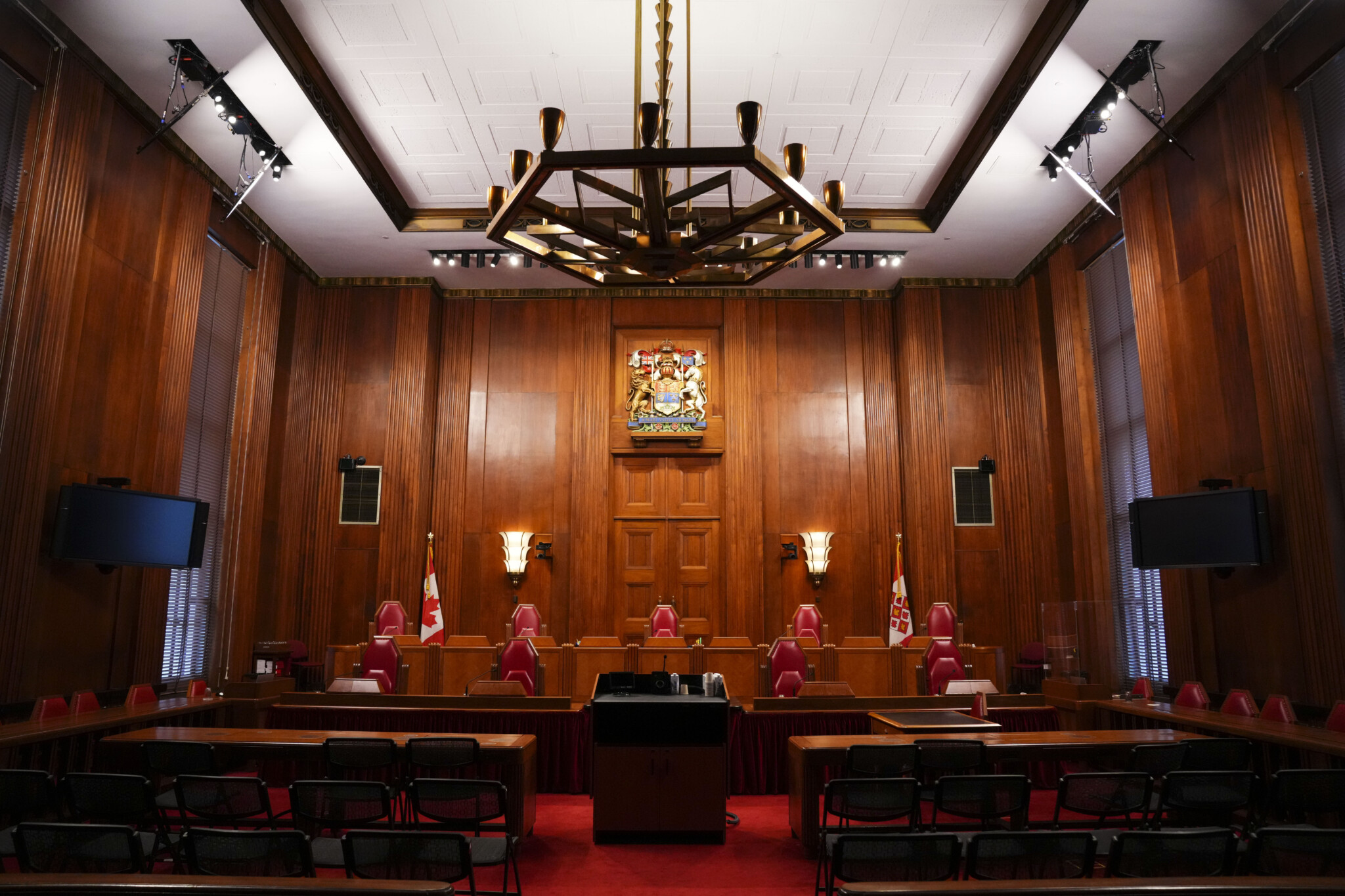
Any discussion of last week’s Supreme Court of Canada judgment that struck down the one-year mandatory minimum prison sentences for possessing and accessing child pornographyAs several commenters on X.com have pointed out, using the term “pornography” for images of children blurs an important distinction between depictions of sexual abuse and exploitation of young people who cannot legally provide consent and “ordinary” obscene images, which while vile and usually exploitative in their own way, involve adults. I agree, but to avoid confusion I will use the term that is used in the Criminal Code and in the Court’s judgment. must begin, as a criminal case should, with the facts. What did the accused do? In this case, the facts are not for the squeamish, but they are necessary to understand why the Court’s decision is not just wrong as a legal matter but morally outrageous.
What follows is quoted verbatim from the Court’s judgment:
Louis‑Pier Senneville pleaded guilty to one count of possession of child pornography and to one count of accessing child pornography. He admitted having been in possession of 475 files, including 317 images of children constituting child pornography. Of those images, 90 percent were of young girls between 3 and 6 years of age, some showing victims being subjected to acts of penetration and sodomy committed by adults and minors. Mr. Senneville admitted that he had acquired these images through specialized sites and that he had possessed them for 8 months. He accessed these images for 13 months.
* * *
Mathieu Naud pleaded guilty to one count of possession of child pornography and to one count of distribution of child pornography. He admitted having been in possession, for 13 months, of 531 images and 274 videos of child pornography, most of which were of children from 5 to 10 years of age being subjected to sexual abuse, such as fellatio and vaginal and anal penetration, by adults. Mr. Naud used specialized software to access that material, make it available and wipe out any traces of it.
* * *
Naud admitted to having made the above‑described child pornography material available online through sharing software nearly every day for a period of 13 months.
Senneville was given two sentences of 90 days in prison each, while Naud was given a sentence of nine months and another of 11 months (one year, less a month spent in treatment, which the sentencing judge equated to time in custody). The sentencing judge was able to impose such light sentences because he invalidated the statutorily-mandated minimum sentence of one year for the offences as “grossly disproportionate.”

On appeal, the Quebec Court of Appeal increased Senneville’s sentence to one year and left Naud’s sentence as it was. In a five to four decision, a majority of the Supreme Court of Canada agreed that the one-year minimum sentence was unconstitutional, not because it would be inappropriate for Senneville and Naud (they did not challenge their sentences), but because a one year sentence would, in their opinion, be grossly disproportionate in a hypothetical scenario they imagined might happen to someone else in the future.
For those encountering the Supreme Court of Canada’s recent jurisprudence on “reasonable hypotheticals,”In this case, the Court expressed a preference for the term “reasonably foreseeable scenario,” but we are under no obligation to go along with such question-begging framing. I will try to explain it as succinctly and sympathetically as I can. The Court begins from the premise that it is offensive to the rule of law for anyone to be sentenced under an unconstitutional statute. It follows, then, that even if the statutory minimum prison sentence would be appropriate in the case before it, the law must nevertheless be nullified if the Court finds that it would be grossly disproportionate in another “reasonable hypothetical” scenario. So, the Court imagines such a scenario and conducts a constitutional assessment of those facts instead of the facts actually before it.
Most of the disagreement between the majority and the dissent in this case was over what constitutes a “reasonable” hypothetical. Specifically, they disagreed over how close the imaginary fact pattern must be to the facts of the actual case before the Court to count as “reasonable.” In this instance, the hypothetical case the majority used to strike down the mandatory minimum prison sentence was that of an adult who shares an obscene photograph of his underage girlfriend with another adult friend, who decides to keep the photograph on his phone.
The majority decided that, in this imagined scenario, a one-year sentence would be “grossly disproportionate,” so the mandatory minimum must be struck down for all cases. In response, the dissent argued that the imagined scenario was unreasonably remote from the actual facts of this case, and that, under any actually reasonable hypothetical scenario,” there is little—or no—likelihood that the disparity (if any) between a fit and proportionate sentence and the minimum sentence will be so intolerable as to make the minimum sentence grossly disproportionate.” The dissent was right on both counts.The majority’s objection that the dissent’s approach would represent a development of the law in the direction of narrowing the range of hypothetical scenarios the Court can consider was right but irrelevant. Clarifying and refining the application of constitutional provisions over time is what the Court does. Justices who do this routinely can hardly object to the suggestion they should do so here.

Had the dissent’s view prevailed, as it should have, the Court would have escaped the opprobrium now being directed at it, but that should not have been the end of the matter. We should not forget these two men are serving sentences of just one year for the revolting crimes described above, and they will almost certainly serve much less than that time in prison. Nor should we leave unaddressed deeper problems with the Court’s use—not just its misuse—of imaginary scenarios to strike down otherwise reasonable laws.
It would require a much longer article to explain why our criminal law is corrupted by a doctrine that turns straightforward criminal cases into private constitutional references, or to set out my broader and more fundamental disagreement with the Court’s superficial, supercilious, and often maddeningly inconsistent vision of the relationship between rights, justice, the individual, and society, so I will confine myself to one quick point and a brief description of an alternative approach.
First, the way the Court uses hypotheticals ignores the structure of the criminal law as Parliament has drafted it. Possessing and accessing child pornography are what are called hybrid offences, which means the Crown can choose to charge an offender in one of two ways. In this serious case, the Crown elected to proceed by indictment, which carried a minimum sentence of one year; but, in another case with different facts, the Crown could elect to proceed via summary conviction, with a minimum sentence of only six months.
The Supreme Court’s doctrine of hypotheticals requires it to ignore the Crown’s discretion and always assume the harsher of two optional sentences. It also ignores the fact that the Crown has the discretion not to bring charges at all if it doesn’t think they are warranted. This flexibility exists for a reason: different charges (or no charges) with different sentences will be appropriate in different cases. By conducting a proportionality analysis that deliberately disregards the proportionality mechanism already built into the law, the Court adds a further air of unreality to an already imaginary scenario.
How should the Court proceed instead?
First, it should start and end with the facts of the case. If another fact pattern is reasonably foreseeable, then it will present itself in due course and can be considered then.Of course, given the prosecutorial discretion described above, those hypotheticals are much less foreseeable in reality than they are in the Court’s mind, meaning it is starting with an unreasonably overbroad range of “reasonable” hypotheticals. If, in that case, the mandatory minimum sentence truly would be not just disproportionate, which is constitutionally permissible, but grossly disproportionate, the Court may then strike down the statutory mandatory minimum sentence or interpret the law to exclude the facts of that case on the grounds that Parliament would not have desired an absurdity. What they should not do is toss out a perfectly reasonable law on an imaginary technicality.

Howard Anglin is a doctoral student at Oxford University. He was previously Deputy Chief of Staff to Prime Minister Stephen Harper, Principal…
Should the Supreme Court prioritize real case facts over hypothetical scenarios when assessing mandatory minimum sentences?
Does the Supreme Court's use of 'reasonable hypotheticals' undermine legislative intent in criminal sentencing?
How does the Supreme Court's interpretation of 'grossly disproportionate' impact the effectiveness of mandatory minimum sentences?







Comments (16)
Stunning how out of touch the SC is. I can imagine them sitting around, a cloistered set of overlords pondering high thoughtS us mere mortals could never grasp. Unfortunately the federals dont have the courage to enact the NWC.