
DeepDives is a bi-weekly essay series exploring key issues related to the economy. The goal of the series is to provide Hub readers with original analysis of the economic trends and ideas that are shaping this high-stakes moment for Canadian productivity, prosperity, and economic well-being. The series features the writing of leading academics, area experts, and policy practitioners. The DeepDives series is made possible thanks to the ongoing support of the Centre for Civic Engagement.
For generations, the Canadian covenant was straightforward: Work hard, play by the rules, and you’ll climb higher than your parents did. Merit, not inheritance, would determine success. That certainty is eroding.
Conservative leader Pierre Poilievre’s persistent claim that “Canada is broken” resonates because it captures a growing anxiety that effort no longer guarantees advancement. The sentiment transcends party lines.
In early 2025, Policy Horizons Canada (the federal government’s own foresight agency) released projections for 2040 where “upward social mobility is almost unheard of” and “downward social mobility might become the norm.” This scenario challenges the foundation of Canadian identity.
The evidence increasingly confirms what many Canadians already feel: Canada’s meritocratic engine is stalling. This DeepDive examines the decline of intergenerational mobility in Canada and the headwinds from rising costs of necessities, and identifies policy areas to reform that could strengthen the pathways to advancement.

What Canadians believe
For the first time since pollsters started asking in 1990, Canadians are evenly split on whether they’re better off than their parents were at the same age. According to the Environics Institute’s 2024 survey, 40 percent say better off, 39 percent say worse off. The proportion feeling they’ve fallen behind is the highest on record. In 1990, it was just 21 percent.
The pessimism is consistent across age groups but sharpest among young adults. Among those aged 18 to 29, 54 percent report being worse off than their parents, compared to just 25 percent who feel they’re ahead. Back in 1990, only 23 percent of this age group felt financially behind.
All of this points to a negative sentiment about the next generation: 53 percent of Canadians expect the next generation (their children, nieces, nephews) will be worse off, while only 21 percent expect better.
Immigrants remain more optimistic, with 38 percent expecting the next generation to be better off—more than twice the rate among Canadian-born citizens (15 percent). This “aspirational dividend” reflects immigrants’ global perspective, where their baseline comparison is often international rather than purely intergenerational. But newcomers face the same structural barriers that constrain native-born mobility. If these barriers persist, immigrant optimism may erode.
A recent Globe and Mail piece by Darrell Bricker and John Ibbitson captures the sentiment:
An entire generation of younger Canadians are at risk of giving up on their own future. A succession of Nanos polls has revealed that seven in 10 Canadians believe the next generation will experience a lower standard of living than people enjoy today. Eight in 10 Millennials and nine in 10 Gen Zs believe that home ownership is a luxury reserved for the rich, according to a 2024 Ipsos poll. Obtaining a college degree has become a crippling expense, with the average graduate carrying $28,000 in student debt, and those graduates confront the precarity of the gig economy, with relatively few secure, well-paying jobs that offer adequate pensions.
What the data shows
Public sentiment tells one story. The evidence confirms it—and the details are equally concerning.
Economists track two types of mobility: absolute mobility (whether you earn more than your parents, adjusted for inflation) and relative mobility (whether your income rank depends on theirs). In Canada, both are declining.
The most comprehensive evidence on relative mobility comes from researchers Marie Connolly and Catherine Haeck, who examined Canadians born between 1963 and 1985 using Statistics Canada’s Intergenerational Income Database. Their 2021 analysis, subsequently published in the 2024 Canadian Journal of Economics, reveals a persistent trend of declining relative mobility.
Their key measure of immobility, which shows how tightly a child’s income rank in their late 20s and early 30s correlates with their parents’, increased by 21 percent from 0.202 to 0.245 between the 1963 and 1985 cohorts. For early Millennials born in the early 1980s, parental income became more determinative of outcomes compared to Boomers and Gen-Xers. The bulk of the mobility deterioration occurred for children born between 1970 and 1975, with continued erosion for those born through the mid-1980s.
The poverty trap also tightened. Children from bottom-quintile families born in 1985 face a 33.1 percent chance of remaining there as adults, up from 27.5 percent for those born in 1963. That’s a 20 percent increase in the likelihood of intergenerational poverty. Their probability of reaching the middle class dropped from 60.1 percent to 55.0 percent. Meanwhile, the probability of “rags-to-riches” mobility (moving from a family in the bottom quintile to the top quintile yourself) remained at around 11-12 percent.
The data reveals a critical pattern: The system’s greatest failure isn’t that the poor can’t reach the top; it’s that they increasingly can’t reach the middle. The initial rungs of the economic ladder have grown further apart. These patterns hold across all provinces, with Manitoba showing the lowest mobility and Saskatchewan experiencing the largest deterioration.

Canada’s international standing on relative mobility has also been revised downward. Early comparisons placed the country among the more mobile societies of the developed world based on the Intergenerational Earnings Elasticity (IEE). Canada’s IEE was thought to be about 0.20 (0 is most mobile and 1 is least mobile), partly because researchers measured children’s income too early in their careers. A 2016 study using better data corrected this to roughly 0.32, meaning about 32 percent of a father’s earnings advantage transmits to his son. Canada now sits in the middle of international comparisons: more fluid than the United States, but significantly less so than Norway.
On absolute mobility (simply earning more than your parents), Canada’s performance is similarly declining. Early research by Yuri Ostrovsky found that for cohorts born 1970-1984, the share of children earning at least as much as their parents remained stable at around 64-66 percent. During this period, about two of every three Canadians were still meeting the basic definition of upward mobility.
But a 2024 international study places Canada in the “lower tier” of developed nations at 57-59 percent, alongside the United States and Finland. Top performers like Norway achieve 74 percent, the Netherlands 80 percent. The study noted a troubling decline of 2.4 percentage points across the 1976-1985 birth cohorts, suggesting the situation is worsening. Financial progress is becoming less reliable.
The inequality connection
Part of the decline in social mobility has been linked to rising income concentration—a relationship economists call the Great Gatsby Curve. Connolly and Haeck’s work found that parental income inequality, measured by the Gini coefficient (0 is most equal and 1 is least), rose from 0.36 to 0.44 between the 1963 and 1985 birth cohorts. Canada and every province have been steadily “going up” the curve. As wealth concentrates, high-income parents make disproportionate investments in their children—superior housing in high-opportunity zones, private education, professional networks—reinforcing socioeconomic status across generations.
But the relationship is more nuanced than the curve alone suggests. Some inequality is natural—parents who succeed want to invest in their children, and this creates important incentives for progress. The problem emerges when inequality closes off pathways for others to rise. A healthy society can tolerate meaningful income differences, provided opportunity remains broadly distributed. Canada’s challenge is that the mechanisms ensuring this are eroding.
According to Statistics Canada’s latest data for the second quarter of 2025, the disposable income gap between the top and bottom 40 percent of households remains at a record high of 48.4 percentage points, continuing an increase that began with the COVID-19 pandemic. In the 2010s, the average gap was 45.1 points.

A family takes a break on the steps of the Bank of Canada building in Ottawa, on Wednesday, July 24, 2024. Justin Tang/The Canadian Press.
Geography matters
There’s also a local dimension to the national mobility challenge. Miles Corak’s analysis of 266 Census Divisions reveals a divided landscape clustering into five distinct mobility regions. High-mobility areas include Southern Ontario, parts of Alberta, and Southern Saskatchewan, with some Alberta regions reaching 18.5 percent for “rags-to-riches” transitions. Alberta’s resource sector may be a driving force for its social mobility—evidence suggests natural resource development can break intergenerational earnings patterns, providing jobs and economic opportunities that improve quality of life, particularly in rural and resource-dependent communities.
Meanwhile, low-mobility regions—Manitoba, Atlantic provinces outside urban areas, northern and remote areas—show 35-40 percent chances of remaining in the bottom quintile.
An additional key finding is that mobility outcomes across Canadian regions are shaped by inequality in the bottom half of the distribution, regardless of whether communities are urban or rural. The bigger the income distance between the low-income group (25th percentile) and the middle class (50th percentile), the lower the mobility rate. When these rungs are too far apart, climbing becomes more difficult. While extreme top-end inequality exists, it correlates less strongly with general upward mobility. The gap between the working poor and the stable middle class most influences the difficulty of initial advancement.
A separate regional analysis comparing Canada to the United States found that while Canada’s overall mobility exceeds the U.S. average, Canadian regions share characteristics with low-mobility regions in the American South. The key difference is that such regions represent a much larger fraction of the U.S. population than Canada’s.

The contemporary challenge: Purchasing power
While the evidence above traces declining relative mobility across multiple generations, a pressing issue has accelerated since 2020: the erosion of purchasing power from surging costs for housing, food, and other necessities. Even when today’s young adults earn more than their parents, soaring basic expenses consume those earnings, leaving little room for saving, investment in children, or building the financial reserves that facilitate upward mobility.
Canada has weathered affordability storms before. The 1980s and early 1990s saw high inflation and interest rates around 20 percent, making mortgage carrying costs comparable to today’s, despite lower home prices. Yet the sustained inflation post-COVID-19, particularly for shelter, food, and transportation, hit when generational mobility was already declining, compounding pressures for young Canadians.
Housing captures the squeeze most clearly. The average share of shelter costs in household budgets rose from 23.4 percent in 1982 to 32.1 percent in 2023. By spring 2024, 38 percent of Canadians expressed serious concern about affording housing, up from 30 percent two years earlier.
The debt burden compounds the challenge. Canada’s household debt-to-disposable income ratio now sits highest among G7 countries. While housing represents a significant share of household wealth, the rising ratio of interest costs to disposable income means households enter their peak earning years already financially constrained, with less capacity to save, invest in children’s education, or weather economic shocks. The burden is pushing younger households to increasingly turn away from the housing market entirely, limiting their ability to build wealth through homeownership.
When a greater share of income flows to mandatory costs like housing, food, and debt servicing, the capacity for wealth accumulation diminishes. The purchasing power challenge thus compounds the mobility problem: Not only is relative mobility declining, but the absolute gains that do exist are being eroded by rising costs.
The consequences extend to behaviour. Recent reporting documents a generation engaging in “doom spending”—accumulating consumer debt not through recklessness, but as a response to blocked mobility pathways. When homeownership, retirement, and career advancement feel unattainable, rational long-term planning gives way to short-term coping.

The structural challenge: Policy barriers
In the face of financial pressures and declining mobility, the critical question is: What can public policy do? The Montreal Economic Institute distinguishes between natural barriers, such as parental involvement, family stability, and social capital, and artificial ones created by policy. While we may not fully understand all the historical drivers of declining mobility, we can identify which mechanisms enable upward advancement and where policy creates barriers. Addressing them could improve mobility outcomes.
Housing
Housing policy is particularly damaging to mobility beyond affordability alone, as it prevents Canadians from physically moving to high-opportunity regions. The “geographically stranded poor” often cannot relocate to opportunity-rich areas because housing costs in these regions have become prohibitive.
The core policy failure holding back housing supply is a combination of excessive regulations, approval delays, restrictive zoning laws, high municipal fees, labour shortages, and unfavourable economic conditions that increase building costs and financial risk. Together, this creates artificial scarcity.
Record population growth, driven by immigration, accelerates unaffordability when supply constraints prevent housing from keeping pace with demand. This structural mismatch acts as a brake on both young domestic workers and new immigrants seeking to access opportunity-rich labour markets. With the 2024 federal announcement to slow immigration levels, TD Economics estimates lower average rental prices in Canada. Similarly, the Parliamentary Budget Officer projects that slowing immigration growth could reduce Canada’s housing gap by 45 percent by 2030, underscoring the severity of the demand-supply imbalance.
The mobility consequences of unaffordable housing are significant. A TD Economics report confirms that homeownership access perpetuates inequality across generations. Those without high incomes or parental wealth transfers face significant barriers, creating a self-reinforcing cycle where homeowner wealth begets more homeownership in the next generation.
In response to high housing costs, a massive societal adaptation has occurred: An estimated 9.5 million Canadians are pooling resources and living in either multigenerational or intergenerational setups.
Policy must address both liberalizing supply through regulatory reform, while managing demand pressures through immigration levels aligned with housing capacity.
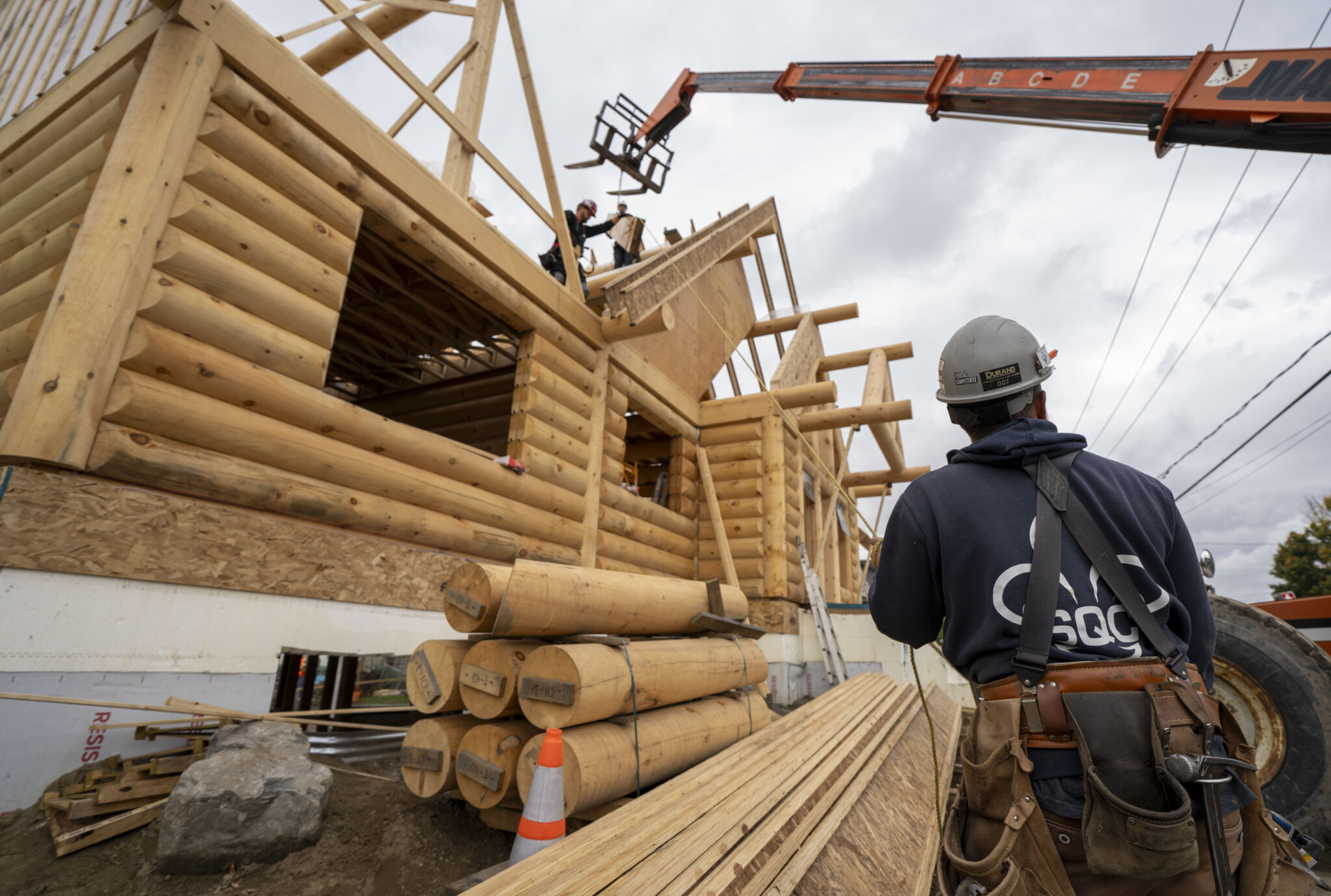
Carpenters build a log home made from white pine in Salaberry-de-Valleyfield, Que., on Wednesday, Oct. 22, 2025. Christinne Muschi/The Canadian Press.
K-12 education
The link between K-12 education to mobility is straightforward. Quality K-12 education forms the foundation for human capital development and increasing high school completion rates.
Over the past decades, the performance of Canadian high school students has declined significantly across all subjects. John Richards documents the trends in a recent CD Howe report. Math scores fell from 532 in 2003 to below 500 in 2022, the first time Canada dropped below the OECD benchmark. With limited exceptions, scores declined in each successive PISA cycle. In Saskatchewan, Manitoba, and Atlantic Canada, math scores fell 50 points, reading 38 points, and science 27 points. Since a 20-point drop approximates losing a year of schooling, students in these provinces have effectively lost two and a half years of math education since 2003.
COVID-19 compounded educational inequality through learning losses that disproportionately affected disadvantaged students. Seventy percent of teachers in low-income schools reported performance drops, compared to 40 percent in high-income schools. High-income parents could supplement privately; low-income families couldn’t. This differential impact will suppress mobility for the next generation by reinforcing class-based educational inequality.
Expanding school choice—through open enrolment, charter schools, or funding models that follow students—could introduce competitive pressure to improve outcomes while giving disadvantaged families options previously available only to those who could afford private schools or homes in desirable catchment areas.
Post-secondary education
Education levels account for between 40.5 percent and 50.1 percent of the correlation between parental and child income, making post-secondary education (PSE) a key driver of Canada’s mobility engine. Reductions in its access and efficacy will eventually correspond to a decline in mobility.
A growing threat is the mounting financial burden that risks turning PSE into a barrier for lower-income families. Soaring housing costs in university cities, driven partly by the surge of international students, force some students to work excessively to cover expenses, hindering academic success. Financing PSE contributes to significant debt (the average bachelor’s graduate carries over $30,000), inhibiting asset accumulation and delaying milestones like homeownership. High tuition for lucrative professional programs compounds this problem: The most financially rewarding credentials are disproportionately accessed by the affluent, reinforcing inherited class advantages rather than promoting meritocracy.
Hindering this pathway is the growing misalignment with the labour market, which reduces the economic value of credentials. Approximately one in six core-aged workers with post-secondary credentials work in jobs unrelated to their field of study, a figure that climbs to nearly one in five among young adults aged 25–34. For recent immigrants, the barrier is even higher, with an estimated one in three classified as overqualified for their current roles. As RBC reports, higher educational attainment doesn’t always correspond with higher skills, and employer surveys consistently indicate difficulty finding new hires with needed interpersonal and communication skills, revealing a gap between institutional curriculum and workforce reality.
Policy Horizons warns the sector risks becoming a “stranded asset” if returns fail to materialize. Rising costs coupled with delayed adulthood are weakening certain degrees’ value proposition, prompting a shift toward vocational training that offers more direct paths to employment. Reform should focus on accountability for outcomes, stronger industry partnerships, and ensuring funding models reward programs that genuinely enhance employability and earnings potential.

Labour market frictions
Onerous occupational licensing and slow credential recognition are artificial barriers that disproportionately impact immigrants and those without established networks. Canada licenses 160 professions with requirements varying widely across provinces, creating redundancies and compliance costs for workers relocating internally.
The mobility costs are substantial. U.S. research shows occupational licensing reduces worker mobility by 7 percent, resulting in 12 percent welfare losses. An OECD assessment ranked Canada among the more restrictive countries for entry into personal and professional services professions, with comparably high restrictions for aestheticians, driving instructors, electricians, painters, hairdressers, plumbers, civil engineers, and real estate agents. A recent CD Howe analysis suggests that for many Canadian occupations, the added costs consumers pay for regulated services may outweigh demonstrable public safety benefits. These rules prevent young talent from capitalizing on regional opportunities and trap skilled immigrants in roles below their qualification levels, making streamlined occupational regulations potentially as impactful for mobility as massive education investments.
Artificial intelligence presents another emerging friction, though its ultimate impact remains uncertain. AI promises productivity gains but could narrow traditional entry points where young workers build skills, networks, and credibility. If automation displaces entry-level positions before workers establish themselves, it risks severing the bottom rungs of the mobility ladder, not through malice, but by eliminating the roles that once launched careers.
Record immigration levels compound these challenges. When newcomers arrive faster than housing stock and labour market infrastructure can absorb them, intensified competition for entry-level positions, housing, and public services follows. This isn’t an argument against immigration—Canada benefits enormously from newcomers—but recognition that immigration policy must align with absorption capacity. Misaligned population growth strains the systems enabling upward mobility for everyone. The mismatch penalizes both established residents and new immigrants competing for insufficient opportunities.
Tax and transfer system
High Marginal Effective Tax Rates create powerful mobility traps. When families with children earn more money, they face a double penalty: they pay more in taxes and lose government benefits. These benefit reductions, called “clawbacks,” act like hidden taxes that make it much harder for families to get ahead through work.
The problem is especially severe for lower-income families, who face much higher effective tax rates than wealthier families. For families earning between $30,000 and $60,000—when various benefits like the Canada Workers Benefit phase out simultaneously—around 50 cents of every extra dollar earned is lost to taxes and reduced benefits. In the worst cases, the penalties can be extreme. A working parent in a two-child family who takes on extra hours can lose up to 79 cents per dollar in Ontario or 88 cents in Quebec. These punitive rates create powerful disincentives to increase earnings and trap families at lower income levels, making upward mobility extremely difficult.
It’s important to acknowledge that the federal government increased the Canada Child Benefit (CCB) after the final year of the cohort assessment in the mobility studies. Expanded by the Trudeau government, the CCB has been credited with reducing child poverty. Statistics show a substantial drop in the number of children living below the poverty line after the CCB’s 2016 implementation, with some attributing the decrease to the direct cash transfer to families. While rising above the poverty line may improve income, it does not guarantee access to the opportunities that enable upward mobility. Nonetheless, poverty rates have been rising since 2020, and some suggest the CCB’s effectiveness in combating poverty is being eroded by the rising cost of living.

Other economic factors
These specific barriers operate within broader economic challenges. Over the past decade, Canada’s real GDP per capita has barely grown, ranking 37th out of 38 OECD nations. That means stagnating living standards for the average person. Rising unemployment and underemployment, especially among youth, further limit opportunity, with the national unemployment rate trending upward since mid-2022.
Structural problems compound these headwinds. New business formation has halved since 2000, while oligopolistic market concentration in banking, telecommunications, and groceries extracts economic rents from consumers, suppresses competition for talent, and limits the overall dynamism required for widespread upward mobility.
Restoring the covenant
The bigger picture shouldn’t be lost. Canada remains a country where social mobility exists—we aren’t a rigid society like Peru or Bangladesh. But the data reveals a concerning trend: Relative mobility has been declining across generations. While this historical trend is clear, the future trajectory remains uncertain. The recent confluence of rising costs for necessities like housing, combined with structural headwinds in key policy areas (education, labour markets), could further constrain mobility for future generations.
The hardening of ranks occurred even with progressive tax policies and income transfers in place, underscoring a key reality: Redistributing income after people earn it is insufficient against powerful structural forces. These forces include concentrated educational opportunity, lack of inherited human capital, and local regulatory barriers—factors that shape outcomes before individuals even enter the labour market.
The path forward demands structural reforms: liberalizing housing markets through regulatory reform, aligning immigration with absorptive capacity, improving K-12 school choice and quality, reforming post-secondary education to align with labour market needs, dismantling occupational licensing barriers, and reorienting the tax and transfer system to reward work. Strengthening competition and reducing barriers to business formation would also create opportunities for advancement. The ultimate goal is ensuring the next generation’s success is determined by merit, not birthright.
Is the 'Canadian dream' of upward mobility truly dead, or just harder to reach?
What are the biggest policy barriers hindering upward mobility in Canada?
How does the rising cost of necessities impact the ability of Canadians to achieve upward mobility?






Comments (10)
I really wish Canadian writers would retire this silly trope “Obtaining a college degree has become a crippling expense, with the average graduate carrying $28,000 in student debt”. OMFG, the average used car loan in Canada is $32,000 and somehow investing $28k in a degree which should tremendously increase lifetime earnings is “crippling”?