
On the west side of the Netherlands, near Leiden, is a national park called, in typical straightforward manner, Hollandse Duinen. Tourists, as our family was this summer, can hire bikes in Leiden, the birthplace of Rembrandt, and cruise down the paths toward the beach in Klapwijk by the sea, and then take the “Dunes and Mansions” tour, which takes them through that national park, and past the houses of the rich and famous—well, at least the rich—before returning to the city centre.
And in the middle of that park—nestled in a wooded area away from the dunes—is a small rest stop with a restaurant where tired travellers can grab a cold “biertje” or some coffee and gabek. It’s beautiful. The birds sing; it’s quiet, away from the wind of the North Sea, and away from the hustle and bustle and the student party culture of the city. It’s idyllic; peaceful.
And outside of that restaurant, adding to the sense of idyll is a small, totally unremarkable bench. A pot of pansies, white and purple, was placed on this bench, confirming my long-held suspicion that the point of the Dutch obsession with taking land from the sea is to maximize the area on which they can place fresh flowers.
The bench was clearly older, but still functional, and well-made in a type of bench you’d find in most city parks: iron rails holding wooden slats set up in gentle curves which allow a tired body to relax and take a swig of water, or just sit and enjoy the birdsong. And that’s precisely what my eldest son was doing. He sat down next to the pansies, took a sip of water, and, as I was about to fill up my own bottle, I heard him say: “Dad, look at this.”

He was looking at a bolt. A normal bolt, entirely unremarkable except for the fact that it had a swastika on it. You wouldn’t have noticed unless you were looking closely. I’ll bet nobody else has noticed it since. But there, in the middle of a peaceful national park, right beside a pot of flowers, was a bolt forged by one of the deadliest regimes in history. Wickedness and hatred embodied with steel, in the middle of a peaceful, prosperous nation. A mark of death, in the middle of a preserve for life.
It was jarring.
We had come to the Netherlands in part as a family pilgrimage. We wanted to visit our parents’ birthplaces and to see the places in a foreign land that were part of our family’s story.
And that story, it turns out, is a braid of Dutch, Jewish, and Canadian culture.
My family comes from the northern part of the Netherlands. Friesland on one half, and Groningen on the other. My grandfather, who, despite being a man of very few words, has played a massively outsized role in how I understand myself and the way I ought to live. He was a small man in stature, and a man of so few words that I don’t recall having a conversation with him in which he spoke more than one sentence at a time. But my father, who knew about his life from listening to aunts and uncles and others, told me his story; later, someone wrote a book about him and his brothers. And, if actions speak louder than words, you ought to put hearing protection on before reading the small volume of their lives.
Grandpa was born and raised in Groningen, a city in the northwest of the Netherlands. As war descended onto the Netherlands, Grandpa and his family moved into the heart of the city—a city that once had a massive Jewish presence. Groningen is also the birthplace of the Dutch painter, Josef Israels. If that sounds Jewish, that’s because it is. Josef Israels was a Dutch Jewish painter most famous for depicting scenes of life that are at once totally normal and deeply profound. His painting Peasant Family at the Table was one of the influences behind Van Gogh’s famous Potato Eaters series. It’s classic; it’s Jewish; it’s quotidian; and for anyone who grew up in a Dutch family that immigrated to Canada, and I’m sure for many more, it’s home.
For us, the connection to Josef Israels was closer than a sense of recognition of our family in his paintings. During the war, my grandfather and his family lived at 16a JosefIsraelstraat. It’s a lovely part of the city now, in the heart of the student quarter. It’s the type of home that new urbanists would love: tight, close to the street, and with a beautiful façade. We went to visit this house to see where Grandpa and his family lived in their greatest time of trouble.
I say trouble, because as you walk up to 16a JosefIsraelstraat, you stumble across a cobble that has been deliberately raised to do just that: cause you to stumble and look down. And as you look down in frustration, you see one stone has a brass plaque on it. And this particular brass plaque says:
Hier Woonde Reint Albertus Dijkema Geb. 1920. Verzetsstrijder Gearresteerd 4.6.1944 Geexecuteerd 22.8.1944. Vught.
(Here lived Reint Albertus Dijkema. Born 1920. Resistance fighter. Arrested 4.6.1944. Executed 22.8.1944. Vught.)
And then you look to your left, and to your right. And then you realize, to your horror, that the Dijkemas, we, are lucky to have someone three generations removed from the war to come visit this stone and to weep. Because to the left, at 12a JosefIsraelstraat there are three more stones: Here lived Jocheiwet Lichtenstein-Sobol, and (Juda) Lajb Lichtenstein, and (Juda) Lajb Lichtenstein, deported 1943 to Westerbork, murdered, 1943, Auschwitz. And then you look to your right at 18a, and there are nine people. Here lived an entire family: Zitta, Esther, Hartog, Henderiena, Jozeph, Marga, Marij Altenburg-, Franziska, and Hartog Sr. Cohen, deported 1943 to Westerbork, murdered, 1943, Auschwitz.
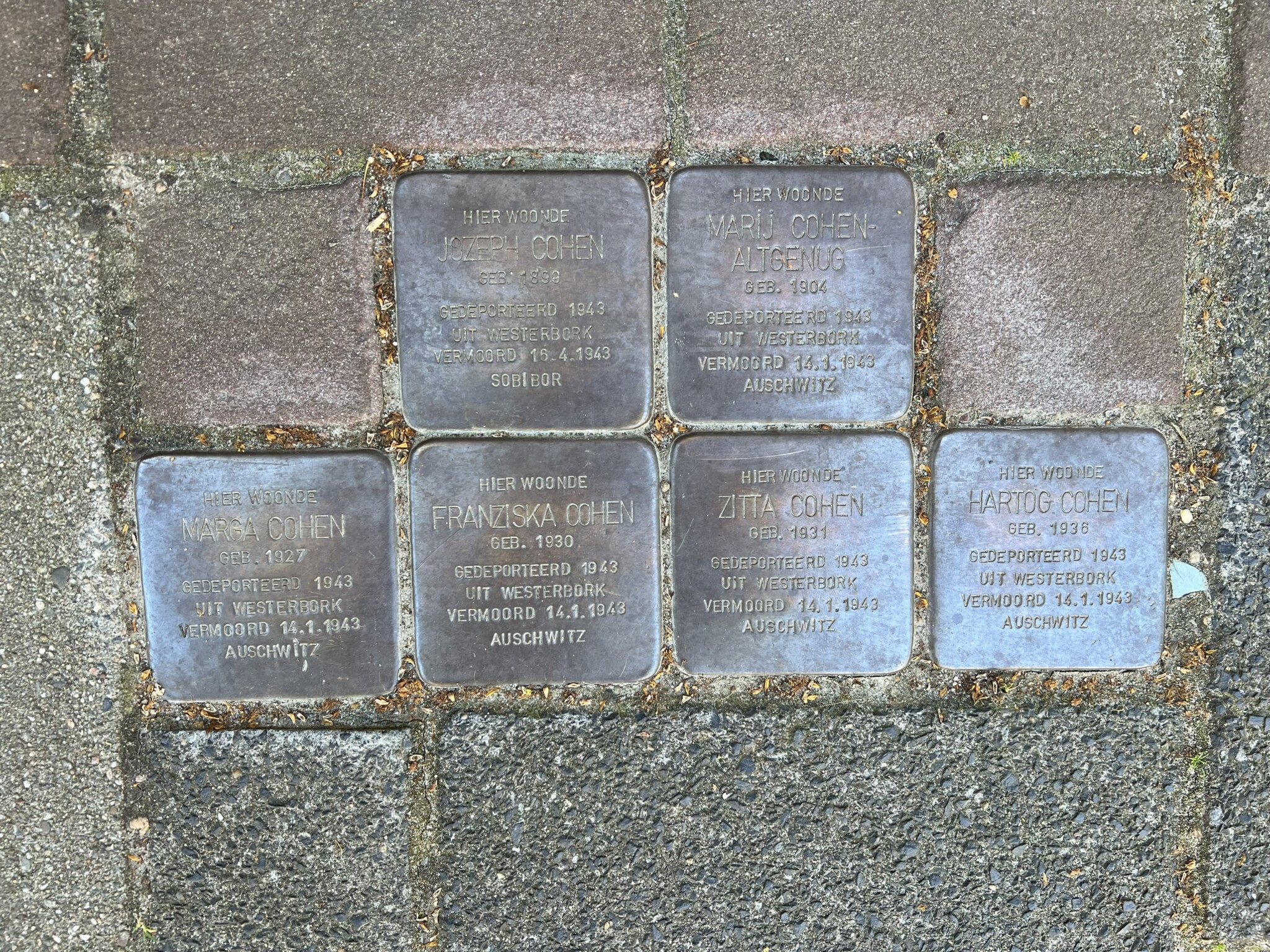
Stumbling stones commemorating the Cohen family, my grandfather’s neighbours on JosefIsraelstraat street in Groningen, Netherlands. There were three more next to this photo. They were all murdered in concentration camps. Photo credit: Brian Dijkema.
And then you look closer at the street, and the neighbourhood, and you realize, on a beautiful, sunny day with clear skies and typical skudding Dutch clouds, dear God, half the neighbourhood is missing.
This is Dutch life. This is the reality of what my family came from. Dutch Christians, living in a country, in a city, in a neighbourhood, on a street, that has a giant, silent hole in it. The absence of what was once a thriving, boisterous, prosperous, contributing community is palpable.
And when you start to look, you suddenly see that hole everywhere.
We saw it as we climbed the famous Martinij tower in the heart of Groningen. My grandpa had one of those little souvenirs that you can hang from your car mirror on his car. I used to look at it when he took me fishing and wonder what it looked like in real life. So when we went to the city centre, I climbed it with my kids, and we looked over the city for the landmarks, and read the plaques. And we noticed that one of the plaques invites you to look for the synagogue that “was the heart of Jewish community in Groningen.” Past tense. You can barely see it. A small dome among skyscrapers and other buildings.
And then you go to little podunk towns like Siddeburren, where grandpa was born—the butt of many a Dutch joke—and realise that even nothing towns weren’t spared from the horror.
Or, as you’re poking through a small antique shop in Gouda after getting your haircut, you notice that there are more than a few Menorahs among the memorabilia. Heavy, lasting menorahs, selling for 65 EU, among cute little trinkets and wooden shoes, and you wonder about how many Shabbat dinners, how many Hanukkahs did that menorah light? And you realize that while almost all of the stuff in that antique store comes from people who are dead, some of it comes from people who are dead because other people killed them: methodically, horribly, and often with the consent, or inaction, of their next-door neighbours.

And then you visit your wife’s family’s home, and you realise that the community centre, which now has pickleball courts where people in bright sport gear play without a care in the world, was built by slave Jewish labour for Nazi soldiers.
And then you go to Amsterdam, and you walk through Waterlooplein, in the heart of the former Jewish quarter—formerly one of the most vibrant Jewish communities in Europe and now a flea market—and you see rows of shoes being sold by the merchants, and you take a picture because all you can think about is the last time you went on a family vacation to DC with your family and saw shoes on the floor like that.
And then you just stop. And you understand the words of another Dutch woman, Etty Hillesum, who might have shared the same space as your grandpa’s brother on his way to Vught, and definitely shared the space with his neighbours in Westerbork:
the sky is full of birds, the purple lupins stand up so regally and peacefully, two little old women have sat down on the box for a chat, the sun is shining on my face—and right before our eyes, mass murder. The whole thing is simply beyond comprehension.
And then you have a whole new appreciation for why your grandfather was so quiet. Or, why, when he was dying of cancer and on morphine, was terrified when he heard nurses walking down the hall. You realize that he, as a member of the Dutch resistance, who killed a collaborator from his own church, who stole ration cards so that members of his community with a conscience that hid Jews could eat, was on the Gestapo’s hit list. And then you wonder, knowing that the time between when one got on the Gestapo’s hit list and when one ceased to be on this earth was extremely short, how it is that you, the grandson of this man, came to be in the Netherlands, experiencing all of this quiet, empty sadness not just by himself, but with his wife, and his children. How did we, three generations away, come to be here?
The answer to that we discovered on Canada Day.
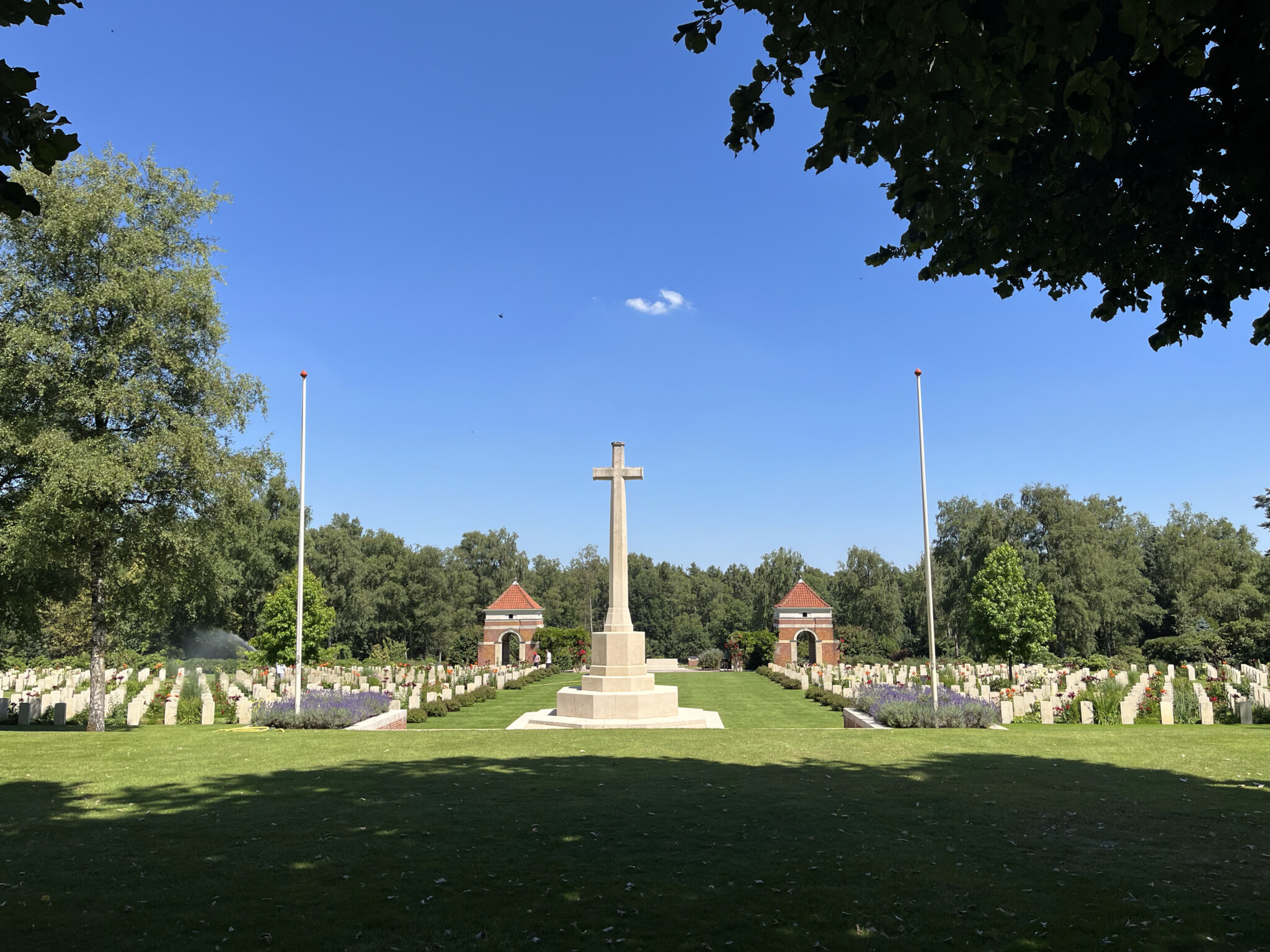
A cross at the Canadian war cemetery in Holten, Netherlands. Photo credit: Brian Dijkema.
On July 1, 2025, my second cousin took us to see the Canadian war cemetery at Holten which is within walking distance of her house. Set deep in the woods, not unlike the place my son discovered the Nazi bolt, it is a profoundly sad, quiet, and beautiful place.
That day was excruciatingly hot—38 degrees—but when we walked into the graveyard, everything was lush. It was beautiful and manicured in a way that only the Dutch can. And our family experienced what I can only describe as a type of holy sadness. As we walked through the graves, we read their names, we read where they came from. We noticed men from the Stormont Dundas and Glengarry Highlanders. Men whose grandchildren, had they been able to have them, would have gone to school with my wife.
And we noticed two graves, one in front of the other, from our home in Hamilton. One was a Jew. One was a Christian. One grave had the Star of David. The other had the instrument of death for the Son of David. Both stones, like all the graves, were marked with a maple leaf:
Lt. T. Herman. The Royal Hamilton Light Infantry. 13th of April, 1945Private L.M. Colford. The Royal Hamilton Light Infantry. 14th of April, 1945
I am a Christian. One of our most important and profound beliefs is that God himself took on flesh and died, and that through that death and through that resurrection, we might have life. One part of our scriptures says this: “He died for all so that all who live—having received eternal life from him—might live no longer for themselves, to please themselves, but to spend their lives pleasing Christ who died and rose again for them.”
I know that to be true. But as I walked through the graveyard and I saw my children, who were roughly the same age as many of the boys buried in the soil in Holten, I knew it on another level that is tied not just to me, but to my country.
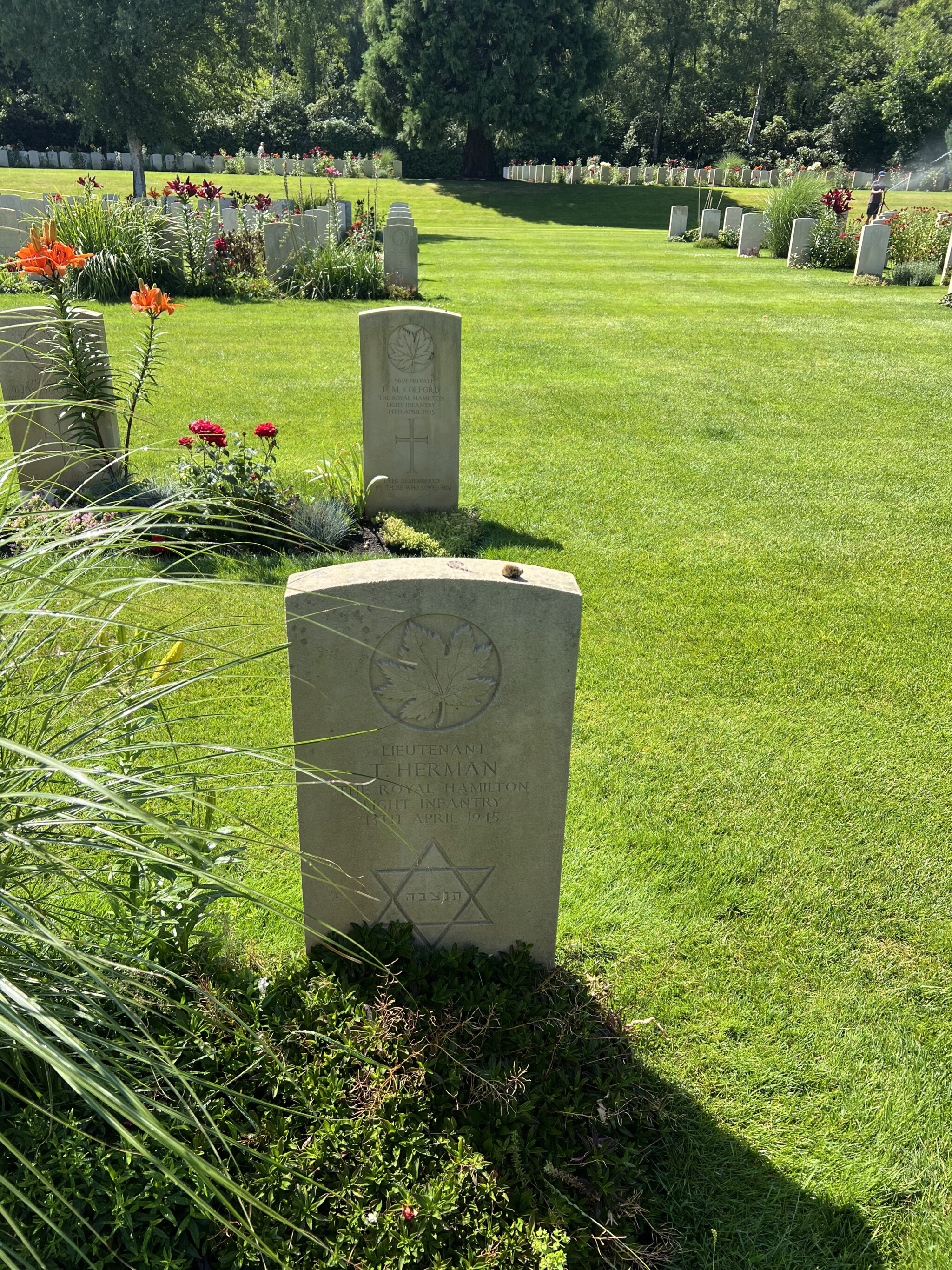
The graves of Lt. T. Herman and Pvt. L.T. Colford of the Royal Hamilton Light Infantry at the Canadian war cemetery in Holten, Netherlands. Photo credit: Brian Dijkema.
Lt. Herman, and Private Colford, and every other boy in that graveyard are dead. They are buried, and I will never meet them this side of the resurrection. As Canadians we often speak of the sacrifice of our soldiers. And that sacrifice is real. But what has it actually bought?
For me, I can say without a shred of irony or exaggeration, those men bought me my existence. They are, in that way, god-like to me, and always will be. Normal men, from the same town as me. I’ll bet that Lt. Herman and Pvt. Colford and I walked the very same streets. Were it not for the efforts and death of Lt. Herman and his comrade, Pvt. Colford, it is very likely that Canadian troops would not have made it to Groningen in time. My grandfather lost three friends in the last days of the war—we visited their graves, and the farm where they were hiding.
If Canadian troops did not arrive that April to free Groningen, my grandpa would be dead. And if he had died, my dad would not have been born. And had my dad not been born, I would not have been born. And had I not been born, I would not have been able to walk through that grave with the children born to my wife and me, to honour them.
We have symbols to remember death and to remember life. For the Christian, we commune with God when, every Sunday, we “take eat, remember, and believe, that the body and blood of our God was broken and shed for the complete forgiveness of our sins.” For us, it’s not just a symbol, but an existential reality. It’s death turned to life, and life abundant. It’s fruitful.

And I don’t think it’s sacrilegious for me to say that, at a lower, but no less existential, level, Remembrance Day operates analogously. I literally owe Canada my existence; the death of all those boys from Winnipeg, from SD&G, from Hamilton, has borne fruit, and it is me and my family. It is the lives of my dad and mom, and my wife’s parents, and our kids, and, Lord willing, their kids. And I’m so grateful.
Etty Hillesum gets at this sense of gratitude:
A desire to kneel down sometimes pulses through my body, or rather it is as if my body has been meant and made for the act of kneeling. Sometimes, in moments of deep gratitude, kneeling down becomes an overwhelming urge, head deeply bowed, hands before my face.
I have that sense of gratitude to God in the deepest sense. I have that with Canadian soldiers in a lesser, though no less true, sense. All of the gifts of this country that I can experience with my wife and my kids were paid for with someone else’s blood.
I cry at church sometimes. I cry because I long for home, for true peace, and because of the beauty of the depth of love that someone has laid down their life for me. I don’t usually cry on Remembrance Day, but I do experience similar pangs of longing and the same sense of beauty and gratitude.
I’d like to end on a future-oriented note: with a gentle caution, and with a word of hope.
The hatred that led to the killing of so many millions of Jews is still with us. In fact, it’s still in the Netherlands. As we walked through the various cities of the Netherlands, I saw at least two instances of it. One said: “FCK ISRL.” It marked a bus shelter post just a few blocks away from the Anne Frank house. Another, just a few blocks away from Waterlooplein, encouraged tourists to “boycott Israel.”
And it’s here in Canada too, that same old hatred, the same indifference to hatred that led the Dutch to watch as their neighbours were hauled away. Do we honestly think that the vandalism of Canadian synagogues, or the thuggish actions at TMU, or the masked mobs at McGill in Montreal are any different at their base than those that preceded the horrors of the holocaust? We’ve seen this hatred made manifest from parts of the Muslim community, but also from the Left in Canada. Sadly, the old hatred of the antisemitic Right has gathered strange company.

I was struck by the fact that the hatred that left a giant hole in Holland’s heart is never that far away. And it struck me that that is because hatred is not bound by time, nor geography. It is something that seems to have its source in every human heart. The Jewish heart. The Christian heart. The Muslim heart. The atheist heart. My heart.
We’re never going to get over this hatred—nor the killing that you so badly want to stop—until we learn to take advantage of the peace won by those men who lie in the graves at Holten. Peace—even peace among ancient enemies—is won at a cost, and it is won with sacrifice. Sometimes justice requires force, even lethal force, as was required in the Netherlands in 1944-45. But justice always requires a purging of hatred if it is to last. There can be no peace where there is hatred.
I would encourage those who are concerned about war in Gaza to do something that is going to feel awkward at first. First, realize that in this country, you have an opportunity—the freedom—to model something different, something that might be harder to do. Take a moment and realize there are no bombs here; there is no war here. You have the freedom to approach your fellow citizens and talk to them in peace. Take that freedom. Take a moment to look inside your own heart and ask: whom do I hate and why? And then take the steps to lose the hatred; learn the desires and worries of those you hate. Share yours.
Ask yourself about the quality of mercy and see if you can find it. Compare that quality with the quality of hatred, and ask yourself which you wish to cherish and grow. Which is more true? Under which regime of the soul, or the state, would you like to live? You will find that the real battle, the real resistance, the real war, the real struggle, starts there.
And it is only once that hatred has been put to death that we can begin the project of life—a shared life that is marked more by the absence of war, but by the tranquility of order; an order of your soul, but also of our society. As we wait for that better day, I encourage everyone in Canada to remember that this, ultimately, is what those men died for. Let’s ensure they didn’t die in vain.




Comments (3)
Six people in my family did their bit in WW l & ll, 5 British and one from Canada. I’ve been fortunate to learn something about what they did and what they saw. So I keep a couple of poppies around the house all year round because every day is remembrance day for me.