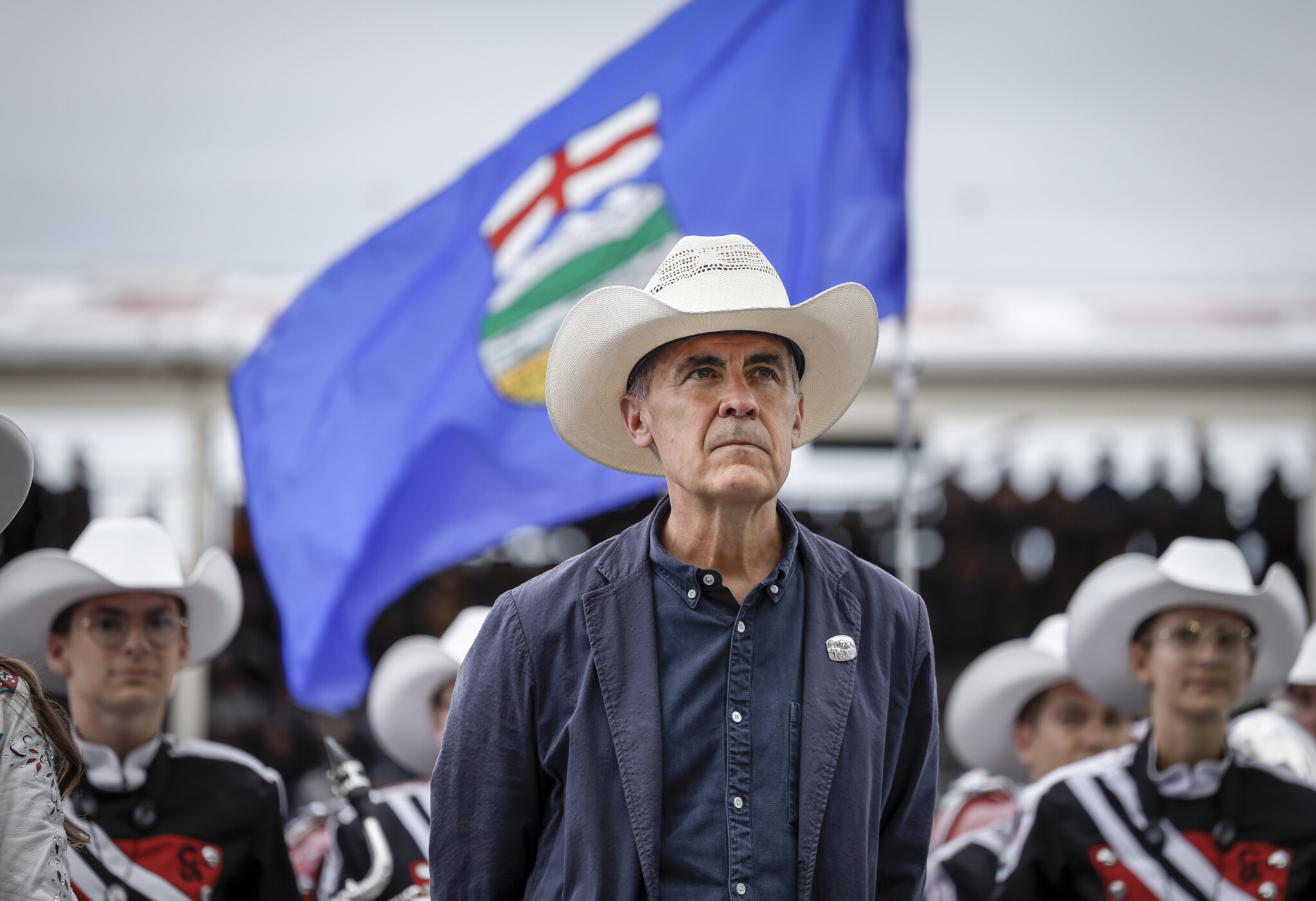
There’s a trope in almost every holiday family movie.
A workaholic father promises the world, swears that this year will be different, and then spends Christmas Eve scrambling to buy presents and make good on his word.
Mark Carney risks casting himself as that disappointing dad this season.
Since taking office, the prime minister has made a habit of delivering grand promises to build big and “at speeds we never imagined.”
So far, they’ve included a trillion dollars in new private investments, a “nation-building” project list to rival the post-war years, and a long-awaited deal with Alberta that would finally marry growth with climate goals. Central to the so-called “grand bargain” is federal backing for a new bitumen pipeline to the West Coast in exchange for advancing decarbonization efforts like the Pathways Alliance carbon-capture network.
Now, as Carney prepares to announce the second tranche of major projects in Prince Rupert, all early signs suggest another list of safer bets. At the time of this writing, we’ve only gotten a whole lot of mixed messaging on the pipeline front.
“The prime minister’s style, and I suspect it’s deliberate…is to set expectations really high—to set these massive stretch goals…but then come up short,” University of Calgary economist Trevor Tombe said last week on The Hub’s Alberta Edge podcast.

“The first tranche was fairly…I don’t want to say disappointing, but they were pretty easy and maybe didn’t need the additional boost of being on the list at all,” he continued. “Maybe the second set of projects is kind of like that, but just marginally more difficult.”
Stretch goals are, in fact, a tried and true corporate tactic.
The idea is to push an organization beyond its comfort zone by deliberately setting targets that seem out of reach. An even grander version of it is the “moonshot” strategy, where leaders bet on impossible but transformative goals precisely because aiming for the moon is the kind of big thinking needed to reset ambitions.
Corporate stretch goals can drive great results, even when employees fall short of hitting them—because their achievements would’ve never happened under more modest targets.
Carney seems to be importing this method from business boardrooms to government.
Big targets can mobilize institutions that might otherwise drift or toil in bureaucracy. Under normal circumstances, the incremental announcements made so far by this government would’ve been deemed pretty fast and furious.
But we’re in extraordinary times. A sluggish economy and a bruising trade war with Donald Trump have jolted the country awake. Canadians picked Carney because they liked his maximalist approach and perceived steady hand.

And Carney has set the bar so incredibly high, using endless superlatives like “best,” “fastest,” and “most” to describe his goals for Canada.
Anything short of a moonshot now could look like a stumble. And unlike in business, missing a stretch goal in politics may not be counted as a win. Perception is everything, and already, we’re seeing public support for the parties shift.
In Alberta, expectations around a pipeline have been carefully stoked for months.
Carney repeatedly touted his Alberta bona fides as a northerner who grew up in Edmonton. He appointed a credible former energy executive, Tim Hodgson, to lead the energy and natural resources file, then bolstered it with Calgary’s lone Liberal MP, Corey Hogan, as parliamentary secretary. He set up the new Major Projects Office in Calgary, then tapped former Trans Mountain board chair Dawn Farrell to head it.
Just last week, Carney told a Toronto business crowd at the Canadian Club not to worry because, in his words, “We’re on the pipeline stuff.”
“Danielle’s on line one,” he said about Alberta Premier Danielle Smith.
“Don’t worry, it’s going to happen,” Carney said. “Well, something’s going to happen, let’s put it that way.”
To its credit, the government did spell out a plan for Pathways Plus in Budget 2025. It positions an Alberta-based carbon capture and storage network as a candidate for fast-tracked approval.

So at the very least, many in the oilpatch are expecting some mention of carbon capture in the second tranche, even if a pipeline is not.
But the window of action is closing fast.
Premier Smith has been clear that she wants a memorandum of understanding with Ottawa in place by the Grey Cup this weekend.
Meanwhile, her B.C. counterpart, David Eby, continues to pour cold water on any new pipeline proposal through his province. It doesn’t help that Hodgson had previously muddled the waters—whether by accident or design—by suggesting Alberta would need B.C.’s consent for such a project.
It all adds up to a lot of hints and promises, conflicting signals, and an undeniable sense of urgency.
It’s as if at any moment now, the disappointing dad will finally come through with the Turbo Man doll and deliver the ultimate Christmas miracle.
Alberta can only hope this movie has a heart-warming ending.

Falice Chin is The Hub’s Alberta Bureau Chief. She has worked as a reporter, editor, podcast producer, and newsroom leader across Canada…
Is Carney's 'stretch goal' strategy for major projects a smart political move or a risky gamble?
How does the potential new pipeline project balance economic growth with climate goals, according to the article?
What are the key political and economic hurdles to Carney's pipeline promise, as outlined in the article?





Comments (6)
So far at least, public opinion has been accepting of this over-promise, under-deliver strategy. Seemingly little or no penalty politically.