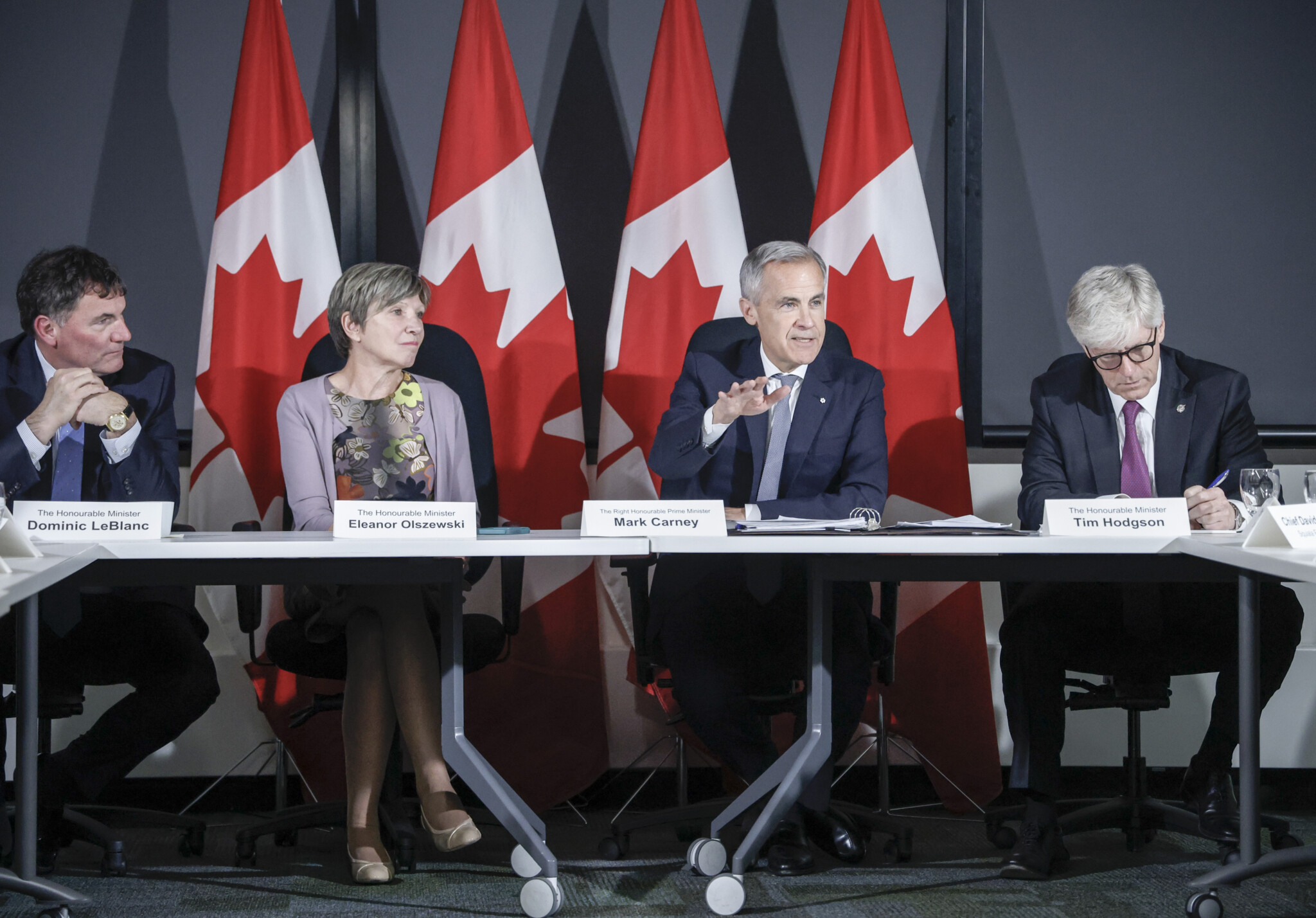
Contrary to the doubts of many who had read the prime ministers’ net zero manifesto Value(s), an oil pipeline agreement with Alberta has finally been announced. The pipeline plan includes significant conditions, and carbon sequestering through an organization called Pathways Alliance is a major part of the plan. It’s not clear at this point whether the conditions are designed to doom the project from the outset or are part of a much more comprehensive remaking of the economy along net-zero goals.
As the prime minister remarked, these were “necessary conditions but not sufficient conditions,” meaning that there may be more to come. He will let you know.
A cautionary example in this regard can be found in the U.K., which is much further along on the net-zero quest, the main result of which has been to raise the costs of producing and living so much in the U.K. that most manufacturing has moved to China, where there is virtually no carbon cost at all. It has left British consumers paying some of the highest costs of power in the world, while likely increasing overall global emissions through the substitution of U.K. gas for Chinese coal.
The Canadian government has a plan that it hopes could avoid the disastrous results experienced in the U.K. The plan is to create a “decarbonized” economy using a sophisticated carbon credit market to get carbon emitters to finance carbon reduction schemes, with border adjustment measures currently being implemented in Europe to reduce distortions in exports and imports.
A critical provision of the European carbon offset plan is the removal of carbon reduction costs at the point of export to a non-carbon-controlling country. We already use a similar strategy with the HST. Domestic consumers pay the HST, but it’s removed for exports and levied on imports, thus avoiding market distortion on either of those.
But it’s easy to measure the amount of HST in a particular product because the price is known. It’s much harder to measure the carbon content, as one would have to go back through the supply chain and make very complex calculations. Importantly, although the removal of the credit may offset the trade distortions, these will still levy significant costs on Canadian businesses and consumers as domestic businesses pass them through.
Comments (9)
Ray Howarth
29 Nov 2025 @ 9:53 am
CCS is an expensive “smoke and mirrors” excercise that will have no significant impact on global carbon reduction but will inflict economic pain on Canadians.
Is the Alberta-Ottawa energy agreement a genuine step towards net-zero, or a costly political maneuver?
Could the carbon credit market, as proposed, truly decarbonize Canadian industry without harming consumers?
Given the potential costs and limited impact, why might Alberta and Ottawa be pursuing this 'decarbonized bitumen' strategy?
The biggest condition for pipeline approval is to “decarbonize” the bitumen. The oil sands have long been criticized because of their higher output of CO2 relative to conventional oil and natural gas extraction. In order to extract bitumen from the sand in which it is situated, it needs to be heated. Originally, this was accomplished by burning bitumen itself, which had the advantage of being inexpensive but the disadvantage of adding to the life cycle carbon emissions relative to conventional oil extraction. The extra emissions used to be as much as 30 percent, but with the evolution of the technology, and the substitution of natural gas (also abundant in the area) for bitumen, it is now closer to 10 percent. But that extra CO2 emission is still used to deride the source with the pejorative Tar Sands label, and removing that extra emission is what is now being called by the government, decarbonization. Removing CO2 from the air is very difficult. CO2 is a trace element in our atmosphere, and, so far, no one has conceived of an efficient way to separate it that would not cost many times more energy than was burned to release it in the first place. It’s easier if the extraction is done at source, meaning extracted from the exhaust stream of combustion, where its concentration may be as high as 10 percent, but it’s still very expensive. The plan as described below is to capture emissions directly from the exhaust from the heating of bitumen so that it can be transported by pipeline and injected into the ground. The first organization ready to extract carbon is the Pathways Alliance. They will build the facilities backed by government funds and then sell carbon reduction credits to finance the operations. Initially, as a temporary measure, the government will provide a “contract for differences,” which is a fancy way of saying that they will backstop the market for carbon credits until another buyer can be found. And buyers will be found, likely by legislating domestic emitters across all industries to offset their emissions through the carbon credit purchases and importantly, mainly, outside of Alberta. As reported in numerous releases, Pathways proposes to build its facilities for $16.5 billion over five years, which will then allow it to capture 22 megatons of CO2 for an additional $1 billion or so per year. That would allow it to capture the CO2 for a barrel of oil for about $5. The capital cost, however, is a few years old, and the experience of other projects in Alberta has shown much higher operating costs that have continued to escalate. In the case of the Alberta Carbon Trunk line and Shell’s quest project, costs have risen to more than $50 per tonne, or about $25 per barrel of bitumen. But regardless of cost escalation or intention, we can’t capture all of the emissions from a barrel of oil—we can only capture those used in its extraction, which represent only about 10 percent. We will not be reducing the carbon content to any level less than a barrel of oil from anywhere else. And we can only “decarbonize” bitumen, as there are no material capturable combustion streams from the production of conventional oil. But it gets worse. Not only will real-world costs likely be higher than estimated, but based on experience in Alberta, there will be significant CO2 emissions from the construction and operation of Pathways’ very capital- and energy-intensive carbon extraction technology, and those emissions are unknown and unincorporated. Surely those would have to be offset as well, making Pathways a customer of its own credits. The Rube Goldberg machine keeps spinning and devouring itself. If this cost were borne by oil producers, it would make exports far less competitive, particularly given the other mouths that will need to be fed to get the oil across British Columbia. But the Alberta government seems keen on the whole plan, and they are certainly aware of the details. Why would Alberta accept this uneconomic proposition? Because they are not going to be paying the bill. It will be paid for by buyers of carbon credits, largely across the rest of Canada, initially backstopped by the Canadian government. For example, the prime minister recently remarked that he was excited to build AI data centres, which in the Canadian case would be carbon neutral. How will this be achieved? By buying carbon credits from carbon capture companies like Pathways. Manufacturing, utilities, telecom, and health-care companies in Canada use lots of power and currently do not generally offset their emissions. For the ones mainly serving the domestic market, the purchase of carbon credits will raise their costs to then be passed on to consumers. We may not see the tax, but we will surely pay it. The government has shown some insensitivity to this point in the past. In a U.S. talk show appearance, the prime minister chuckled that “Really, how much steel do you buy?” in response to whether an industrial carbon tax would raise the cost of living for Canadians. And what will be the benefit of this decarbonized oil? Who will give us credit for our climate indulgences? From a campaign speech in Calgary, Carney gave us his rationale The requirements to trade internationally will increasingly depend on being able to decarbonize products so that they can enter tariff-free into other countries. Our industrial carbon pricing will make Canadian steel, aluminum, and energy the lowest-carbon in the world, opening doors to Europe and Asia while shielding us from unfair competition. This may soon be true of Europe, based on regulatory work underway, and Europe has been targeted by the government as a future alternative to U.S. trade. But it isn’t currently a material export market, and the U.S., at this point, will give us no credit for decarbonized oil. The idea that Asians might embark on that kind of scheme is highly speculative and counter to the reality of the vast majority of energy trade, which is not based on carbon intensity. If anything, alarmism over CO2 emissions has peaked, and under the strain of more immediately pressing issues, many countries are scaling back commitment to net zero. Even if that changed and more countries redoubled their efforts, Pathways can only reduce the CO2 content to that of conventional oil from most sources. While it contributes in a tiny way to the prime minister’s longstanding interest in combatting climate change, he knows perfectly well that the benefits are too small to make any real difference. But many Canadians still put climate at the top of their concerns, and are happy to ignore the math, just as they were with the consumer carbon tax, at least at the low rates where it began. If one were looking for a common thread to the provenance of the most expensive examples of climate theatre over the past few decades, namely Dalton McGuinty’s solar and wind subsidy scheme, the Trudeau Carbon Tax and now this government’s “decarbonized bitumen scheme,” it would be hard to miss the hand of Gerald Butts, an important advisor to all three. Someone who seems to have a particular knack for tapping into the apparent willingness of Canadian consumers to support expensive climate indulgences as long as they have no discernible effect on their consumptive behaviour. The Trudeau Carbon Tax fulfilled these objectives, delivering smug satisfaction to Canadians that they were doing something, while imposing no significant economic or lifestyle limitations. As soon as the costs started to rise, they largely rejected the program. As Carney noted, it became “divisive,” which translated from newspeak means politically ineffective. The government seems to want to create a different program that will feel just as good while imposing no immediate lifestyle consequences. There is no reason why we can’t reduce our own CO2 emissions by developing better technologies while allowing Alberta energy to flow to world markets. The production and export of fossil fuels, on which our economy, our social programs and our national unity depend, have little to do with domestic consumption. Any increase in our exports of oil and gas would effectively displace Middle Eastern oil production, for which Arab dominated OPEC countries manage supply. And oil and gas production by Canada largely displaces dirtier oil from places like Venezuela or coal in places like China. Canadian exports of oil and gas do not add to global emissions, as they already displace worse emissions elsewhere. And until Canadians decide to stop showing up at the gas pumps and heating their homes, oil extraction will be needed to meet their demand. Most frustrating about this plan is that there are many high-density clean energy sources that could be developed with the funds that we will waste on carbon capture. Some of these are being developed, but many are underfunded. Supercritical geothermal, a relatively new technology to bore holes as much as 10 kilometres in the ground to reach heat upwards of 700°F, would provide high-density, limitless, emissions-free, local, baseload energy for electric generation and thermal uses. We have several Canadian companies, and there are a growing number of American ones that are racing to exploit this best-of-all-worlds energy source in spite of woeful underfunding. The $16.5 billion-plus proposed to be spent and then charged back to our already struggling industrial base would provide orders of magnitude more CO2 reductions if used to develop this extremely promising technology (in which the writer has no involvement), as well as providing plentiful, cheap energy that we could use to rebuild our manufacturing base. All of this puts the government in an uncomfortable position, keen as they are to complete their majority. It’s easy to see why some members of the Liberal caucus who want to see the end of all fossil fuel use have deep reservations about this agreement, as it reduces only a tiny fraction of overall emissions from the eventual use of Canadian oil. There are many in the Liberal caucus that may find themselves more at home in an Avi Lewis-led NDP with a “not one drop” approach to oil and gas production. Steven Guilbeault, one of the most ardent net-zero advocates in cabinet, resigned from his post in protest shortly after the MOU was announced on Thursday. On the other hand, standing in the way of Alberta’s legitimate participation in global energy markets risks a unity crisis. While that issue is urgent today, burdening the rest of Canada to satisfy legitimate Alberta aspirations will not lessen national unity problems in the long term. Clearly, the right way forward is to stop trying to unscramble the egg of historical emissions and focus on investments that will provide Canadian consumers with clean high-density energy from fission, fusion, and geothermal at the same time as selling the rest of the world products that they are going to consume from whatever source will provide them.
Philip Deck is a software entrepreneur, the former CEO of Certicom Corp. and MKS Inc., and has also served as the Lead Director of the Bank of Canada and the Chair of the Canadian Opera Company.








Comments (9)
CCS is an expensive “smoke and mirrors” excercise that will have no significant impact on global carbon reduction but will inflict economic pain on Canadians.