One of the most consequential parts of the new energy agreement between Ottawa and Alberta has little to do with crude oil, pipelines, or even the endlessly litigated West Coast tanker ban.
It concerns electricity.
If done right, it presents a GDP-boosting opportunity for genuine nation-building that doesn’t alienate parts of British Columbia. Quite the opposite, in fact.
And it could lower emissions at the same time, even without the nudge or shove of carbon pricing and sequestration.
So what’s this win-win-win scenario that the news headlines seem to have missed?
It’s what many economists and energy observers have long called for: an electricity intertie system that allows Alberta and B.C. (and beyond) to share power, balance their grids, and make better use of each province’s strengths.
Last week’s federal-provincial memorandum of understanding (MOU) paves the way for such cooperation. It does so first by effectively putting a stop to a policy that critics say would’ve disproportionately disadvantaged Alberta—one that the province had criticized, through an $8-million campaign and court challenge, as leaving its citizens to “freeze in the dark.”
In one stroke, Ottawa has immediately suspended the Clean Electricity Regulations (CER) for the province. The rules originally required a net-zero grid by 2035 before being pushed out to 2050, though their facility-level constraints were still set to take effect in 10 years.
That deadline was always going to be very hard to meet. Gas-fired generation makes up more than 70 percent of the province’s total generation, prompting Alberta’s grid operator (AESO) to warn it would drive electricity prices higher while failing to deliver meaningful reductions in carbon emissions.

Getting a reprieve from that regulatory framework means Alberta can now pursue its artificial intelligence ambitions on its own terms, drawing on a panoply of power options ranging from natural gas to nuclear. Many in the sector celebrated this provision as a big win for natural gas and the enduring belief that nobody tells Alberta how to manage its molecules.
But there’s more to tease apart in the MOU.
Specifically, the document spells out a vision to construct “large transmission interties with British Columbia and Saskatchewan to strengthen the ability of the Western power markets to supply low-carbon power to oil, LNG, critical minerals, agricultural, data centres and CCUS industries in support of their sustainability goals.”
What are transmission interties?
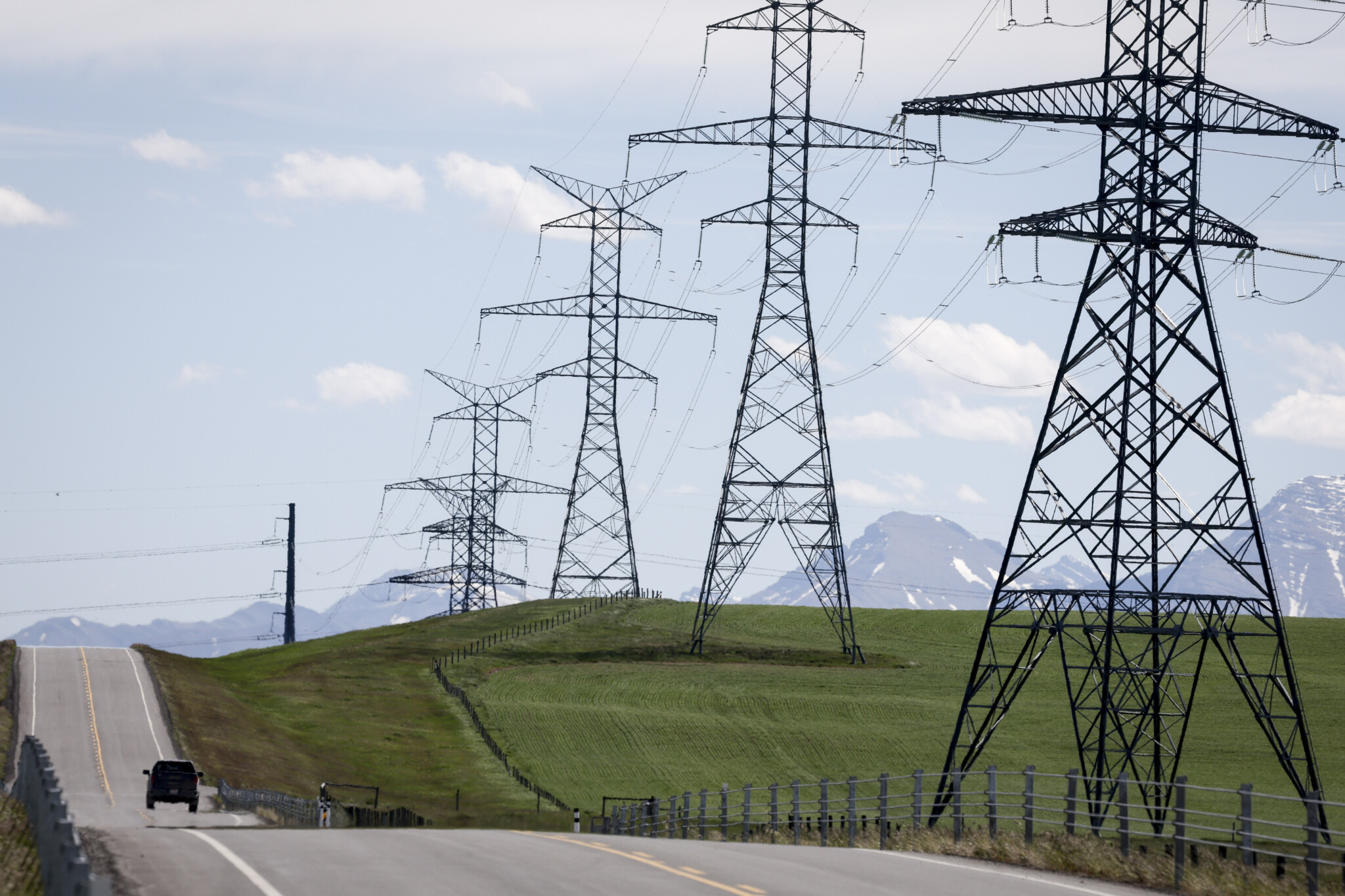
A transmission intertie is a long-distance, high-voltage line that links two provincial grids, enabling them to share electricity in real time, balance supply and demand, and support each other during peak periods or outages.
Such interties already exist between all the Western provinces, but most of them are either small, weak, or technically constrained.
The MOU envisions building on this patchwork to create a true chain of interties from B.C. through Saskatchewan, effectively asking the three provinces to hold hands across the Prairies and mountains to convert a set of isolated provincial systems into a coordinated regional grid.
The idea has its supporters, who believe such a connection could even extend through Manitoba.

Prime Minister Mark Carney takes a photo with BC Hydro workers after a major projects announcement at Skeena Substation in Terrace, B.C., on Thursday, November 13, 2025. Ethan Cairns/The Canadian Press.
It’s the subject of a recent report from the Van Horne Institute, a Calgary-based think tank focused on transportation, trade and infrastructure networks.
“Interties are good, and they’re good for cost,” said Scott Stoness, author of the report. “They’re good for reliability, and they’re really good for GHG-friendly generation.”
Stoness is a long-time energy executive with 40 years of experience across various utilities and pipeline companies, including BC Hydro, TransAlta, Enmax, and Trans Mountain. In the report, he makes an unequivocal case for why stronger Alberta-B.C. transmission connections would deliver major economic, reliability, and emissions advantages for both jurisdictions.
The report argues Alberta and B.C. have significant unrealized “synergies” in how they generate and share electricity.
For example, when B.C.’s reservoirs are stretched, Alberta can ramp up its flexible natural gas-fired units or take advantage of its wide-open plains, which are far better suited to large-scale wind and solar than B.C.’s mountainous terrain. And when Alberta needs a boost, it can draw from B.C.’s hydro, taking advantage of the one-hour time difference that effectively gives the two provinces staggered peaks.
And despite the regulatory differences between the two provinces—BC Hydro being a Crown-run utility versus Alberta’s deregulated electricity generation market—the challenge is largely physical.
Limits to existing B.C.-Alberta intertie
Currently, Alberta and B.C. are connected by a single high-voltage transmission line capable of moving 1,000 to 1,200 megawatts of power at any given moment—enough to power a million homes for a year.
On paper, that looks like a huge asset, but in practice, Alberta can only depend on a third of that capacity.
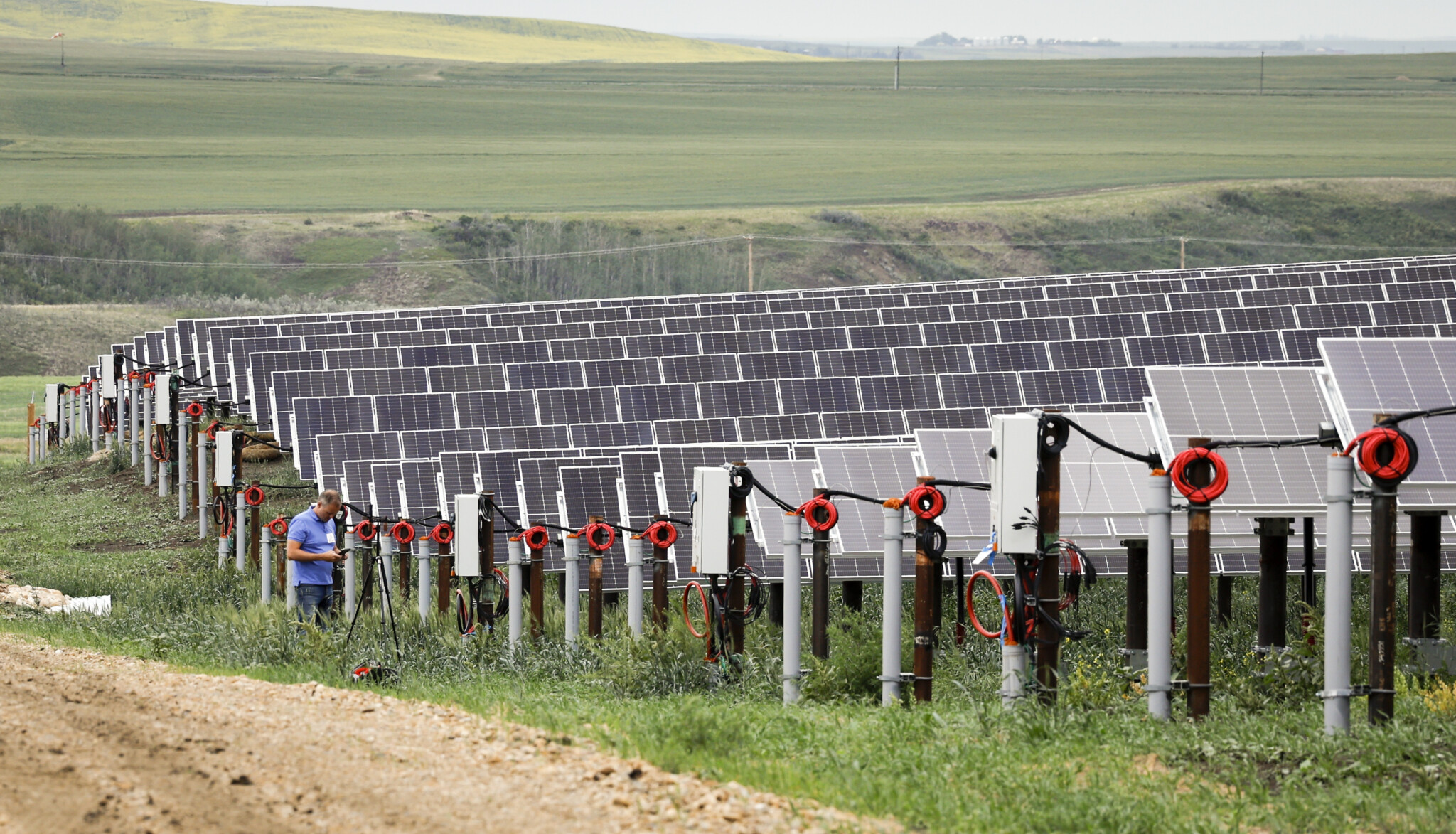
Solar panels pictured at the Michichi Solar project near Drumheller, Alta., Tuesday, July 11, 2023. Jeff McIntosh/The Canadian Press.
“Alberta can only bring in 400 megawatts on that line because going beyond 400 megawatts makes it the largest risk to the province,” Stoness said.
Any sudden outage—a lightning strike, equipment failure, or even a protection-system trip— would drop Alberta’s grid by more power than it can safely replace, forcing operators to cut load to prevent escalating outages.
“Then Alberta’s in a scramble and the lights can go out,” he told The Hub.
In other words, the current setup would become a “single point of failure,” where the entire interprovincial system is only as strong as the one line.
That constraint limits how much cheap, dispatchable hydro Alberta can safely import from B.C. It also limits how much Alberta can export when its wind and solar are producing surplus power.
“If you open up a second line, then you have a redundancy,” said Kent Fellows, an economist with the University of Calgary’s School of Public Policy.
View reader comments (12)
“And once you’ve got a redundancy, that actually makes you free to use more of what’s already there,” he said.
With a second intertie and a clear interprovincial agreement in place, Alberta would no longer need to maintain large amounts of fast-ramping backup generation just in case the line trips. It could instead lean on B.C.’s hydro reservoirs as the stabilizer of first resort—a near-instant, zero-carbon response mechanism that Alberta simply cannot build for itself.
B.C., too, gets something arguably more valuable than exports: time.
BC Hydro can slow or stop dam releases when Alberta’s wind and solar are strong, saving water for moments when prices spike or when the province’s own reservoirs run low. This effectively expands B.C.’s storage capacity without pouring a single cubic metre of concrete.
In short, the two provinces would be able to operate as a coordinated grid rather than two islands with a fragile umbilical cord.
“If you had more intertie capacity, you’re going to grow the size of the economic pie,” Fellows explained.

Economic benefits of a strengthened intertie
The economic benefits are threefold.
For households and businesses, a stronger intertie helps dampen price spikes and lower costs over time.
For the wider economy, it provides the dependable electricity supply needed to attract capital-intensive industries, from petrochemicals to AI.
And finally, it materially improves the region’s ability to reduce emissions naturally by easing the physical limits on how much hydro, wind, and solar each province can integrate into its system.
Politically, this is a remarkable part of the MOU, even though B.C. was not apparently in on its drafting.
The so-called “trilateral engagement” that the document calls for between Ottawa, Edmonton, and Victoria is likely easier to arrange on this front than a bitumen pipeline because the interests around electricity are more aligned between all parties.
Unlike pipelines, interties do not trigger B.C.’s coastal opposition, concerns about marine traffic, or the same level of land-use controversy.
Strengthening the tie to B.C. also does not restrict Alberta’s ability to build up natural gas (especially with the CER suspended), renewables, or any future behind-the-fence projects.
If anything, it expands the range of options available for everyone.
For Fellows, it’s the very definition of improving interprovincial trade.
“What you get is a more productive economy,” he said. “That’s true with electricity as well [because] we can do more with the resources we have right now.”
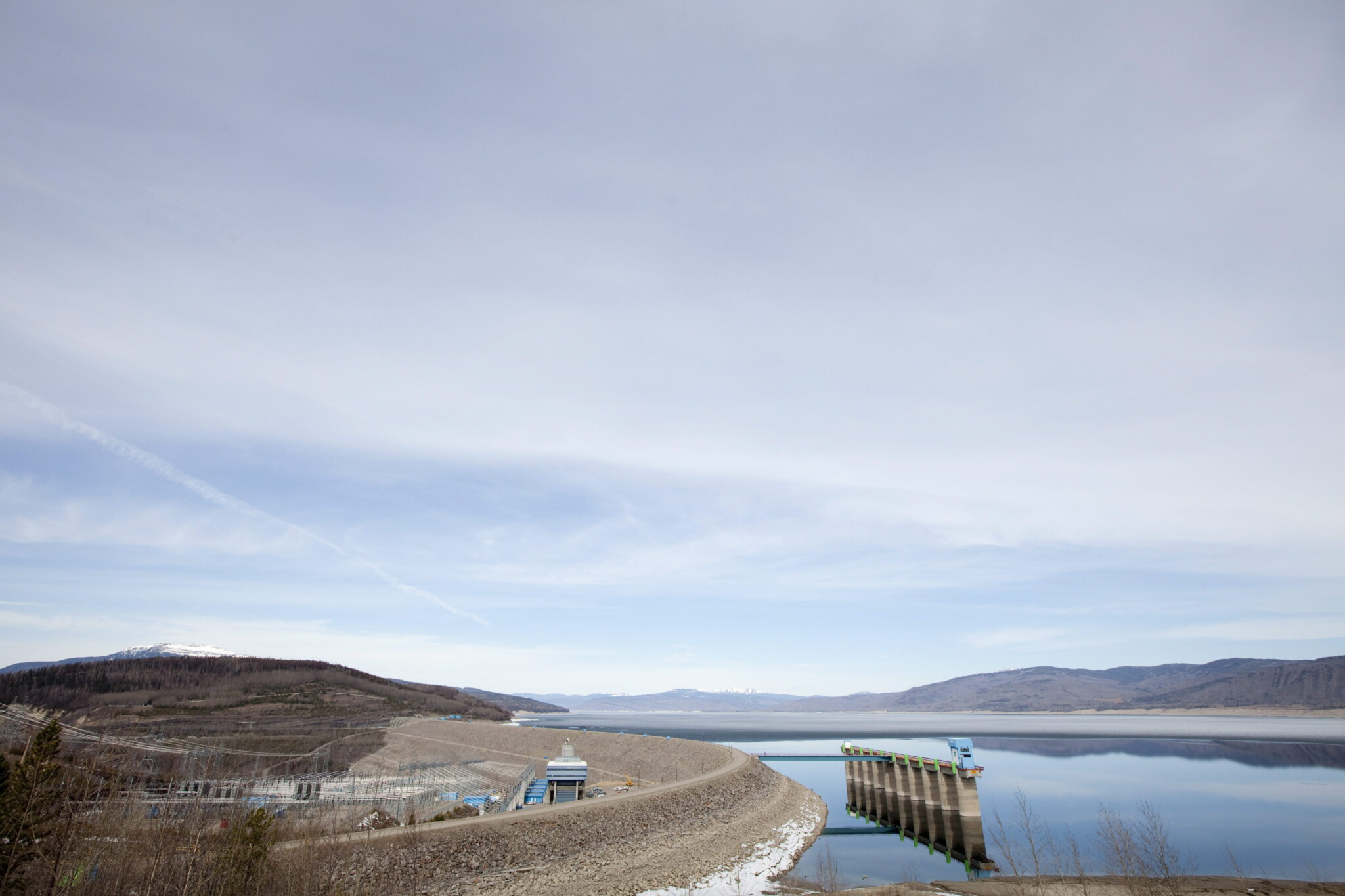
The W.A.C. Bennett Dam – named after former B.C. Premier Bill Bennett – is seen Monday, April 19, 2010 in Hudson’s Hope, B.C. Jonathan Hayward/The Canadian Press.
Familiar question: Who’s the proponent?
There is just one unresolved question.
Who would actually build this intertie system? The MOU doesn’t say.
Unlike the pipeline section of the document, the language around electricity does not even name Alberta as the temporary proponent. It contains no details about ownership, funding, or construction timelines.
“I think it’s difficult,” Stoness said, noting that without a proponent, it’s hard to produce a detailed cost estimate.
What is clear, though, is that it would run into the billions. Alberta already plans to spend roughly $750 million on upgrades and replacements for components of the existing intertie. Any new build would cost significantly more.
“Even when you build that line, the next day, a whole bunch of money doesn’t necessarily transfer to the person that owns the transmission line,” Stoness said.
The benefits of lower prices, better reliability, and improved competitiveness don’t necessarily result in a revenue stream large enough for any single transmission company to justify billions in capital spending.
The AESO’s own long-term transmission plan underscores this ambiguity. While Alberta has a detailed roadmap to restore the existing B.C. intertie from today’s constrained import limit back toward its engineered 1,200 megawatt capacity, the operator is far more tentative about a second line.
Prime candidate for C-5
“A lot of the goals here are public goals, not private goals,” Fellows said.
That mismatch is precisely why he argues that “the public sector and particularly governments really need to get moving and start motivating some conversations on this.”
Any line crossing a provincial boundary also triggers federal jurisdiction, adding a layer of oversight that private proponents are unlikely to navigate alone. For that reason, Fellows believes any such proposal would fit squarely within Ottawa’s new Major Projects Office mandate.
“I would think that this is… if not a prime candidate for a C-5 major project, definitely something industry and government should be looking at and taking seriously,” Fellows said.
In the end, transmission interties may not be the sexiest part of the MOU, but they check many of the boxes the Carney government has laid out for Canada to “build again.”
It also happens to be one of the few areas in energy where the strengths of Alberta and B.C. are complementary, making it a politically low-friction opportunity to bridge conventional and renewable power in the West that benefits individuals, businesses, and communities.
Editor’s note: This article has been updated to include additional context on the Clean Electricity Regulations and their revised timelines.

Falice Chin is The Hub’s Alberta Bureau Chief. She has worked as a reporter, editor, podcast producer, and newsroom leader across Canada…
Could a Western electricity superlink truly foster 'nation-building' without alienating B.C.?
What are the key economic benefits of strengthening the B.C.-Alberta electricity intertie?
Who should lead the construction of a new interprovincial electricity superlink, and why?







Comments (12)
Ms Chin, you continue to provide insightful and well written articles. Well done.