
Seven provinces in Canada rank lower than all of the United States for economic freedom according to the Fraser Institute’s newly released annual research report.
The study, Economic Freedom of North America 2025, found citizens in Manitoba (54th), Saskatchewan (55th), Quebec (56th), New Brunswick (57th), P.E.I. (58th), Nova Scotia (58th), and Newfoundland and Labrador (60th) all fall short of the economic freedom of those living in every U.S. jurisdiction on the index, according to the most current data from 2023.
The study examined government policies that affected economic freedom from all three tiers of government to determine which jurisdictions in North America laid the most fertile ground for their people to prosper by “permit[ing] their citizens to make their own economic choices.” This meant tracking 10 variables, including income taxes, government spending, labour market regulations, and property rights.
“What we find is that those places with greater levels of economic freedom do have higher per capita GDP. They do have higher income, they grow faster,” Fraser Institute senior fellow and one of the study’s authors, Matthew D. Mitchell, told The Hub. “They have lower poverty rates. They have actually longer lifespans and lower infant mortality and greater levels of self-reported happiness.”
Canada had a few provinces that showed more promise for individual economic freedoms. Alberta (30th), tied with West Virginia and beat out 21 states, including New Jersey (35th), Ohio (37th), Arizona (40th), and California (44th).
Meanwhile, B.C. (47th) and Ontario (49th) tied with New York and ranked higher than a few states: Delaware (51st), Hawaii (52nd), and New Mexico (53rd).
New Hampshire topped the list for most economic freedom in all of North America (including the U.S., Canada, and Mexico). Other notable states high up in the charts were South Dakota and Idaho, tied for second, South Carolina (4th), Florida (6th), Tennessee (9th), and Texas (11th).
Researchers found the average personal incomes in the freest states climbed nine times faster than in the most economically limiting jurisdictions in North America. Meanwhile, the top 25 percent of the most economically free U.S. states’ citizens make an average of 19 times more than the least free Mexican states.
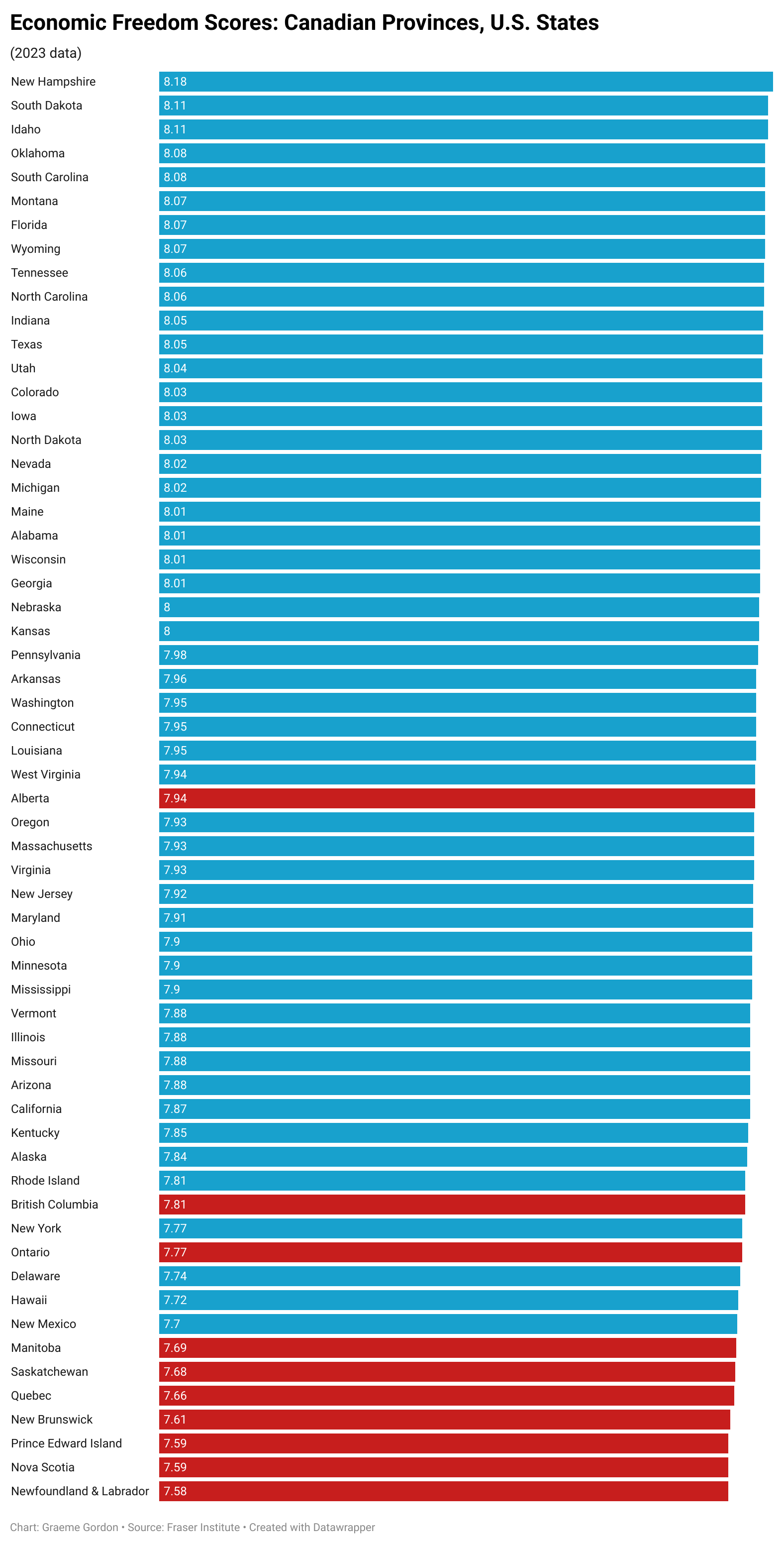
Although Alberta ranks as our most economically free province, it precipitously dropped from a previous height of tying with Florida for second in 2014. It slipped three rungs from its 27th ranking last year. In 2009, it ranked first.
The latest report attributes Alberta’s ascendancy at the end of the first decade of the new millennium as the result of the pro-market reforms of the Ralph Klein government in the 1990s, including “substantial spending cuts, deregulation, privatization, and tax reform,” leading to major “improvements in income mobility.”
“Alberta remains the economically freest province in Canada. But it seems to be increasingly falling behind U.S. states, primarily driven by the labour market regulation and taxing freedom,” Mitchell said.
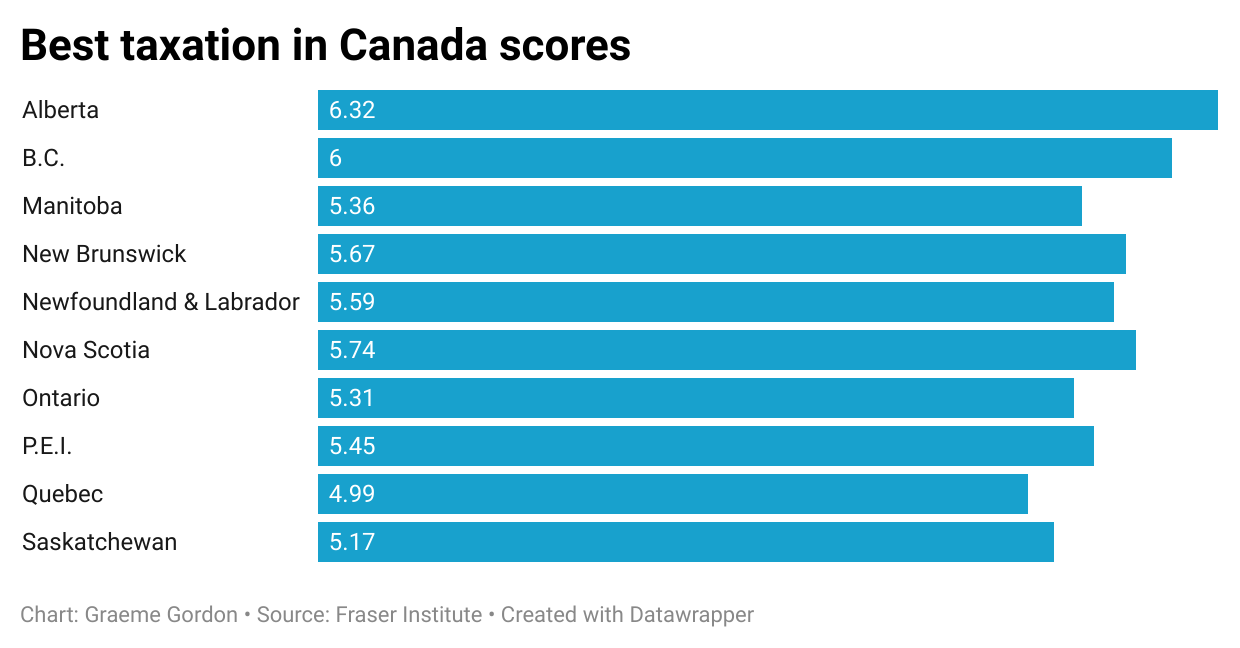
Alberta’s more recent provincial governments have repeatedly run multi-billion dollar deficits, as well as property tax increases, and provincial income tax de-indexation (re-indexed in 2023, but not fully), which critics described as a stealth tax that drew hundreds of millions more from the Albertan taxpayers. These all factor against Alberta’s falling economic freedom ranking. In spite of the recent drop, Alberta still ranks above all other provinces for being the most economically free when it comes to taxation (municipally and provincially), government spending, and labour market regulations of its residents.
The researchers of the report calculated that the attraction of the most economically free states had a correlated average population growth rate 18 times higher than the least free.
This year, Alberta registered the highest net interprovincial migration gain of all provinces, likely a result of its more economically free policies. The wild rose province’s population jumped from 4.39 million people at the start of 2020 to 5.03 million by July 2025.
All 10 Canadian provinces ranked above every one of Mexico’s 31 states, where Ciudad de México (93rd) ranked last, followed by Colima and Campeche.

Graeme Gordon is The Hub's Senior Editor and Podcast Producer. He has worked as a journalist contributing to a variety of publications, including CBC,…
Why do some Canadian provinces lag behind all U.S. states in economic freedom, and what are the implications?
Alberta's economic freedom ranking has declined. What factors are contributing to this, and what does it mean for the province?
The study links economic freedom to higher per capita GDP and population growth. How might this influence future policy decisions in Canada?





Comments (0)