
For the first time in history, the average male Canadian senior now makes more than the average young Canadian man.
The average Canadian man between 25-34 earned an average of $61,200 in 2023, while the average Canadian man 65 and over made $61,600.
This is despite many of the older generation being retired, according to new research conducted by Mike Moffatt, Missing Middle Initiative founding director and Hub contributor.
“Young men have not received a raise in about 25 years. They earn after inflation about what they did back in say 1988, or 1998, or 1999,” Moffatt said on a Hub Hit podcast.
Compared to 1976, men between 25-34 experienced an average decrease of $8,300 in income (after inflation), while the young man’s median income plummeted even further, dropping by $14,300.
In contrast, the average older Canadian man is financially thriving as his yearly earnings have expanded by an average of $26,000 in additional income (inflation-adjusted), due in no small part to growing pensions, generous OAS (Old Age Security), and larger investment incomes. The 65-plus Canadian man’s average income has also been boosted because many older men now work into their late sixties or even into their seventies, while saving more. The median income for a Canadian man over 64 rose by $23,100.
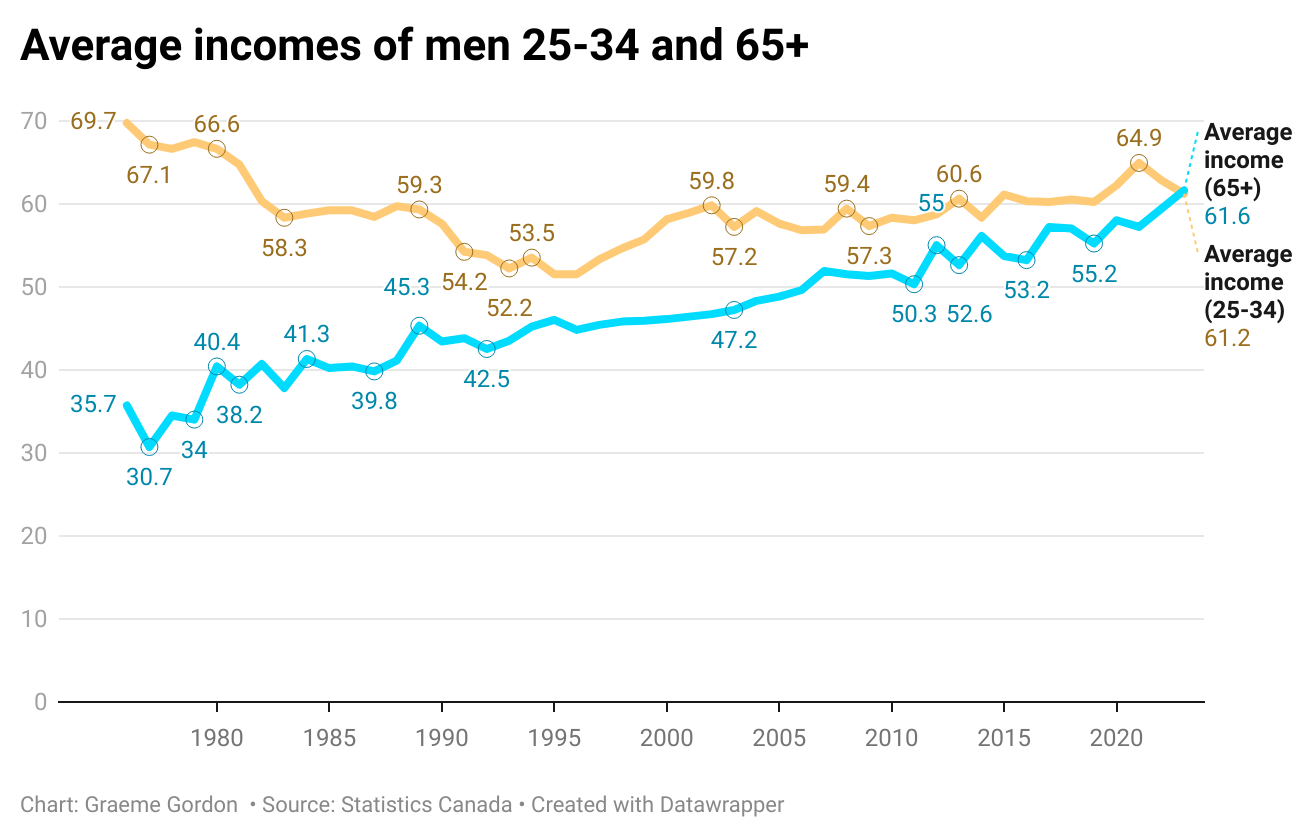
“I had known that things had been challenging for young men, and I had known that economic outcomes for senior men had been better,” Moffatt said. “But what had surprised me was the convergence that in 2023, the last year we have data for, for the first time in Canadian history, male seniors earn more on average than men between the ages of 25 and 34. And that had never happened before.”
Back in 1976, as far back as the Statistics Canada data used in this research goes, men between the ages of 25-34 made, on average, more than double that of their 65-plus counterparts.
While earnings for younger Canadians have stagnated and declined in the last 50 years on average, older Canadians gained an average of $6,400 more in employment income, and their investment/retirement income more than doubled, jumping up an additional $17,600 (after inflation) than in 1976.
Government transfers for senior men also doubled; income coming from OAS, Guaranteed Income Supplement (GIS), social assistance, and the Canada Pension Plan (CPP) provided the average 65-plus Canadian male senior an additional $7,000 more in income in 2023, compared to 1976.
On the other hand, young Canadian men did not see their demographic bracket’s average income from government transfers go up at all, only rising $6 after inflation in the past 50 years.
Their investment income did go up on average, but only by $750, or 4.3 percent, of the amount 65-plus men realized. Young men rely on their employment income for 90 percent of their overall income on average.
The Missing Middle Initiative research also found that the proportion of men earning employment income decreased for every age group from 1976 to 2003, except for Canadian male seniors who increased their participation in the workforce by several percentage points.
A tough job market for Canadian youth, especially young men
Moffatt believes the current job market is tough for young men, and women, due to increased competition and many staying in school longer, stunting their overall earning potential.
“So they’re already kind of at a disadvantage that they’re losing years’ worth of earning potential. And then once they’ve graduated…it’s taking a long time to get something full-time,” Moffatt said. “You got a lot of folks in the gig economy working kind of multiple precarious jobs. Starting your career in your early 20s, you’re going to earn a lot more money and climb further up the ladder than if you’re starting at say 33 or 34.”
The Missing Middle Initiative’s team research did not include home equity, which only adds to the stark disparity between the younger and older male generations’ average wealth.
According to Darrell Bricker, the CEO of Ipsos Public Affairs, a record of nearly 40 percent of Canadians aged 20 to 34 still live with their parents. In Toronto, the number climbs to 47 percent.
Meanwhile, he found that 65-plus Canadians hold a median net worth of above $1 million, while 34-and-under Canadians have a median net worth of only $48,000.
There are a multitude of contributing factors for why Canadian young men, as well as American young men, are not earning more than in the past.
“There’s just been a huge deindustrialization, of course, a big decline in manufacturing jobs, other traditionally male jobs and heavy industries, and so on,” Richard Reeves, president of the American Institute for Boys and Men, told The Hub’s Sean Speer. “Obviously, increased competition from free trade…Those have disproportionately really impacted the male professions and male occupations and just had a disproportionate effect on men.”
In his book Of Boys and Men: Why the Modern Male Is Struggling, Why It Matters, and What to Do about It, he details a deepening malaise afflicting modern males. Economists are tracking drops in male participation in the labour force. Teachers and professors are seeing girls outperform boys in a growing number of subjects at school. Mental health experts are recording that men are far more likely to feel socially excluded than their female counterparts. Public health officials are watching men become three times more likely than women to take their own lives through “deaths of despair”—suicide and addiction.
Some politicians have taken notice of the plight of young men and boys. Conservative MP Jamil Jivani has been advocating for male youth for the better part of a decade, including writing a book back in 2018 entitled Why Young Men: Rage, Race and the Crisis Identity.
“We see a lot of reason to believe that young men across this country are not getting the attention they deserve from policymakers,” Jivani said in a recent Hub interview, kicking off his national campus tour on the subject. “And we also see that these problems have a ripple effect on everybody.”

Graeme Gordon is The Hub's Senior Editor and Podcast Producer. He has worked as a journalist contributing to a variety of publications, including CBC,…
Why are older Canadian men now earning more than younger men?
What are the key economic factors contributing to this income disparity?
What are the broader societal implications of this trend?







Comments (2)
No. Why would anyone work for low wages and be loyal to a company that will lay them off with no notice, or export their jobs to the lowest bidder in China?