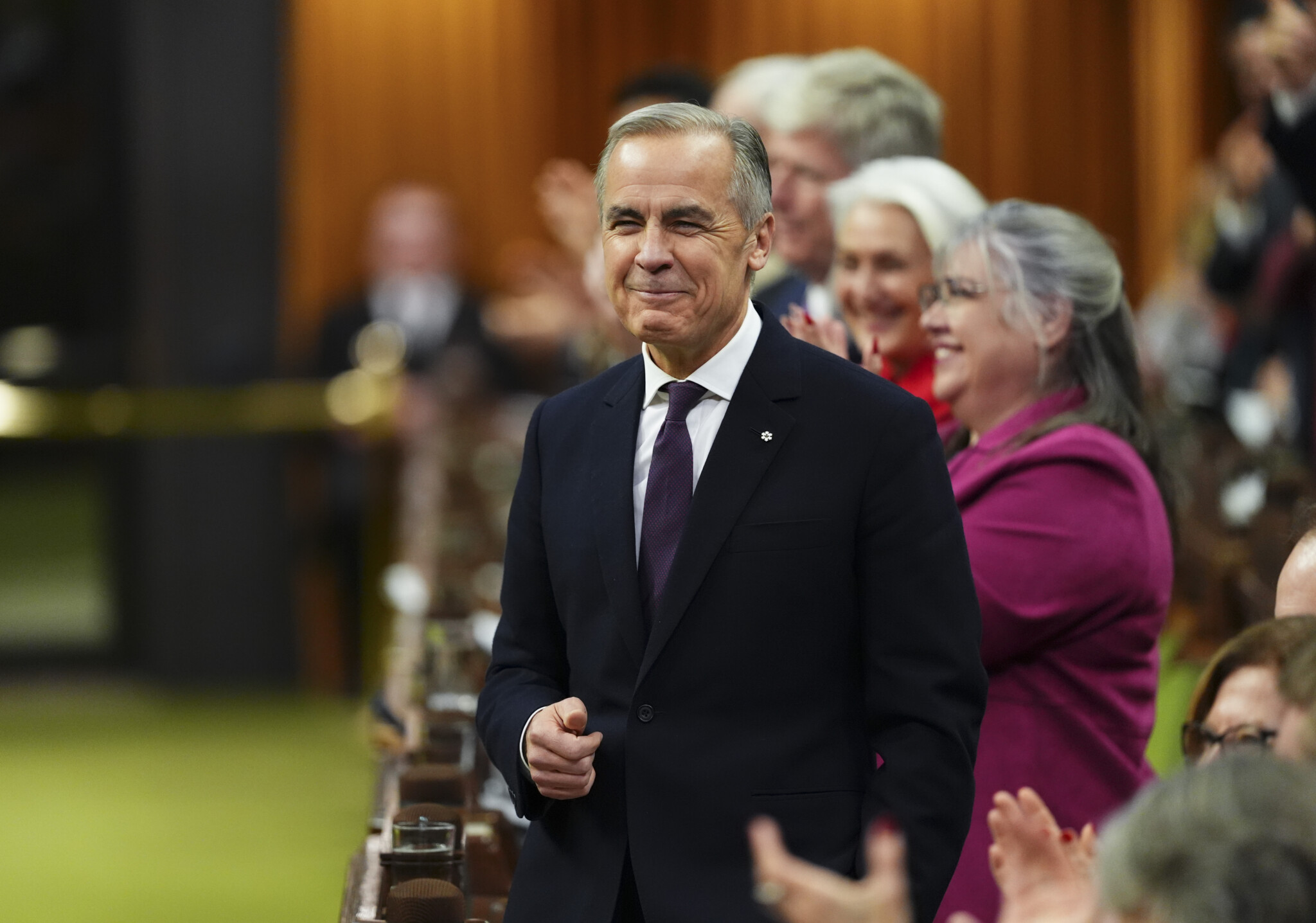
The Liberal government inched to just one seat shy of a majority government Thursday, after Conservative MP Michael Ma crossed the floor just hours after attending the Tory’s Christmas party the evening before. Ma is the second Conservative defector in a little over a month, dealing another blow to Conservative Leader Pierre Poilievre in the leadup to his leadership review late next month.
Ma, who represents Markham-Unionville in the Greater Toronto Area, announced his decision hours before being paraded in front of hundreds of Liberals at their holiday party. In a statement released Thursday evening, the rookie MP said he made the decision after listening to his constituents and reflecting with his family on the direction of the country.
“This is a time for unity and decisive action for Canada’s future,” Ma wrote in a statement. “In that spirit, I have concluded that Prime Minister Mark Carney is offering the steady, practical approach we need to deliver on the priorities I hear every day.”
Carney’s early Christmas gift
“So let’s give a warm welcome to our newest member of the Liberal Party, Michael Ma,” an elated Prime Minister Carney told the crowd at the Liberal caucus holiday party on Thursday night, then inviting Ma to the stage and welcoming him to the fold.
The prime minister then thanked fellow floor-crosser Chris d’Entremont, who won his seat in the 2025 election as a Conservative candidate in the riding of Acadie-Annapolis, only to leave his party during the release of Carney’s first budget in early November.
Back then, political observers were speculating the Liberal government could fall, causing a snap election, because of the minority government potentially not having enough opposition votes to pass the budget.
However, Carney’s Liberals were able to avoid a non-confidence vote in part due to d’Entremont joining their ranks, as well as Conservative MP Matt Jeneroux suddenly announcing his resignation from politics—with some speculating he was intending to also join the Liberals—and then being absent from the House for the vote.
Michael Ma at the Conservative Christmas Party last night with Pierre Poilievre. pic.twitter.com/P0ovqX65LP
— Brian Lilley (@brianlilley) December 12, 2025
Poilievre responds to the defection and receives major endorsement for review
Poilievere did not delay responding to the betrayal of one of his caucus members this time around, calling Ma out on social media for jumping ship.
“Michael Ma was elected as a Conservative by the constituents of Markham-Unionville to fight against Liberal inflationary spending driving up the cost of living in his community. Today, he chose to endorse the very policies he was elected to oppose,” Poilievre wrote on X. “The people he let down the most are the ones who elected him to fight for an affordable future. He will have to answer to them.”
Despite the defections and confidential sources within the Conservative Party of Canada suggesting to journalists that parts of caucus are not fully behind Poilievre due to poor unfavourability numbers and leadership style, the Conservative leader just received a strong endorsement from Alberta Premier Danielle Smith in the stronghold province.
Poilievre faces a crucial test on January 29th and 30th, when he will undergo a mandatory leadership review with party members voting on whether to keep him as leader.
How the Liberals get enough seats for a majority government
Edmonton MP Matt Jeneroux formally resigning next spring means there will be a byelection to replace him in the New Year, where a potential majority government hangs in the balance.
The Liberals won 169 seats in the spring 2025 federal election, and since adding d’Entremont and Ma are now just one seat away from a coveted majority government.
Although the Liberals probability of winning Jeneroux’s open seat are not great, the Liberal runnerup in the Alberta riding of Edmonton Riverbend lost it by only 5.5 percent, raising Liberal support by nearly 20 percent from the 2021 election.
Besides a shocking upset in the Edmonton Riverbend byelection, the Liberals best chance of securing a majority is enticing another opposition MP, who won a slim victory against a Liberal opponent.
Both d’Entremont and Ma won their seats by slim margins in ridings that were previously held by Liberal MPs, potentially improving their chances if they run as Grits in the next election.
Whether or not the Liberals convince another MP to cross the floor, the government could soon temporarily hold a functional majority (a de facto majority in the House despite not having a true majority of seats). The House missing two opposition MPs would translate to the Liberals only needing their current 171 MPs in order to pass legislation and survive non-confidence motions.
With Jeneroux already absent from the House, and now B.C. Conservative MP Aaron Gunn expressing interesting in potentially resigning his seat to run for the recently-vacated leadership of the provincial Conservative party in B.C., then two opposition MP’s seats would be vacated, giving the Liberals a functional majority.
An early 2026 election isn’t impossible
Even if the Liberals reach 172 seats, they could be vulnerable if polls go south for Carney’s government.
In recent polls, the Liberals and Conservatives have been neck and neck. As the economy continues to largely stagnate with the continued uncertainty of a renewed trade deal with the U.S., and the possibility of a looming recession, Carney still faces political headwinds that could result in some caucus defections of his own.
On Friday, Bloc Québécois leader Yves-François Blanchet said he believes a spring 2026 election is still a real possibility.
“I wouldn’t go so far as to say [very likely], but surviving the spring will be a big challenge for the Liberals,” Blanchet told reporters.
Last election, the Bloc Québécois lost a Montreal riding by single vote to the Liberal candidate, where mail-in ballots were defective. The Bloc Québécois candidate who lost in Terrebonne is now challenging the election result by appealing to the Supreme Court for a new election, potentially putting one Liberal-won seat into question.
The Liberal Party also won some ridings by very slim margins and is currently facing dissatisfaction within its environmental ranks after Carney signed a deal with Premier Smith for a new pipeline to the B.C. coastline. The decision saw long-time Liberal cabinet minister Steven Guilbeault resign his post in protest, but stay in caucus.
A potentially strengthened NDP, whose membership will choose its new leader in March 2026, could court some disaffected Liberal MPs unhappy with the Liberals’ more oil-friendly stance.
Finally, the Liberals cannot count on Green Party leader Elizabeth May’s vote again to help them in another tight vote. She recently expressed deep regret for supporting the Liberals’ budget.
“I kept my word and I voted for confidence in this government,” May told reporters. “I will not make that mistake again.”

Graeme Gordon is The Hub's Senior Editor and Podcast Producer. He has worked as a journalist contributing to a variety of publications, including CBC,…
What does Michael Ma's defection mean for the Liberal government's path to a majority?
How might Pierre Poilievre's leadership review be impacted by these defections?
Beyond seat numbers, what other factors could lead to an early election for the Liberals?






Comments (4)
Not to mention Ms. Freeland – who’s seat in the House and presence in this country we will blessedly be relieved of in 2026.