
Go west, young Canadian. That’s the message of opportunity many Canadian youth and immigrants are heeding as the province of Alberta continued to grow its population from emigration in the third quarter of 2025. Meanwhile, everywhere else in Canada, except Nunavut, experienced declining populations over that same period.
Alberta is projected to have gained an additional 11,525 people through the months of July, August, and September of 2025, bringing the wild rose province’s total population to 5,040,871 people, per Statistics Canada’s latest population estimates. The province is projected to have grown by 1.1 percent, or 52,690 people, over the first three quarters of 2025, surpassing a population of five million near the start of this year.
As the fourth-most populous province, Alberta continues to attract young people due to its comparatively stronger economy—buoyed in no small part by oil prices staying high from increased global energy demands.
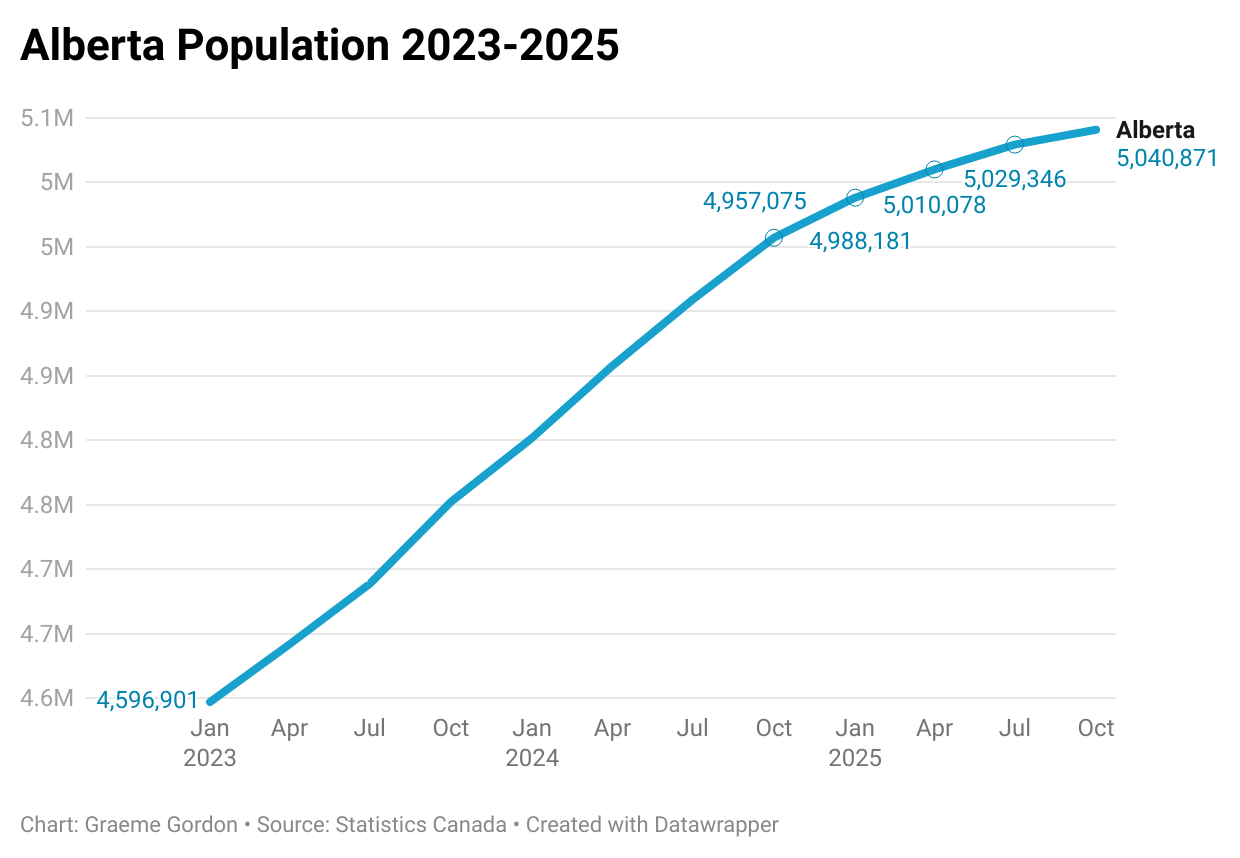
Meanwhile, the other nine provinces and two of the three territories are seeing their populations decline for the first time since the height of the pandemic in the second quarter of 2020 (before Canada’s population boom began in 2022 to 2024).
In contrast to Alberta growing its population at the end of 2025, Ontario lost 66,888 people, or 0.4 percent of its population, in the third quarter. The province is suffering from an anemic manufacturing sector, primarily in automotive.
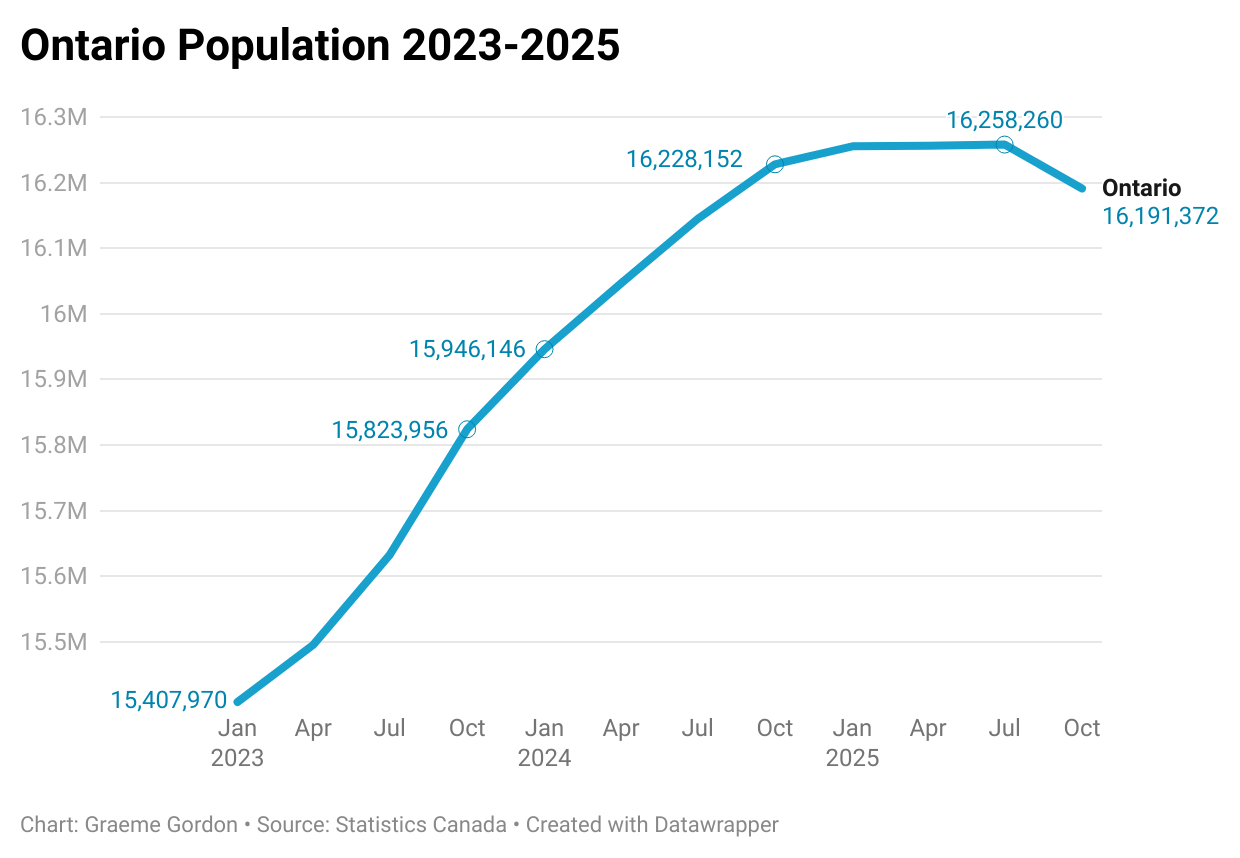
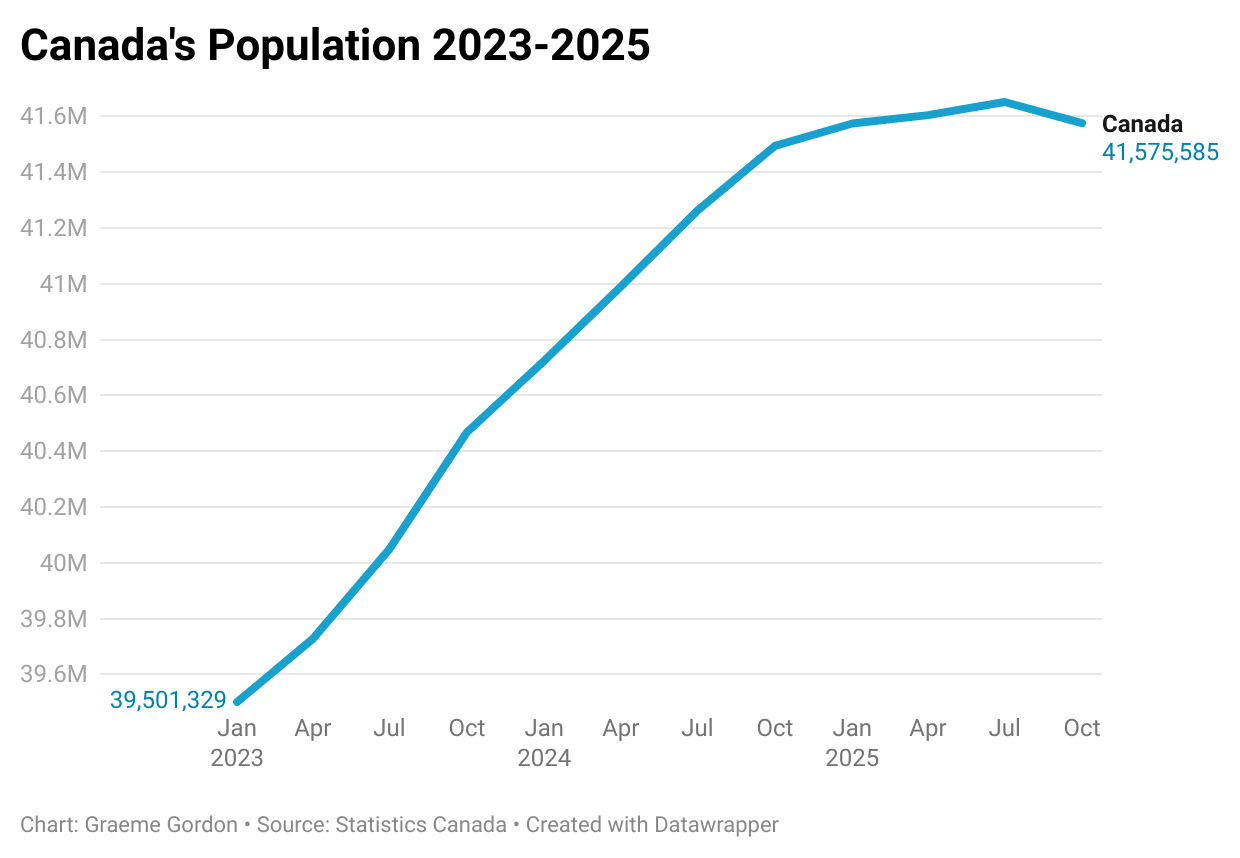
The national population is projected to have dropped by 0.2 percent in the third quarter compared to the second quarter. However, Canada’s population is still projected to have grown by 1,068 this year in the first three quarters compared to the end of 2024.
The slight dip in population in the third quarter of 2025 was largely the result of policies implemented during the tail end of then-prime minister Justin Trudeau’s last government. The policy shift was made to curtail the ballooning temporary immigration numbers fueled by foreign students and workers within Canada.
Trudeau announced the federal government would aim to reduce Canada’s population by 0.2 percent annually in 2025 and 2026 and drop temporary residents to 5 percent of the population from the peak of 7.6 percent. So far, by the third quarter of 2025, the temporary resident population has been reduced to 6.8 percent of Canada’s overall population.
Currently, projections show that Canada’s population reduction target for 2025 will be missed.
Last month, Prime Minister Mark Carney announced his government would be further reducing the number of temporary residents over the next three years.
Alberta continues to grow as other provinces lose citizens
Alberta, the economy, largely propping up Canada as it suffers stagnant GDP growth, continues to attract young Canadians and new immigrants looking for greener pastures from other provinces hardest hit by the tariffs of the trade war with the U.S.
“Alberta is doing much better than almost every other province in the nation except Saskatchewan. Its employment is up almost 2 percent year over year, and yet unemployment in Alberta has risen in the past year. That’s because people are pouring into Alberta,” Philip Cross, former Statistics Canada chief economist and Fraser Institute senior fellow, told The Hub.

“[Emigration to Alberta] reflects these social variables that economists don’t fully understand, like population growth,” Cross said. “And it may just be that words spread quickly, particularly to new arrivals and young people that you don’t bother stopping in Toronto looking for a job, [and] just keep going right out to Alberta because that’s your best chance at finding one.”
Cross notes that for decades, Alberta has had a younger population that’s grown faster than the other provinces.
The rest of Canada’s population declines at the end of 2025
Canada’s natural increase (births minus deaths) turned negative in the first quarter of 2025, meaning 5,628 more people died than were born. However, the population of Canada still increased by 30,038 people due to new immigration.
By the third quarter, the main contribution to the drop in the national population was non-permanent residents by 176,479, the largest decrease since at least the third quarter of 1971, when comparable records started.
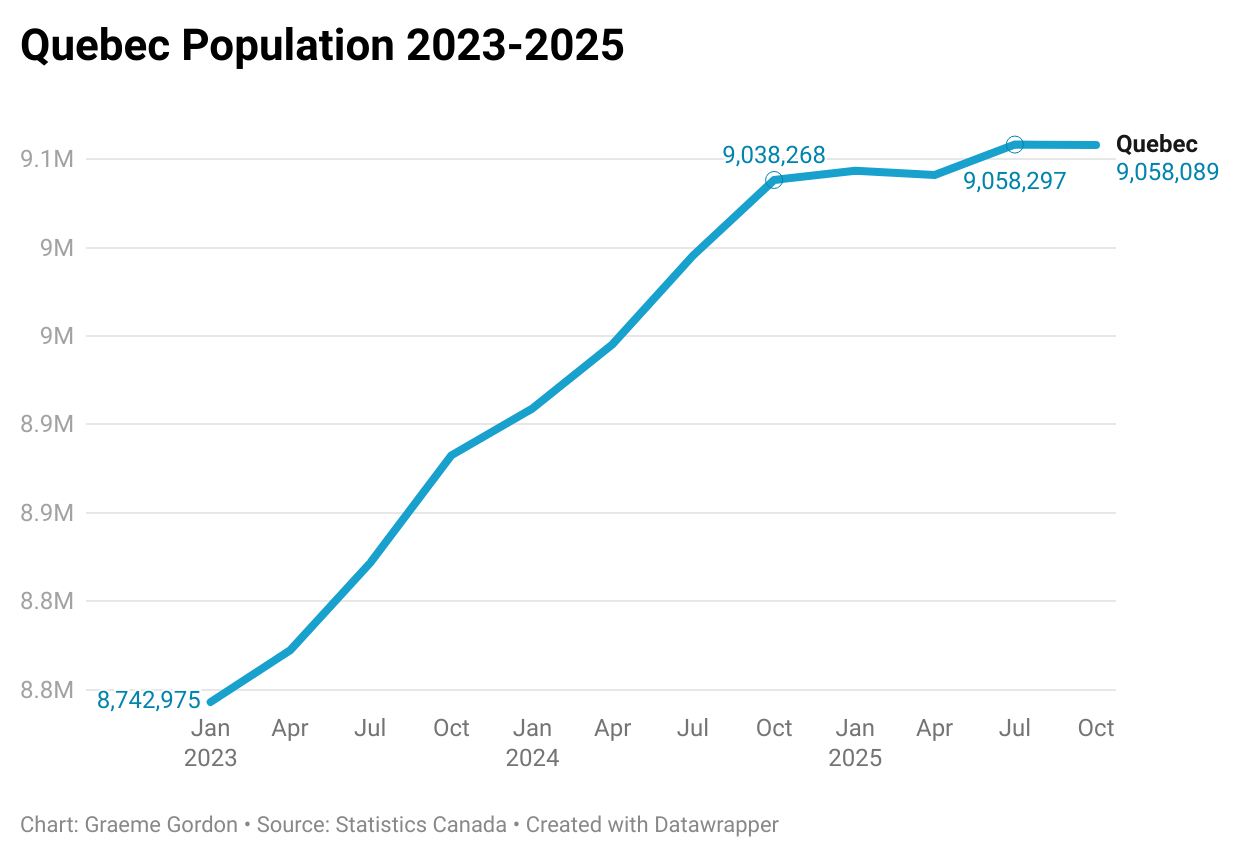
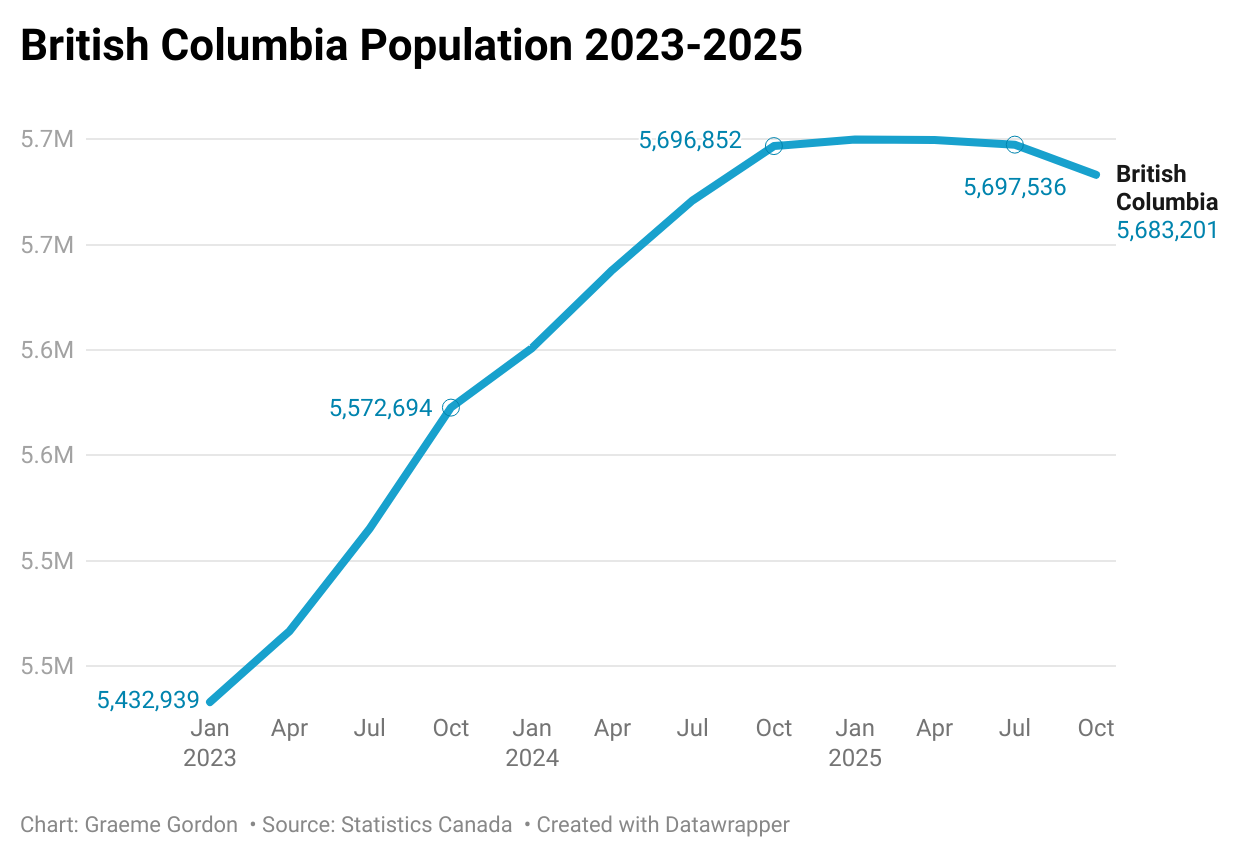
Beyond Ontario, B.C. lost the largest proportion of its residents. The West Coast province lost 14,335 of its population or 0.25 percent. Next came Manitoba and the Northwest Territories, shedding nearly 0.2 percent each. The Yukon, Saskatchewan, Quebec, New Brunswick, P.E.I., Nova Scotia, and Newfoundland all had even more marginal drops in their populations.
Statistics Canada’s “population clock” now estimates the birth rate is equivalent to the death rate, with an estimated birth happening every minute and 26 seconds compared to a death occurring on average every minute and 27 seconds.
Canada’s fertility rate has been on a downward trend in recent years, and now sits in the lowest of low nations. Making up some of the shortfall in the fertility rate has been foreign-born mothers having children, who registered 42.3 percent of births in Canada in 2024.
With a nearly flatlined natural increase in population, Canada will continue to rely almost solely on immigration for any net population growth.

Graeme Gordon is The Hub's Senior Editor and Podcast Producer. He has worked as a journalist contributing to a variety of publications, including CBC,…
Alberta's population boom contrasts with other provinces. What economic factors are driving this migration?
Federal policies aimed to curb temporary immigration. How effective have these been, and what's the current trend?
With natural population increase turning negative, how will Canada sustain population growth?







Comments (2)
Do our politicians even talk about boosting fertility? It seems they have given up. Immigration helps, obviously, but Lyman Stone has done surveys and many Canadians are not having as many children as they want to have. This not about forcing women to have kids they don’t want or bringing back the 1950s. But most families in Canada want 2 kids, but many provinces (if not all) have averages closer to 1 child than to 2. Housing, child care, career choices and career dynamics, the list goes on reducing TFR. We should have public policy that encourages (or stops discouraging) family formation and having children.