
Every kid knows that if they don’t make Santa’s “nice” list, they’ll end up with a lump of coal in their stocking. None of them wants that.
That feeling about coal is widely shared. While some still call it beautiful and clean, most see coal as old and dirty: a high-emitting source of power in a world with cheaper and cleaner alternatives.
Over the past decade, Canada has largely moved away from coal-fired power. Provinces that historically relied on coal have phased it out or have a plan to do so. Just last year, Alberta shut down its last coal plant, years ahead of government targets, saving an estimated 234 million tonnes of carbon emissions by 2030.
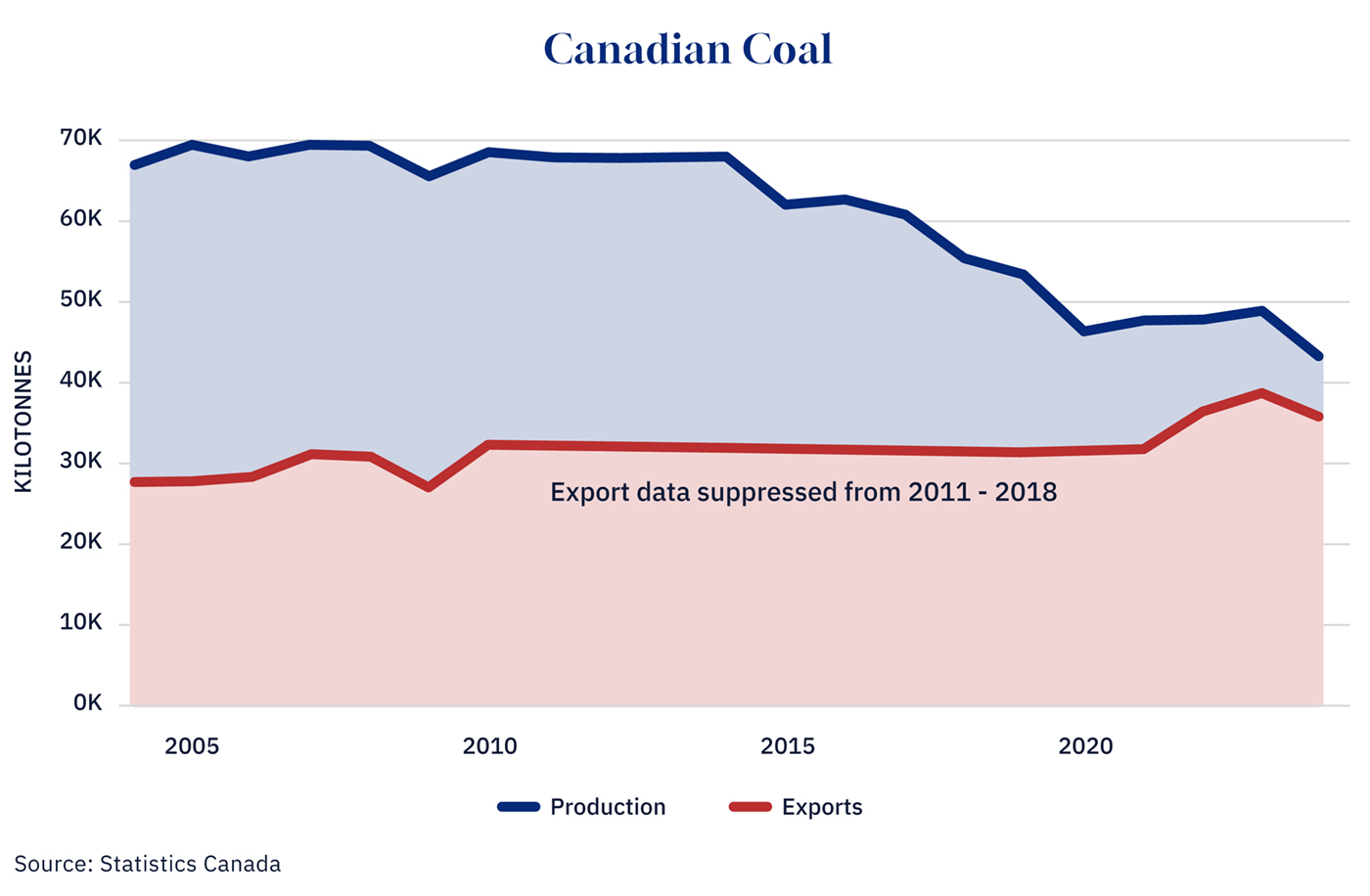
But while domestic coal use has dropped to almost nothing, global demand has modestly grown over the same period. And when it comes to production and export, Canada remains a major player, ranking as the sixth-largest coal exporter worldwide.
Graphic credit: Janice Nelson
Assuming no massive increase in children on the naughty list, why does coal—a resource thought to be on its way to irrelevance in the early 1900s—remain in demand? One reason is electricity generation. Global demand has grown faster than cleaner sources can be built, and coal remains a reliable, albeit dirty, backstop to hydro, wind, and solar. China—the largest consumer—still relies on coal for over half of its electricity generation.
The other reason is steel. Steelmaking requires a specific type of coal, known as coking or metallurgical coal, and demand for this input remains high, particularly in fast-growing Asian economies. While green steel technologies exist, they are costly and there aren’t many such facilities around. That plays to Canada’s strengths: a large share of its coal is suitable for steelmaking. Over the past decade, Canada’s coal production has increasingly shifted toward the metallurgical variety, which now accounts for 67 percent of its coal production.

And while it may not be a coveted stocking stuffer, coal still pays the bills for many Canadians. It is a top-15 export product, generating billions of dollars in revenue and ranking above canola seeds, fertilizer, and uranium. It’s particularly important to British Columbia, where it accounts for 15 percent of total exports, and to a lesser extent, Alberta, where export revenues exceed $1 billion.
Coal may no longer be the dominant fuel it once was, and, eventually, demand will decline in favour of cleaner and better alternatives. But for now, it still matters more than most realize. Canadian coal keeps global steel production moving and brings real economic value back home. It may not be cherished at Christmas, but it remains an important part of Canada’s economy.
A version of this post was originally published by the Business Council of Alberta. To learn more, read the commentary here.

Alicia Planincic is the Director of Policy & Economics at the Business Council of Alberta. She regularly provides insight and analysis on…
Given Canada's domestic coal phase-out, how can it balance its role as a major global coal exporter?
Why does global demand for coal persist despite cleaner energy alternatives?
What economic impact does coal still have on Canada, despite its declining domestic use?







Comments (2)
I got a lump of coal for Christmas once from my exwife. I put it in the wood stove.