Polish off your crystal balls, consult the stars, call up the scryer in your life—2025 is creeping to a close, and it’s time to turn our attention to what’s to come in 2026. But if the future still feels fuzzy, don’t panic: The Hub has you covered. Once again, our best prognosticators are here to provide some foolproof predictions for the headlines and happenings ahead.
Long live great power competition
As we enter 2026, the short-lived age of great power competition may be ending for America.
America simply appears to be losing the political will and material heft necessary to compete with an ascendant China and a revanchist Russia. Recent events magnify this reality. Despite the Trump administration’s newly released National Security Strategy (NSS) trying to talk a good competition game, America’s actions signal otherwise.
Start with China. The NSS deploys strong rhetoric on strategic competition, technology leadership, and the importance of maintaining American advantages. Yet within days, the administration moved to allow Nvidia to resume shipments of advanced AI chips to China.
This is not “competition” as the term has been used for the past decade. Rather, it’s an admission that, in a domain central to future economic and military power, America is prepared to trade leverage for short-term commercial and political convenience.

Now Russia. The NSS insists the United States will deter aggression and protect the sovereignty of threatened democracies. Yet, the administration’s push to “end the war” in Ukraine increasingly looks like a process of laundering Moscow’s preferred end state through an American negotiating channel.
More examples abound; we have thus entered an age of great-power capitulation, where America seemingly no longer sees it in its self-interest to compete with other great-power adversaries.
That this is where American foreign policy has ended up is not entirely unforeseeable.
Back in February, The Hub’s editor-at-large Sean Speer and I read the early tea leaves of the Trump administration to see that America was embracing, and even accelerating, its relative decline.
It’s thus not surprising that the U.S. is seemingly losing its will to compete. But 2026 will be the year when this reality becomes starker.
To compete with great power rivals requires conscious effort. It requires the willpower to often bear disproportionate costs to build alliance systems and institutions that have historically offered America disproportionate benefits.
Instead, the Trump approach is to alienate and abuse long-standing American allies, while exiting institutions, thereby losing its voice to advance American interests.
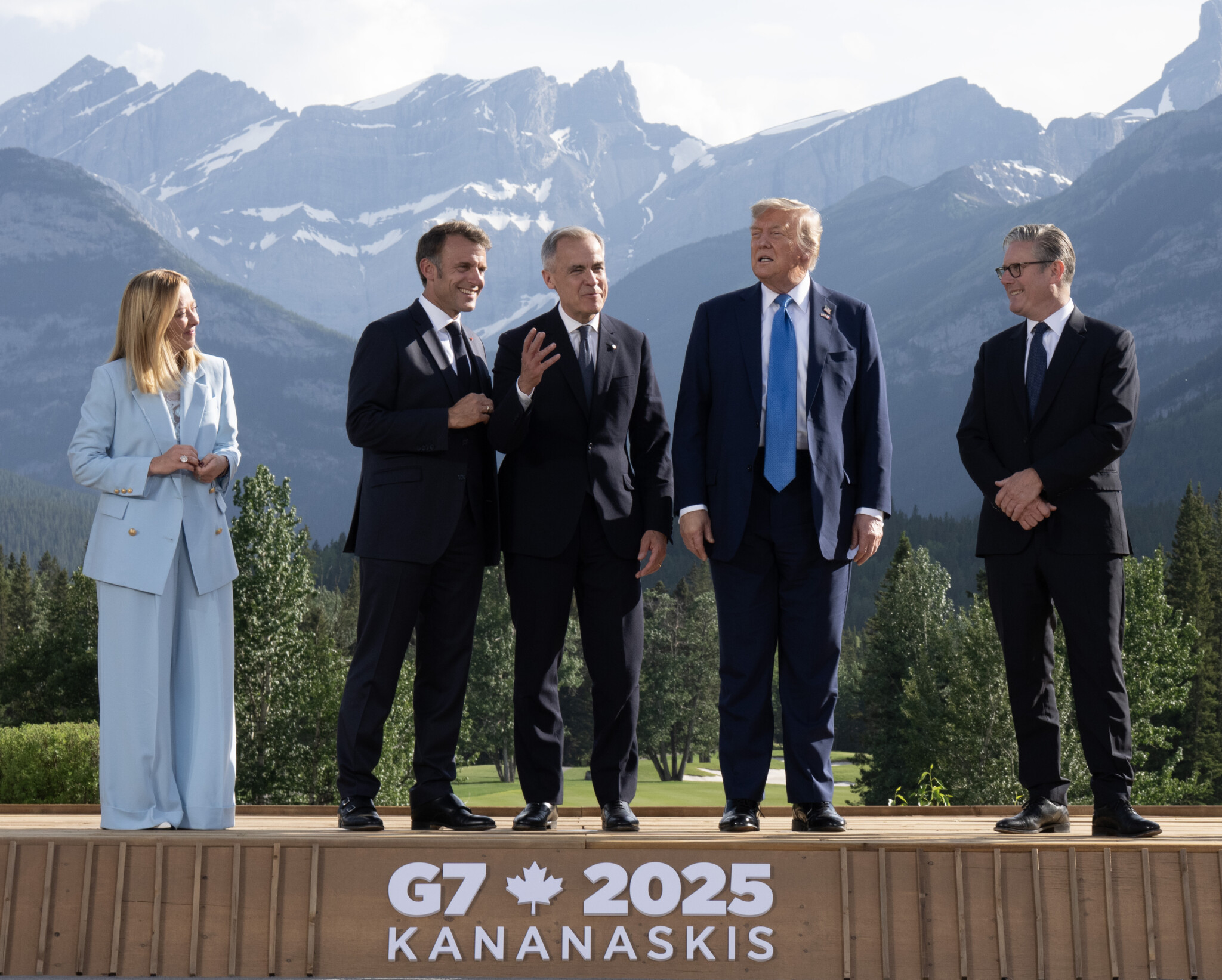
French President Emmanuel Macron jokes with Prime Minister Mark Carney as Italian Prime Minister Giorgia Meloni, left, United States President Donald Trump and United Kingdom Prime Minister Keir Starmer, right, look on during the G7 Summit family photo, in Kananaskis, Alta., Monday, June 16, 2025. Adrian Wyld/The Canadian Press.
It is hard to run a durable coalition against Beijing when Washington makes a sport of treating partners as freeloaders. It is hard to deter Moscow when the message to allies is that American commitments are conditional on the president’s mood.
Great power competition also requires the material heft to bolster military and economic security.
Instead, it looks like the U.S. economy would be in trouble were it not for large investments in AI and its associated infrastructure. Moreover, the administration’s signature economic instrument—tariffs—has been less a strategy for national power than a self-inflicted wound.
Trump has upended the global economy with his tariffs, taking the average American tariffs from 2.4 percent to 18 percent as of October.
View reader comments (5)
If the goal was to boost America’s economic heft, the results are an utterly predictable failure. Farmers are being bailed out, manufacturing employment has fallen by 67,000 between April’s “Liberation Day” tariffs and November, and Americans paid an estimated $179 billion in tariff taxes through the first nine months of the year. This doesn’t provide the economic basis for a competitive America.
Instead of engaging in competitive efforts that seek to maintain America’s position in the international hierarchy, we have a growing pattern of capitulation, alongside a broader drift toward personalized, patronage-inflected statecraft that is difficult to reconcile with any serious national strategy.
Despite the competitive rhetoric of some U.S. policymakers and documents like the NSS, the whims of the president—so easily swayed by gifts and flattery—are unfit for an America that seeks to defend its outsized position in global affairs.
The gap between what America says and what it does is widening into a canyon, and adversaries, allies, and non-aligned states are adjusting accordingly.
In 2026, expect more capitulation from America to the interests of its traditional adversaries.

Taylor is The Hub's Research and Prize Manager. He is a Ph.D. candidate in Political Science at the University of Toronto. He…
Does the article's 'great power capitulation' thesis accurately reflect current US foreign policy?
How do US tariffs, as described, impact its ability to compete globally?
What role do alliances play in the article's prediction of US 'capitulation'?





Comments (5)
It is interesting that you criticize Washington for treating its partners as “freeloaders”. Aren’t these the same partners that have continually refused to hold up their end of the bargain when it comes to their contributions to NATO?