
Polish off your crystal balls, consult the stars, call up the scryer in your life—2025 is creeping to a close, and it’s time to turn our attention to what’s to come in 2026. But if the future still feels fuzzy, don’t panic: The Hub has you covered. Once again, our best prognosticators are here to provide some foolproof predictions for the headlines and happenings ahead.
Efforts to protect societal cohesion will actually erode it
By Elia Gross, The Hub’s advertising content coordinator
President Trump’s recent move to begin the process of designating certain Muslim Brotherhood chapters as foreign terrorist organizations is regrettably unlikely to be mirrored north of the border.
While the announcement has generated headlines, it is important to emphasize that this is only the first step in an uncertain bureaucratic process. Trump’s executive order merely instructs the Secretary of State and the Treasury to submit a report, in consultation with intelligence and justice officials. The full process, including submission and review, is expected to unfold over roughly a two-month period.

The selective nature of the order also weakens its credibility. While Brotherhood chapters in Lebanon, Egypt, and Jordan are subject to investigation, Qatar and Yemen are conspicuously absent from the list. One begins to wonder how much of the designation process is shaped by political convenience, as opposed to legitimate counterterrorism logic.
The United States is notably late to the game. Several countries (including Egypt, Saudi Arabia, the UAE, Bahrain, Kenya, and Russia) have already made the designation, some as early as two decades ago.
These blind spots are legitimate. Still, Canadians may reasonably be envious that some action is being taken, even as our own government, despite overwhelming evidence supporting alignment, has resisted following suit.
It’s been six months since the Institute for the Study of Global Antisemitism and Policy (ISGAP) warned Canadian officials of a rising national security risk. Their 200-page report details extensive Muslim Brotherhood-linked activity in Canada’s political, academic, and civil society institutions, including millions of dollars in annual government funding flowing to affiliated organisations.

Casey Babb, director of the Promised Land Project at Ottawa’s Macdonald-Laurier Institute, has emphasized the need for a coordinated North American response, pointing to a wide range of cross-border activities that could involve Brotherhood-linked networks, including academic exchanges, speaking engagements, and financial or asset transfers.
Since October 7th, Carney has made his rounds appeasing affected diaspora communities. Within the last year, he has affirmed Canada’s recognition of a Palestinian state, condemned Hamas and antisemitism on the second anniversary of the attacks, and given remarks at a Muslim Association of Canada Eid celebration, an organization with known ties to Hamas and the Brotherhood. Taken together, these gestures echo a diagnosis made by my colleague Stephen Staley just days after the horrific attacks in Australia. He writes, “Cowardice in leadership always presents itself as balance. But this is not neutrality, it is abdication.” There is a growing risk that efforts undertaken in the name of cohesion are, paradoxically, enabling forces that erode it.
I hope the needle will move and that I’ll be proven wrong—that in this new year, our public spaces, institutions, and universities will be safe from violence and hate and restored as hubs for meaningful engagement and debate. But I wouldn’t count on it.
Political competency will be rewarded, and the economy will continue to stagnate
By Kirk LaPointe, The Hub’s B.C. correspondent
1. Centralization will continue in B.C.
British Columbia will continue its provincial centralization over local governments, especially around housing approvals, land-use planning, infrastructure prioritization, and climate resilience spending. What begins as a B.C. housing rescue strategy has the potential to become a template for national policy gravity: In an era of urgency, a big question will be whether voters tolerate higher-order governments overriding municipal inertia in a post-local era in key policy domains.
2. Voters will respond to the steady hand
The public mood will shift decisively from ideological loyalty to managerial credibility in its politics. Voters will reward leaders who can show execution, fiscal stewardship, and problem-solving around affordability, health-care functionality, and housing delivery—not just rhetoric. “Steady-hand” branding will replace “transformational” branding, with politics that sound more like procurement and less like poetry, and parties that reposition around trust, capability, and proof of outcomes.
3. Fiscal restraint becomes a political necessity
The age of cheap government is over. Across Canada, and particularly in B.C., governments won’t be able to rely on low interest rates, asset booms, and quiet deficits to smooth the fiscal picture anymore. Debt servicing costs will keep taking a meaningfully larger slice of budgets. Governments will have less financial room for “free” policy ambition. Fiscal restraint will become a mainstream political virtue again.
4. The B.C. economy will be worse than it seems
B.C.’s weakness won’t be recession risk as much as stagnation risk. The province can muddle through 2026 with modest growth, but without productivity reform, faster project approvals, and clear signals to private capital, it will be an economy that feels expensive, constrained, and low-momentum, even when the numbers say it’s technically growing. The growth may exist on paper, but it will feel absent to households, businesses, and governments alike.
5. Canada will not capture the Cup
The Stanley Cup won’t return to Canada in 2026, even if the Olympic hockey gold medals will for men and women. The majority of Canadian NHL teams, perhaps five of seven, will not even qualify for the playoffs.
The media will get even more government cash
By Peter Menzies, a Macdonald-Laurier Institute senior fellow, a past publisher of the Calgary Herald, and a former vice chair of the CRTC
When it comes to the media and communications world, here’s what absolutely will happen in 2026 along with a few thoughts on what could happen.
The Canadian Radio-television and Telecommunications Commission (CRTC), which incidentally is setting new standards for inertia, will hesitate to issue its next decision on how it intends to implement the Online Streaming Act. This decision was intended to clarify how it will increase subsidies for the newsrooms it demands its licensed broadcasters operate. However, with the Trump administration having put—as your faithful servant predicted—the streaming act and the Online News Act on its list of contentious issues to be raised when free trade agreement renegotiations begin, everything will slow down if not completely grind to a halt.
The broadcasters—TVA in particular—are already desperate for cash and in reaponse will up their demands that Prime Minister Mark Carney’s government expand the criteria for the Journalism Labour Tax Credit and other federal media subsidies from “print” products to include broadcasters.
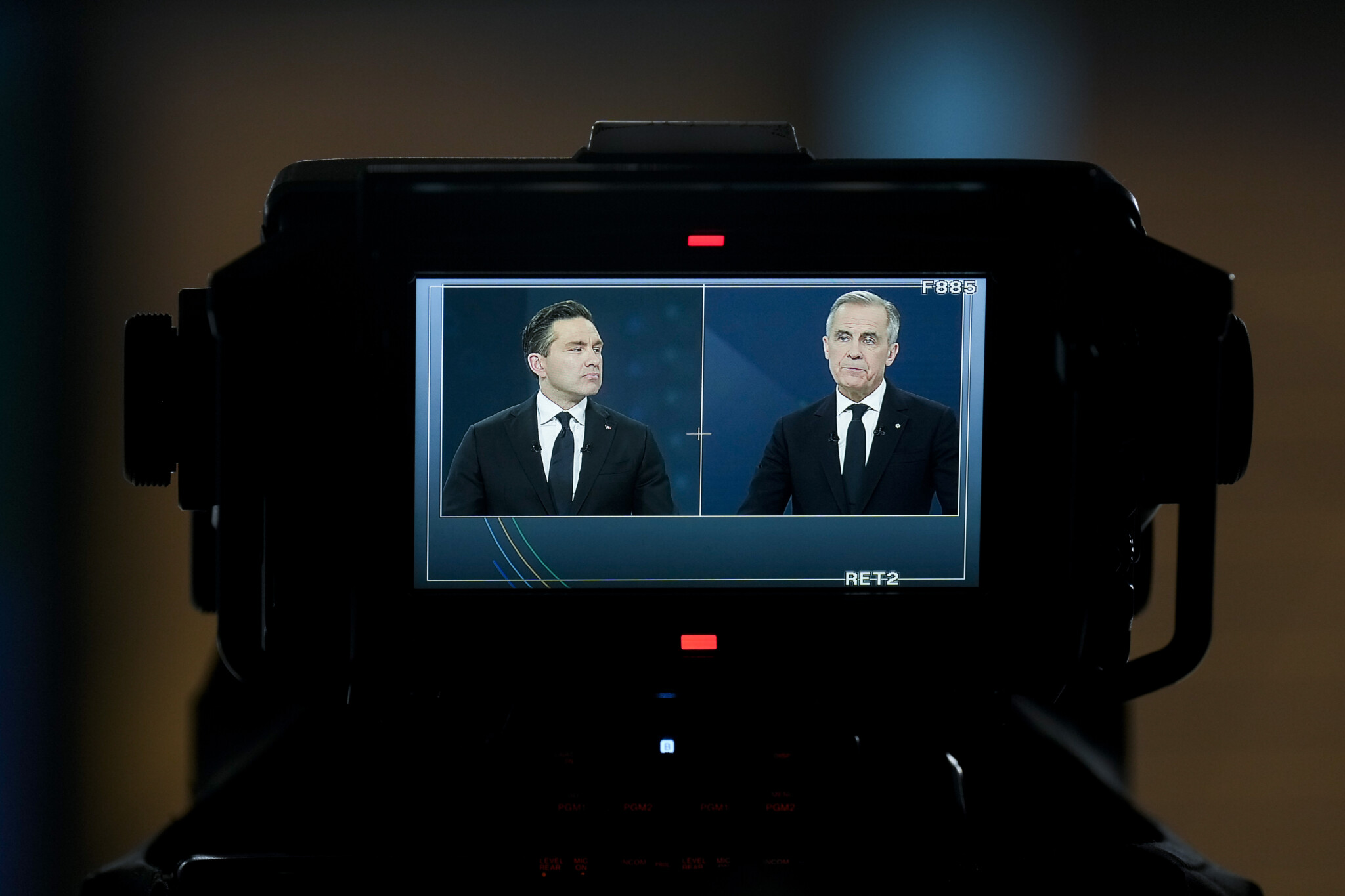
Conservative Leader Pierre Poilievre, left, and Liberal Leader Mark Carney are seen in a TV camera monitor as they participate in the English-language federal leaders’ debate, in Montreal, Thursday, April 17, 2025. Adrian Wyld/The Canadian Press.
Canadian Identity and Culture Minister Marc Miller will almost certainly champion their cause and it will be announced that they will be included among those eligible to become approved by a government-appointed panel as Qualified Canadian News Organizations.
The “print” industry, alarmed that this expansion could reduce their take from these juicy pots, will fiercely lobby on that point, which they will win. They may even seek, in return, the opportunity to become eligible for any news CRTC funding. That may involve having to concede some oversight over their content, but they won’t care.
The prospect of the Online News Act being dismantled will prompt demands that, if it is and the $102 million Google fund disappears, the government replace it.
The news industry has clearly evolved into one that is internet-based, but the CRTC and the government will continue to view it as Boomers do: either “broadcast” or “print.” Both will lobby the federal and provincial governments to direct a percentage of their advertising to them as a form of subsidy.
Finally, as predicted by Nieman Lab, the artificial intelligence arms of Big Tech will continue to destroy those media dependent on news releases and information otherwise available to the general public. In response, most major media will become more dependent upon unnamed sources. This weakness will continue to be exploited by partisans within government to ensure that their interpretation of events maintains primacy. Many reporters will continue to be played for patsies.
Happy New Year.
Should Canada mirror US foreign terrorist organization designations for groups like the Muslim Brotherhood?
Will voters prioritize 'steady-hand' leadership over 'transformational' promises in 2026?
How will the Canadian media landscape evolve with increased government funding and AI?




Comments (0)