DeepDives is a bi-weekly essay series exploring key issues related to the economy. The goal is to provide Hub readers with original analysis of the economic trends and ideas that are shaping this high-stakes moment for Canadian productivity, prosperity, and economic well-being. It features the writing of leading academics, area experts, and policy practitioners. The DeepDives series is made possible thanks to the ongoing support of the Centre for Civic Engagement.
On paper, the “price” of a new home is the sticker in the brochure. In practice, it’s a layered stack of costs—land, labour, materials, financing—and a growing set of government-imposed charges that buyers never see itemized.
For many households, that hidden stack is the difference between qualifying for a mortgage and being able to carry its costs and staying renters for another decade. And one line item has become especially consequential: development charges. In Canada’s hottest markets, these fees can now rival a down payment before a shovel hits the ground.
Municipalities levy these charges for a reason: growth requires pipes, roads, transit, parks, community centres, and more. But as development charges rise and cities come to rely on them, Canada has drifted into a system in which the upfront cost of long-lived infrastructure is increasingly embedded directly into the price of new housing, paid for by those who purchase it. The predictable effect is higher home prices, challenged projects, fewer starts, and a policy tug-of-war between affordability and municipalities’ fiscal challenges.
Given the state of housing affordability and the role of development charges in this crisis, this DeepDive assesses a new path for financing municipal growth, drawing on and further exploring ideas in RBC Thought Leadership’s “A Housing Trifecta” paper. New tools and approaches, like tax-free municipal bonds and low-income housing tax credits, may be a credible way of rethinking municipal finance issues and improving housing affordability.

What is a development charge—and why municipalities use them
Development charges (DCs) are fees municipalities (and sometimes regions) impose on new development to help pay for growth-related infrastructure and services, such as roads, water and wastewater, stormwater facilities, parks, and, in some cases, transit and other community facilities. The Canada Mortgage and Housing Corporation (CMHC) summarizes the basic idea: they are fees imposed on developers of new housing and “intended to be used to help cover the cost of infrastructure and services needed to support new growth.”
The logic is intuitive. When a city grows, it needs additional capacity. New residents mean new demand on pipes, intersections, bus service, daycare spaces, recreation centres, and emergency services. If municipalities funded all of that through the existing property tax base, current residents might feel they’re subsidizing growth. DCs, on the other hand, attempt to charge growth for growth.
In the background, there’s also a hard fiscal constraint. Municipalities in Canada shoulder major responsibilities, but have limited revenue tools. In Ontario, for instance, municipalities receive only about 9 cents of every household tax dollar, while owning/maintaining more than 60 percent of the province’s infrastructure and covering “downloaded” services estimated at roughly $10 billion annually. That mismatch helps explain why cities reach for the few levers they do control, and why DCs have become such a prominent one.
DCs can also shape urban form. The CMHC notes that some researchers argue escalating development charges can function as a form of implicit growth management. Whether or not that’s the intent, the practical effect is that higher upfront costs make marginal projects harder to pencil out, especially in slower markets or for housing types with thinner margins.

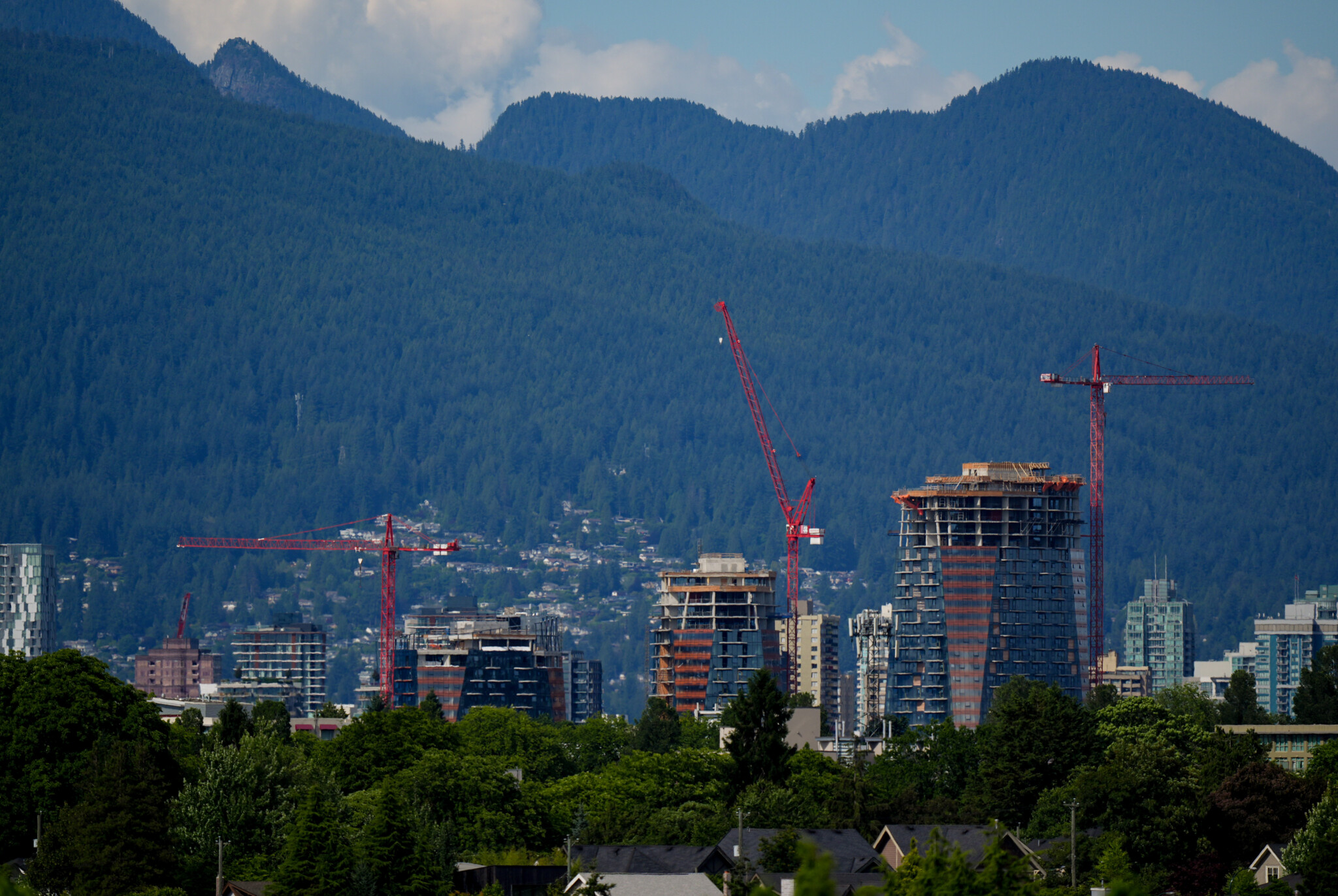
Prime Minister Mark Carney speaks to construction workers as he tours a housing development in Ottawa on Thursday, Nov. 6, 2025. Spencer Colby/The Canadian Press.
How development charges have risen—and what Toronto and Vancouver show us
A central challenge with DCs is that, over the past several years, they have risen faster than inflation, incomes, and even construction costs, posing a structural affordability challenge. Indeed, DCs have risen much faster than general inflation in the Canadian economy.
A striking illustration comes from Toronto’s trajectory over the past decade-plus. One Ontario-wide comparison shows the City of Toronto’s development charges for single-detached units rose from $14,025 (2011) to $97,041 (2023), a 592 percent nominal increase. While the City of Toronto saw the largest increase, most municipalities across the GTA saw an over 100 percent increase in DCs for this type of unit during the given period, with many seeing an over 200 percent increase.
And the trend hasn’t stopped. A Toronto Region Board of Trade report notes that, in Toronto, development charges on a single detached or semi-detached unit are now $137,846 (2025). In Vaughan, they’re now just shy of $200,000.
This isn’t just an abstract number. It’s a cost that must be financed, either as an embedded purchase price for an ownership unit or as higher rents required to make a rental project viable.
It’s also a revenue pillar for municipal capital planning. The Board of Trade report estimates DCs now fund about 60 percent of the cost of a typical growth-related capital project in Ontario. For the City of Toronto, the report cites a 10-year capital plan that includes $6.1 billion in DC-funded projects (roughly 10 percent of planned capital spending), with the City collecting roughly $520 million in development charges annually.

In Metro Vancouver, development charges are not a single fee but a stack of levies that vary by municipality and have increased noticeably over time. A 2023 report from the Homebuilders Association Vancouver (HAVAN) explains that Development Cost Charges (DCCs) are utilized as a similar funding vehicle to DCs in Toronto as a “user pay/benefiter pay” tool used to help fund growth-related infrastructure such as roads, drainage, water, sewer, and parks, typically collected at subdivision approval for single-family homes or at building permit for multi-family projects.
The municipal DCCs themselves differ widely across the region. Using an illustrative single-family home, HAVAN reports municipal DCCs of $29,611 in Vancouver, $60,422 in Coquitlam, $48,355 in Langley Township, and $14,749 in the City of North Vancouver. The report also documents sharp increases in some municipalities over relatively short periods, for example, Coquitlam’s DCCs for its single-family case rose 37.4 percent from 2019 to 2022, while Vancouver’s DCCs increased roughly 12.8 percent from 2021 to 2022 for the illustrated unit.
More importantly for housing costs, projects in Metro Vancouver can face regional charges on top of municipal DCCs. HAVAN notes additional levies tied to agencies such as TransLink and Metro Vancouver utilities. For instance, TransLink’s single-family DCC rose from $0 (2019) to $2,100 (2020) and $2,975 (2021), with inflationary increases thereafter. Metro Vancouver’s newer Water DCC is shown at $6,692 per single-family unit, while Metro’s Sewerage and Drainage DCC varies by service area (for the Vancouver sewerage area, $3,335 per single-family unit).
When these layers are combined, HAVAN estimates total charges of $42,613 for the illustrative single-family home in Vancouver.
The reality is that within Canada’s two largest cities, DCs are rising, which ends up contributing to a deteriorating affordability situation.

What’s wrong with development charges as a municipal financing tool
The core problem isn’t that municipalities need revenue. It’s how revenue is raised, and when it’s collected.
Problem 1: DCs are typically passed on to buyers and can inflate broader prices
A common misunderstanding is that development charges fall on “developers.” CMHC’s review of the evidence finds the burden is largely borne by new homebuyers, especially in strong markets, and that price increases are often proportionate to, or greater than, the fee itself.
The spillovers go further. CMHC notes that existing home prices also rise, because sellers can price off the higher cost of new builds, even though the charges apply only to new construction. In other words, DCs can widen the gap between those who already own (who may benefit through higher resale values) and those trying to enter the market (who face higher prices on both new and resale supply).
Problem 2: They front-load the cost of long-lived infrastructure onto today’s buyers
This is the intergenerational equity issue. Infrastructure that lasts 50 to 75 years is increasingly built into the price of new homes, effectively asking younger households to pre-pay for assets that previous generations paid for gradually over time.
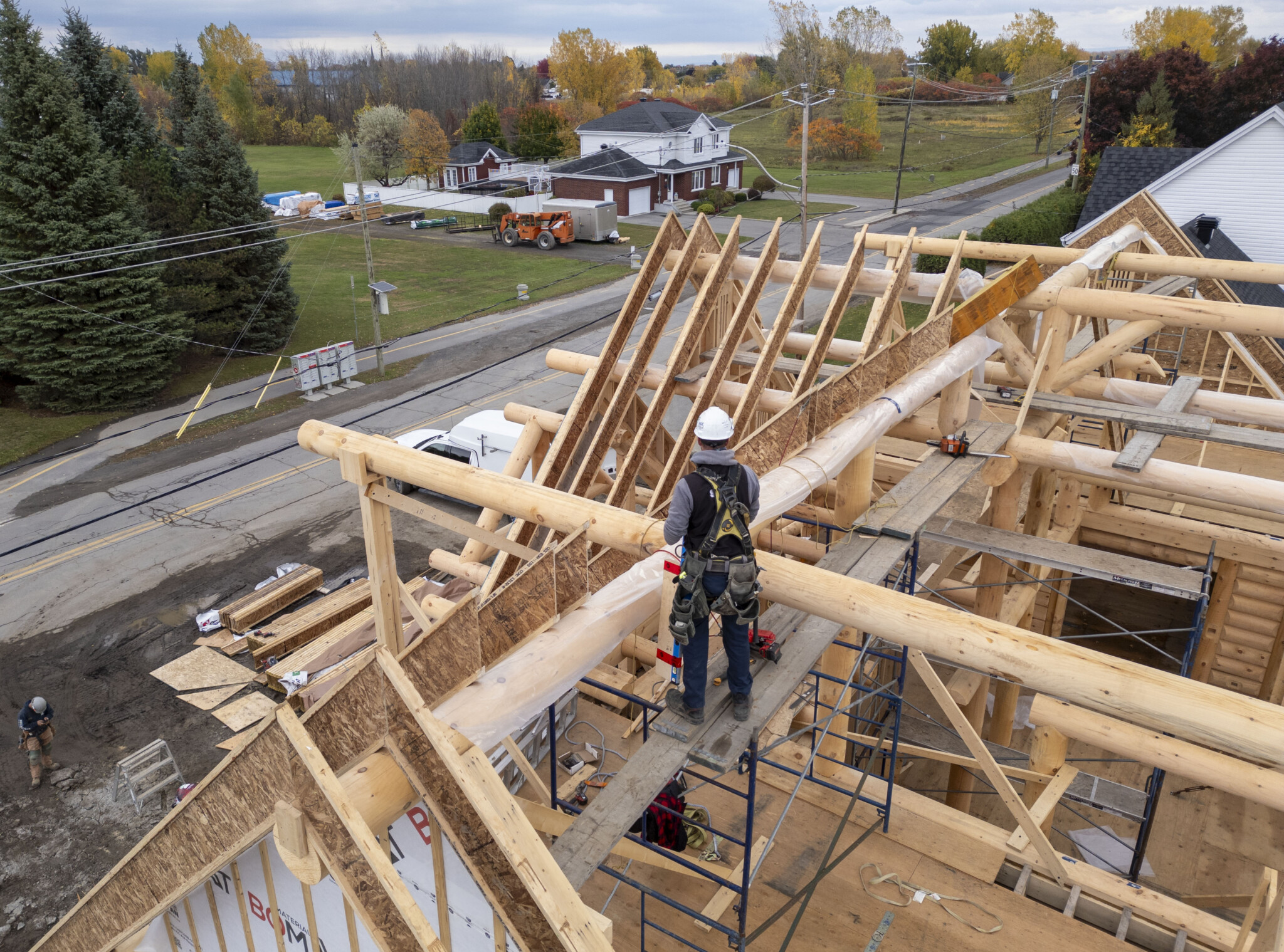
An aerial view shows carpenters building a log home made from white pine in Salaberry-de-Valleyfield, Que., on Wednesday, Oct. 22, 2025. Christinne Muschi/The Canadian Press.
That matters because housing affordability is fundamentally about monthly carrying costs and entry barriers. When six-figure charges are capitalized into a home price, they become mortgage principal. In high-rate environments, that makes qualifying harder, pushes buyers into smaller units, and can make entire projects unviable.
Problem 3: Overreliance creates a vicious cycle for both housing and municipal finance
There’s an uncomfortable feedback loop:
- Cities face major infrastructure needs (Ontario municipalities, for example, are estimated to require $250–$290 billion in capital investment over the next decade, including $100-plus billion tied to growth).
- With limited revenue tools (e.g., municipalities are often legislatively barred from issuing debt or levying new taxes, such as municipal sales taxes), they lean more heavily on DCs and similar charges.
- Higher charges increase the upfront cost of building and worsen housing affordability, particularly for buyers of new housing.
- Projects stall or are cancelled, reducing housing starts, and potentially reducing the very DC revenues cities were counting on.
- To fill the gap, cities raise charges again or defer infrastructure, further constraining supply.
Even in the best-case scenario, where charges fund important infrastructure, this model can still be economically problematic. It concentrates infrastructure costs on the marginal buyer and the marginal project rather than spreading them across time and the broader base of beneficiaries.

It’s time to reform development charges
There is no single “magic wand” reform to improve housing affordability. But there are credible alternatives to the DC model that can reduce the pressure to treat new housing as the primary funding source for growth-related infrastructure, while still giving municipalities the revenue capacity they need.
Alleviating Canada’s housing shortage will require substantial capital deployment, and two policies currently in place in the U.S. can attract private investment into both infrastructure and affordable rental supply. These are 1) tax-free municipal bonds and 2) a low-income housing tax credit.
Option 1: Tax-free municipal bonds for housing-enabling infrastructure
The concept is straightforward in that governments exempt interest earned on certain municipal bonds from federal income tax (with guardrails so proceeds are earmarked for housing-related infrastructure). Implementing this would require changes to Canada’s Income Tax Act, as well as various municipal acts, along with frameworks to ensure proceeds are used for defined purposes.
Why does the tax exemption matter? It lowers the yield investors require (since they keep more after tax), reducing borrowing costs for municipalities. The idea is that this can finance infrastructure more cheaply and over a longer horizon, reducing the need to collect so much money at the outset through development charges.
Municipalities could reduce housing costs materially by financing infrastructure with bonds, across a broader base, rather than loading costs into upfront charges for buyers of new housing, and the RBC report suggests costs could fall by as much as 20 percent.
How this helps affordability is that instead of embedding new infrastructure costs in the price of each new unit, cities can amortize costs over the useful life of the infrastructure, thereby aligning payment with the long-term stream of beneficiaries, not only the first buyer.
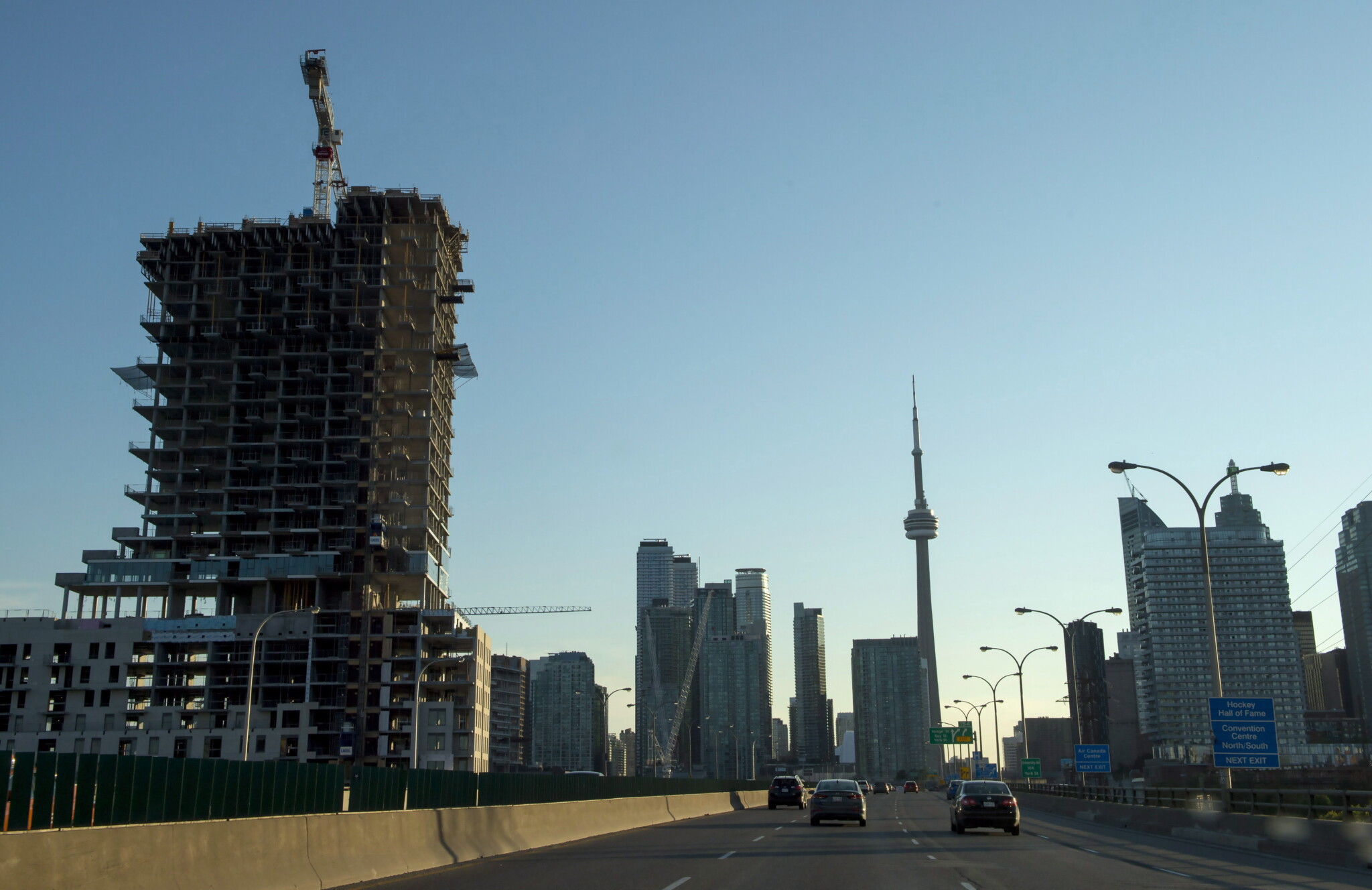
Construction cranes feature on the skyline in Toronto on Wednesday, July 5, 2017. Frank Gunn/The Canadian Press.
Option 2: A low-income housing tax credit for affordable rental housing
The second proposal targets rental supply directly and is based on the U.S. Low-Income Housing Tax Credit (LIHTC), which has been in place since 1987. Overall, it has supported 3.65 million units, accounting for about 7.8 percent of new U.S. housing stock since its inception.
Mechanically, there are two credit streams (a 4 percent and a 9 percent credit), with the 9 percent credits allocated to states and distributed to eligible projects, and the 4 percent credits generally tied to projects financed significantly through tax-exempt municipal bonds.
The key economic benefit is that tax credits attract private equity to projects that would otherwise require large subsidies or expensive debt. Indeed, investors often provide equity (commonly around $0.90 per $1 of credit) and that partnerships are typically structured around a 15-year affordability period, with credits offsetting tax liability for 10 years (and recapture risk if projects don’t comply).
The broader idea is that, while the credits would represent foregone tax revenue, they “crowd in” large amounts of private capital into housing development.
How this helps affordability is that a Canadian LIHTC-style instrument would reduce the cost of capital for below-market rental projects, making more builds viable, and reducing the need to rely on ad hoc grants, one-time waivers, or sporadic capital programs.
In terms of upside and overall bang for buck, estimates suggest each dollar of forgone tax revenue mobilizes about $2 USD in investment. The effect is even larger for tax-exempt municipal bonds, which are estimated to attract roughly $10 USD in private capital for every dollar of tax revenue the government gives up.
Both policies are real-world examples of success that could deliver meaningful housing affordability improvements by reducing municipal reliance on development charges.
View reader comments (7)
Key takeaways
Development charges started as a sensible “growth should pay for growth” tool. When new residents arrive, cities need pipes, roads, parks, transit capacity, and other services, and it is politically difficult—often impossible—to fund those entirely through property taxes. In that context, charging new development a portion of growth-related capital costs has a certain equity logic, especially in systems where municipalities have limited access to broad-based revenue sources.
But the scale and pace of today’s increases are no longer affordable or sustainable. In Toronto, Vancouver, and elsewhere across the country, development charges have risen dramatically over the past decade and a half, far outstripping inflation, and the result is that a large and growing slice of long-lived municipal infrastructure is being financed through a one-time levy embedded directly into the price of new housing.
These costs do not simply sit with developers. In strong markets, fees are largely passed through to households through higher prices, and they can even push up the value of existing homes by raising the “replacement cost” of new supply. This is why development charges can worsen affordability not only for buyers of new units but for would-be buyers and renters across the market. They raise the entry price of housing, increase financing needs, and make marginal projects harder to build, reducing supply precisely when Canada needs more of it.
The right response is not to pretend municipalities can do without revenue. It is to change how that revenue is raised and when it is collected, so that the burden does not fall so heavily on the next cohort of homebuyers. The emphasis here is on tax-free municipal bonds and a low-income housing tax credit points toward a credible direction of spreading the cost of housing-enabling infrastructure over time through cheaper, longer-term financing, and crowding private capital into affordable rental construction so that projects can proceed without relying on ever-larger upfront charges.
Ultimately, development charges sit at the intersection of two realities Canada can no longer afford to keep separate. Cities are being asked to quickly deliver new housing supply, and households are being priced out of the very homes that growth is supposed to deliver. If the country is serious about restoring affordability, it needs to stop treating new housing as a central source of municipal revenue and start building a growth-financing system that can support both functioning communities and a housing market that ordinary Canadians can still enter.
Are skyrocketing development charges a fair way to fund municipal growth?
Could tax-free municipal bonds solve Canada's housing affordability crisis?
Is relying on development charges creating a housing affordability 'vicious cycle'?






Comments (7)
Very informative. I agree the “pay up front” model for new city builds is very discriminatory to new home buyers. The buyer mortgages over 20-30 years but the city gets the immediate benefit of the new infrastructure. A current example in Calgary shows that they can also get “double whammied”: the current rupture in the main 70 yr old water line highlights that this worn out piece of infrastructure is in need of replacing and will cost billions, no doubt to be spread over the entire tax base including new arrivals.
Mortgages, bonds and denentures are all accepted financial instruments and why shouldn’t they be used to long term finance infrastructure over time instead of dumping all up front on home builds.