The U.S. intervention in Venezuela has generated a lot of buzz—about sovereignty, international law, and, of course, the country’s oil potential. But it also raises a question for Canada: are we making the most of our own resource wealth?
Venezuela sits on roughly 300 billion barrels of oil but produces less than 1 million barrels a day—the lowest production-to-reserve ratio among the world’s major oil owners. For a country so rich in resources, it’s strikingly poor: per-capita GDP is just $8,600 USD, a fraction of the roughly $76,000 average across advanced economies.
By contrast, Canada produces more with less—roughly six times more oil per day with about half the reserves—a result you might expect given our advantages of democracy, free trade, and political stability. But even so, when it comes to production relative to reserves, Canada still underperforms relative to other large non-OPEC producers: the U.S. and Russia both have smaller reserves yet far higher daily output.
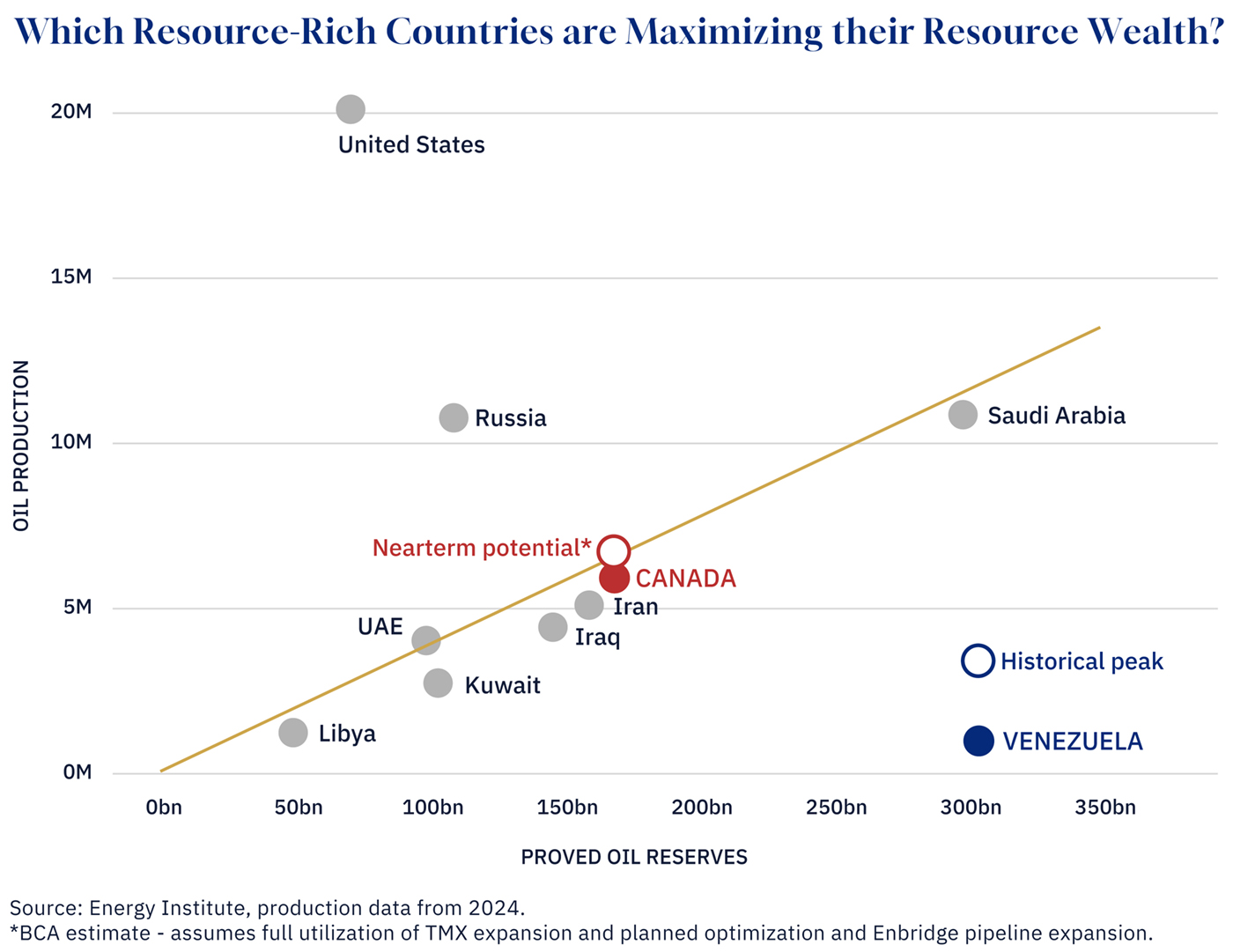
Graphic credit: Janice Nelson
To be sure, more production isn’t always “better.” One reason Canada produces relatively less is the nature of its crude: much of it is heavy oil and bitumen, which is more expensive and complex to extract and refine, and typically sells at a discount to lighter grades.
But the other constraint is self-imposed. Limited pipeline and export capacity have long restricted how much Canadian producers can sell and to whom. That’s finally beginning to change. The Trans Mountain Expansion (TMX), which came online in 2024, is easing those bottlenecks, allowing crude oil to reach non-U.S. markets and supporting higher production and better prices. Efforts to optimize the existing pipeline are likely to further increase output.
But even with TMX, Canada’s export capacity is likely to remain a constraint on the industry’s output and potential. The recent memorandum of understanding between Alberta and the federal government to explore another West Coast pipeline shows that the need for greater capacity is widely recognized. And that need is becoming clearer by the day.

Right now, all eyes are on Venezuela and how quickly it can ramp up production. The country’s oil sector has a long way to go, and many have written it off, with dilapidated equipment, a depleted workforce, and years of underinvestment. Still, if recent changes bring greater stability, money will talk. Forecasts suggest the country could double its current output over the next few years, moving toward historical norms. Even modest gains would compete with Canadian crude, reducing U.S. demand and potentially offsetting the producer revenue gains from TMX.
And those forecasts could be just the tip of the iceberg in terms of potential implications for Canada. They’re based on the potential for better investment conditions through domestic reforms, not necessarily aggressive intervention by the U.S. and U.S.-based oil companies. This latter possibility is all the more reason for Canada to leverage its own resource endowment as quickly as possible.
Expanding and diversifying export capacity mattered before. But in a world where the U.S. could develop the capacity to supplant Canadian supply, it matters even more.
A version of this post was originally published by the Business Council of Alberta. To learn more, read the commentary here.

Alicia Planincic is the Director of Policy & Economics at the Business Council of Alberta. She regularly provides insight and analysis on…
Canada must urgently expand its oil production and exports in light of turmoil in Venezuela and potential shifts in U.S. energy policy. While Venezuela possesses vast oil reserves, its production is low due to underinvestment and infrastructure issues. Canada, despite its own resource wealth, underperforms compared to other large non-OPEC producers in production relative to reserves, partly due to the nature of its crude and self-imposed export capacity limitations. The Trans Mountain Expansion (TMX) is a step forward, but further capacity is needed to compete with potential Venezuelan output increases and to diversify markets, especially if U.S. demand shifts.
Given Venezuela's vast oil reserves but low production, should Canada prioritize increasing its own oil output to capitalize on global demand?
How significant is Canada's pipeline and export capacity as a constraint on its oil industry's potential?
What are the potential economic implications for Canada if Venezuela significantly increases its oil production?






Comments (3)
Excellent article. Let’s build the pipeline to the West coast now! Our economy is desperate for a boost, and our oil is the fastest way to do that.