Close to one in four women in Canada in their 40s had no children in 2024, and just over half of childless women ages 20 to 49 indicated they wanted to have kids, according to newly released Statistics Canada data. The latest numbers reflect major shifts in family trajectories as the country grapples with record-breaking low fertility rates.
The 2024 Survey on Family Transitions found that 23.6 percent of women aged 40 to 49 years had no biological or adopted children.
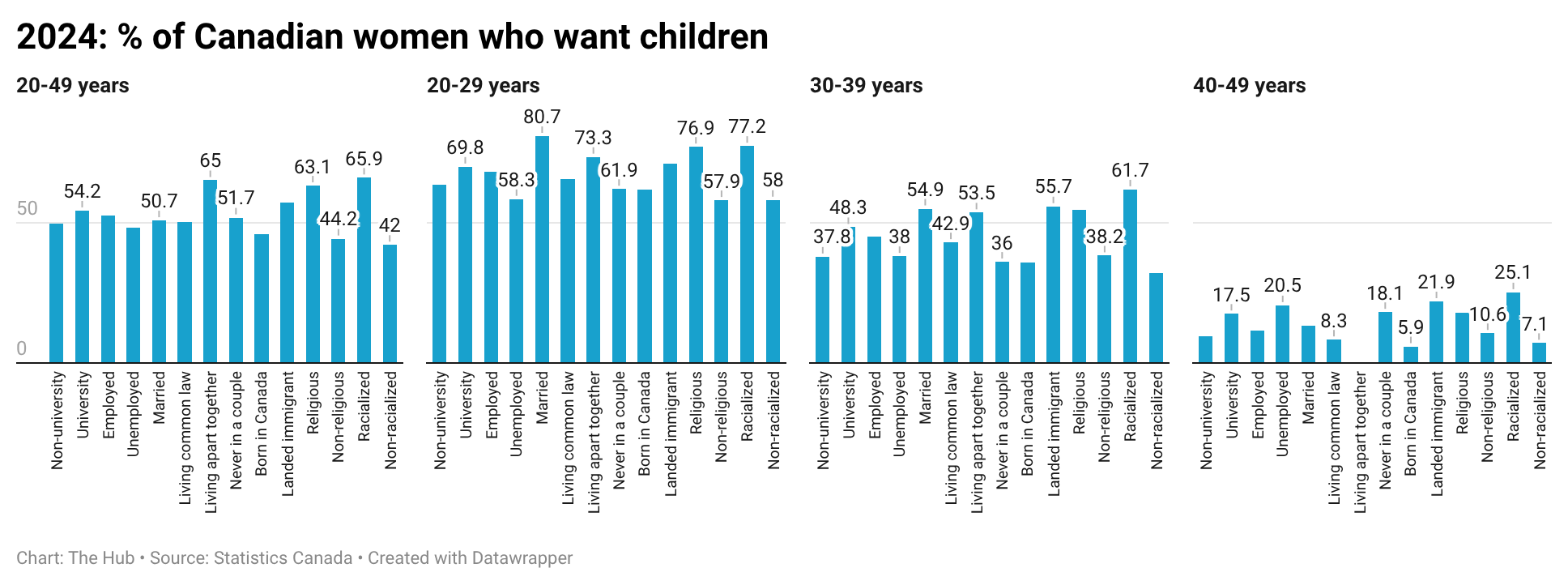
Overall, 51.5 percent of women in Canada aged 20 to 49 years were not yet mothers. Out of those childless women, just over half surveyed said they wanted to become mothers.
Around seven in 10 women in their 20s without children expressed wanting a child, dropping to four in 10 for women in their 30s and one in 10 for women in their 40s.
The findings come as Canada’s total fertility rate dropped to 1.25 children per woman in 2024, placing it among countries with “ultra-low fertility” rates, including South Korea (0.75), China (1.02), Italy (1.2), Spain (1.21), and Japan (1.23). The average age of first-time mothers reached an all-time high of 31.8 years in Canada in 2024.
“The decline in fertility is due not only to a decreased birth rate, but also to an increase in the number of women who do not have children either by choice, by circumstance or because they are delaying motherhood,” the report states. “These results show that fertility does not depend solely on individual preferences, it also reflects complex socioeconomic and cultural factors.”
Fertility rate measures the average number of children a woman has in her lifetime.
Women without children who wanted to become mothers said they would like to have 2.2 children on average.
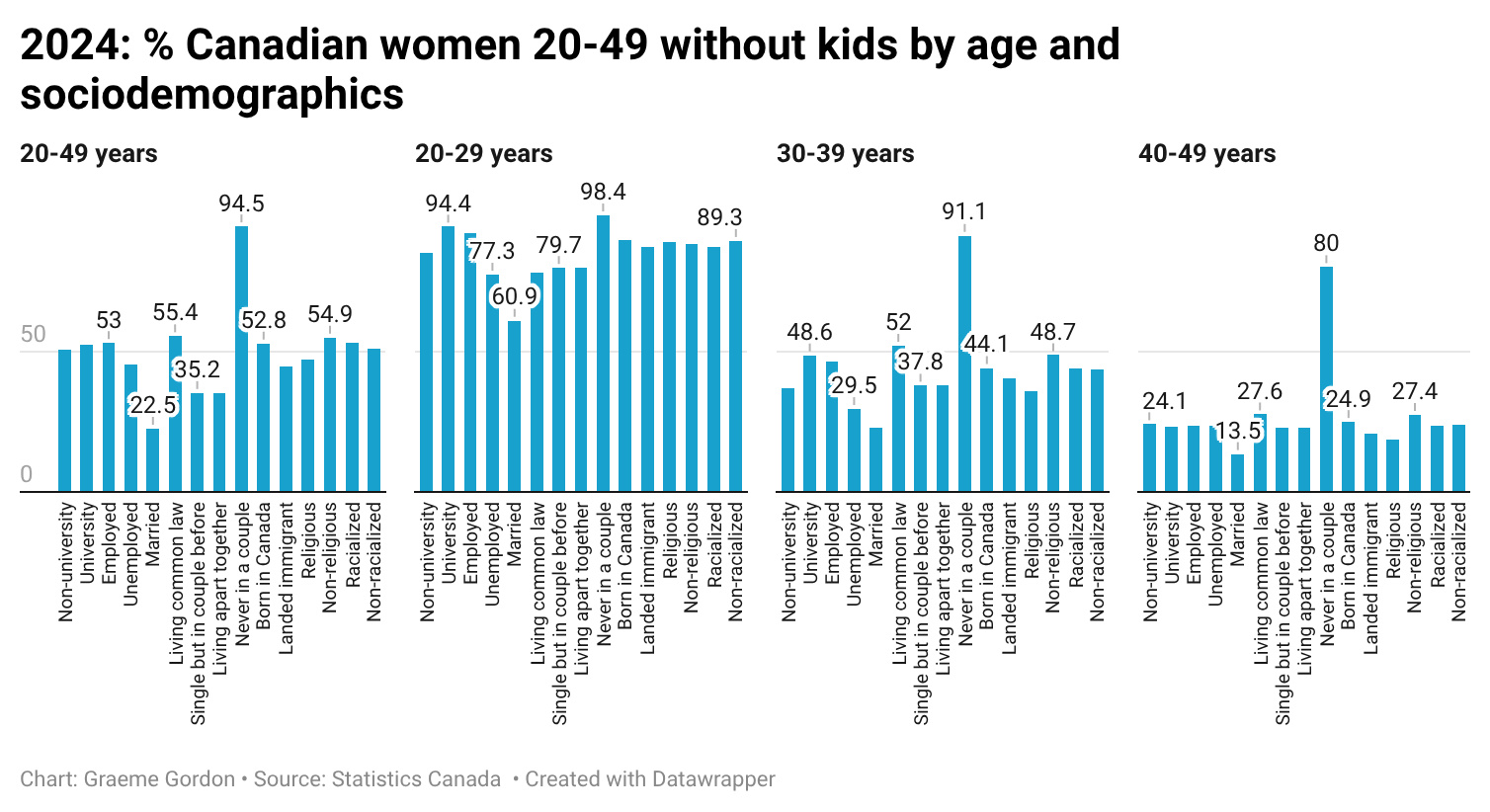
The data reveals stark differences across age groups. Nearly nine in 10 women in their 20s did not have children, compared with just over four in 10 women in their 30s.
Education and employment status emerged as significant deciding factors for procreation. Among women aged 30 to 39 years, close to half of university graduates had no children, compared with 37 percent of those without a university degree.
Employed women were more likely to remain childless than unemployed women. Among women in their 30s, 46.5 percent of employed women had no children, compared with 29.5 percent of unemployed women.
The survey suggests constraints related to work-life balance, as well as the cost and availability of child care, are likely responsible for the higher proportion of women in the labour market not having children.
Marital and relationship status showed a strong correlation with motherhood, too. At least 80 percent of women aged 20 to 49 years who had never been in a long-term relationship had no children. Married women were substantially more likely to have children than those in common-law relationships or couples living apart.
Religious beliefs also played a role. Among women in their 30s, 48.7 percent of non-practising women had no children, compared with 35.9 percent of practising women. A higher proportion of women of faith in their 20s also wanted children (76.9 percent) compared to non-practising women (57.9 percent).
Immigration status revealed notable patterns, too. More than half of Canadian-born women aged 20 to 49 years had no children (52.8 percent), compared with 44.6 percent of landed immigrant women. Canadian-born women wanted children less than women who emigrated to Canada, too, with 45.7 percent of native-born women wanting kids compared to 57.2 percent of landed immigrant women. The findings align with a previous Statistics Canada report showing foreign-born mothers gave birth to nearly half of Ontario and British Columbia’s babies in 2024, underscoring immigrants’ significant contribution to Canadian births.
Among minority groups, Chinese (59.6 percent) and West Asian women (64.2 percent) were most likely to have no children. Latin American (58.4 percent) and Arab (59.9 percent) women were the most likely to have kids.
The report highlights a gap between intentions and reality, noting that nearly one-quarter of women in their 40s had no children, with about one in 10 still wanting them. Such plans are less likely to materialize given biological constraints and risks associated with geriatric pregnancies.
The survey collected data from 23,941 respondents aged 20 to 79 years living in Canadian provinces between April and September 2024.

Graeme Gordon is The Hub's Senior Editor and Podcast Producer. He has worked as a journalist contributing to a variety of publications, including CBC,…
New Statistics Canada data reveals significant shifts in Canadian women’s family planning. In 2024, nearly a quarter of women in their 40s were childless, and over half of childless women aged 20-49 expressed a desire for children. This reflects Canada’s record-low fertility rate of 1.25 children per woman. Factors influencing these trends include delayed motherhood, education, employment, relationship status, religious beliefs, and immigration. The report highlights a gap between the desire for children and their realization, particularly for older women, and points to socioeconomic and cultural influences beyond individual preferences.
What societal factors might be contributing to Canada's declining fertility rate beyond individual choice?
How might Canada's low fertility rate impact its future economy and workforce?
Given the data, what policy areas could Canadian policymakers explore to address fertility trends?







Comments (2)
Time for higher tax rates and CPP contribution requirements for the deliberately childless. If you won’t have kids to pay for your retirement and health care in old age, then pay for it yourself.