
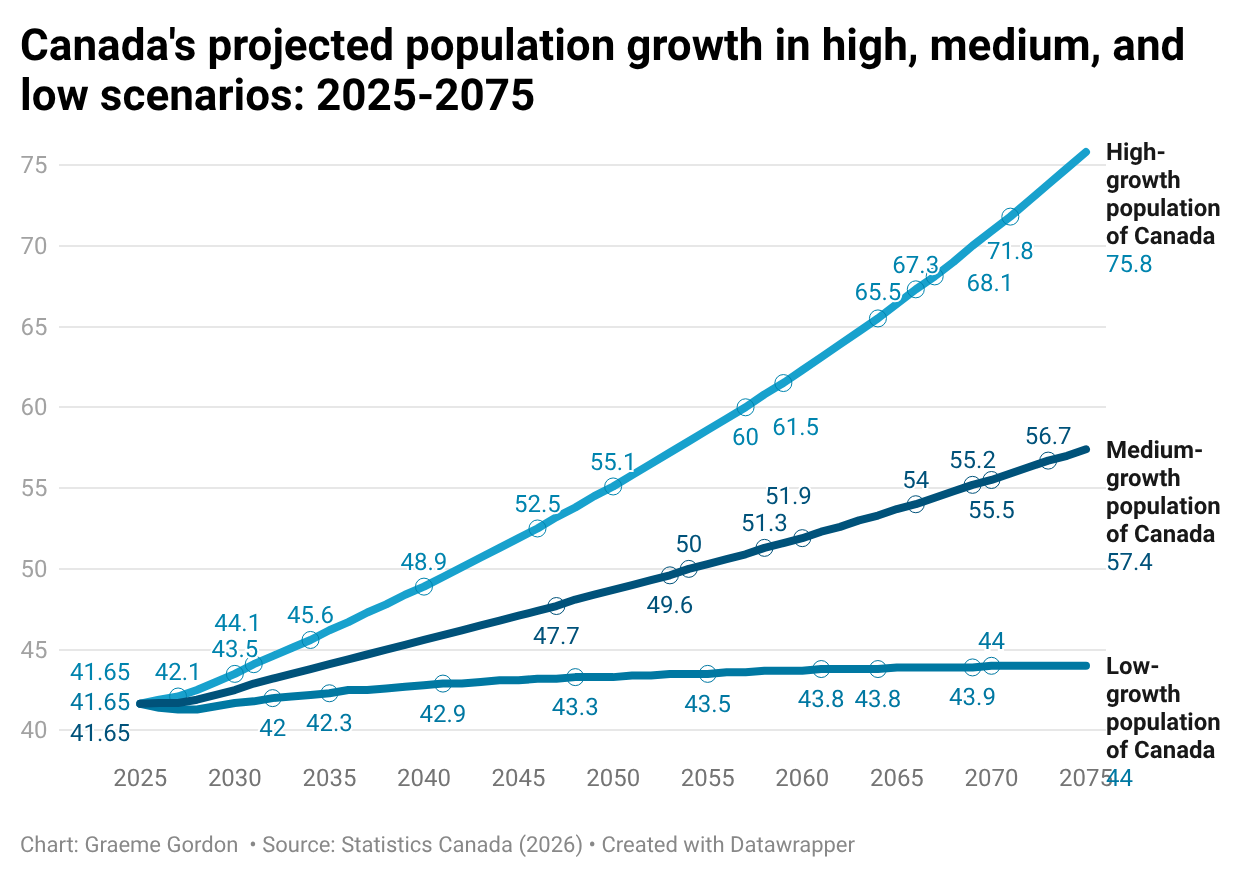
Canada could nearly double its population to 75.8 million people by 2075 under a high-growth scenario, according to Statistics Canada’s latest population projections.
The projections, released Tuesday, are not forecasts but scenarios based on different assumptions about rates of fertility, immigration, mortality, and Canadian migration patterns meant to outline a range of possible demographic futures for Canada.
The numbers that will matter
Starting from an estimated population of 41.7 million as of July 2025, Canada’s demographic trajectory diverges significantly depending on which scenario materializes. The medium-growth scenario, generally treated by demographers as the central reference point, projects a population of 57.4 million by 2075—an increase of 37.8 percent. The low-growth scenario projects only modest growth, to about 44 million—a 5.6 percent.
In the high-growth scenario, fertility rises from 1.25 to 1.55 children per woman by 2049, immigration reaches 11.3 new immigrants per thousand Canadians, and life expectancy increases to 88.8 years for women and 85.5 years for men.
In the short term, the projections suggest a sharp slowdown compared with recent years. After a period of record population growth between 2021 and 2024, driven by permanent and temporary residents, growth is expected to decelerate following the federal new government’s immigration policies to reduce temporary and permanent residency, including attempting to stabilize permanent residency at 380,000 from 2026 to 2028
Under certain scenarios, population growth turns slightly negative in 2026 and 2027, reflecting reduced permanent resident targets and falling numbers of temporary residents.
Regardless of the population growth downturn, most projections predict immigration to increase within a few years and for population to grow by hundreds of thousands annually.
Provinces in the West gain, the East loses
Beyond the national totals, the projections point to significant regional shifts in the next 25 years.
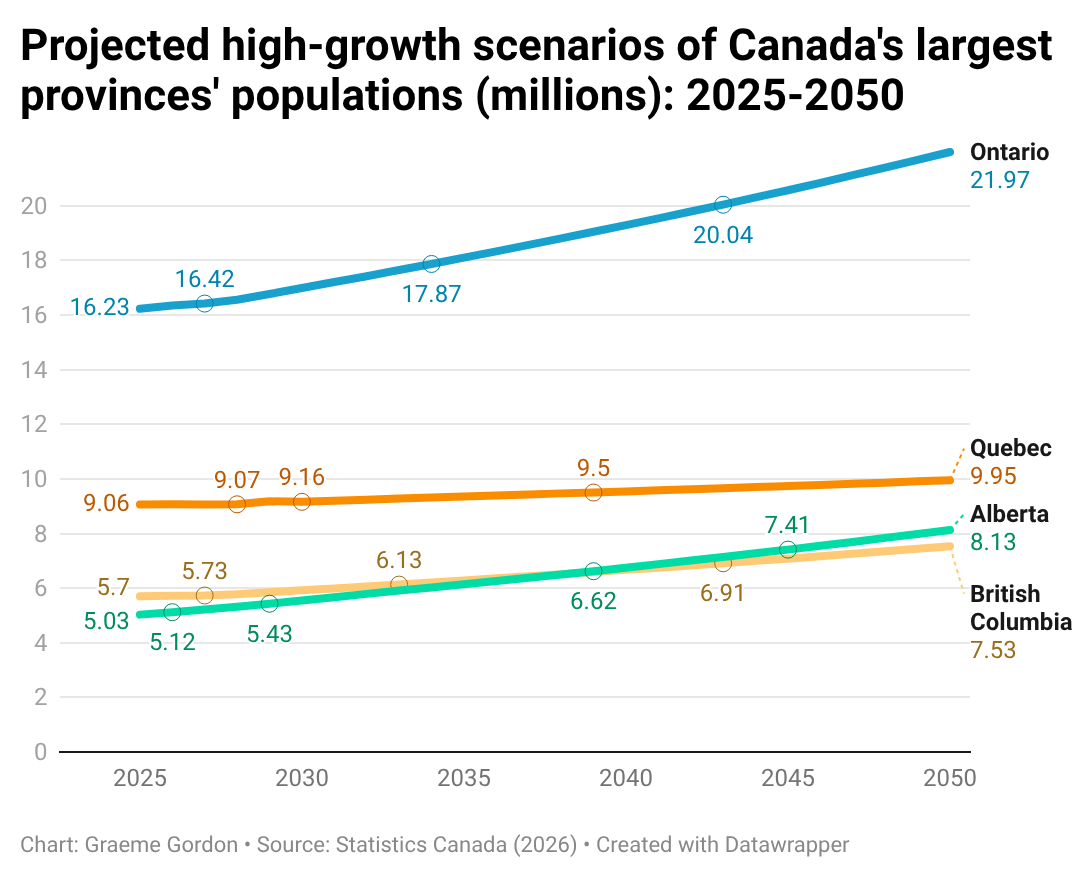
Alberta is expected to surpass British Columbia as the third-most populous province in most scenarios.
In the high-growth scenario, Alberta would hit over 8.1 million residents in 2050 from 2025’s 5.03 million. Meanwhile, in the same scenario, B.C. would grow at a slower rate from last year’s total population of 5.7 million, reaching 7.5 million residents by the middle of this century in the high-growth projection.
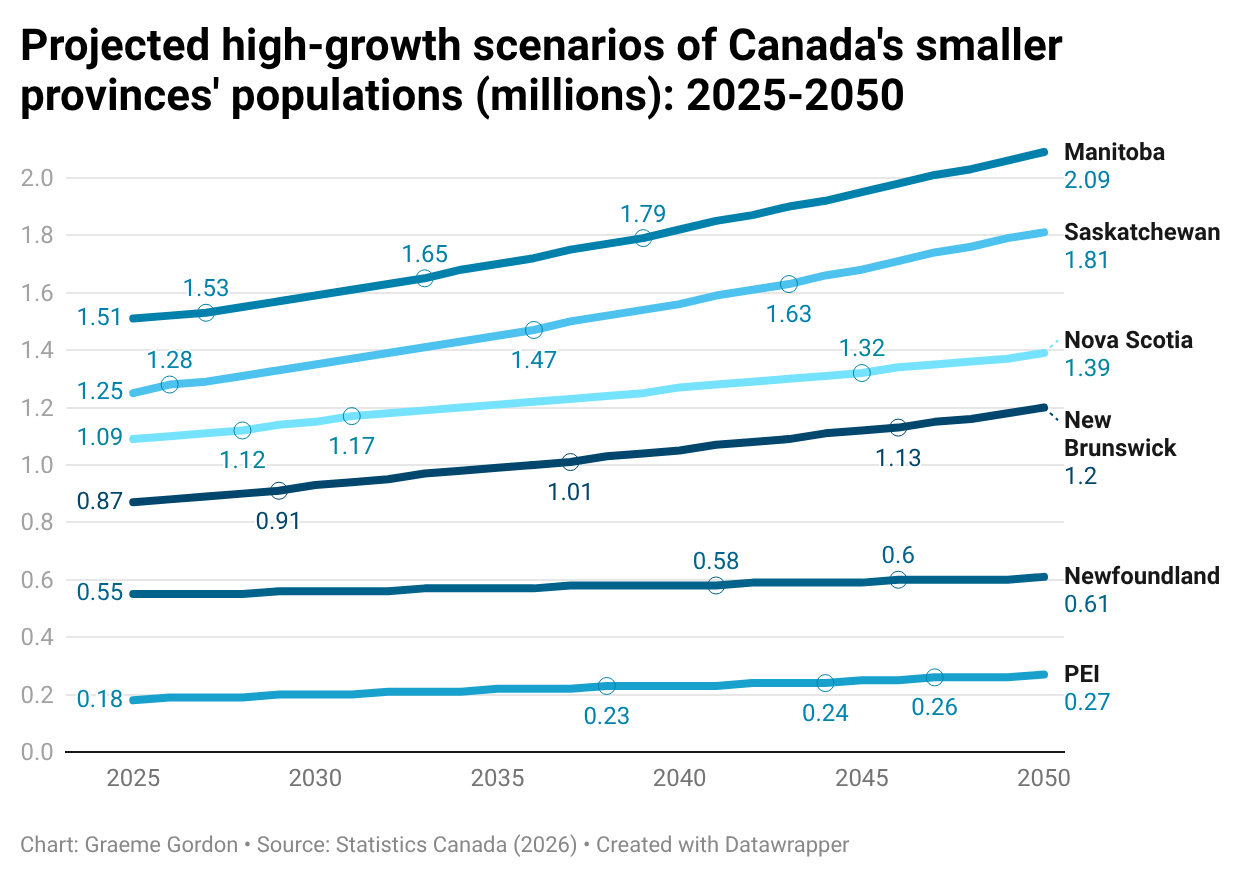
Manitoba and Saskatchewan would also increase their share of the national population in the various growth projections.
By contrast, Newfoundland and Labrador, Nova Scotia, and Quebec are projected to experience relative demographic decline. Quebec’s share of the national population, estimated at 21.7 percent in 2025, would fall to between 18.1 percent and 19.1 percent by 2050. Alberta’s share would rise from 12.1 percent to as high as 16.1 percent over the same period.
These shifts would have implications for political representation, federal transfer payments, infrastructure planning, and economic development strategies.
The high-growth scenario lists an annual growth rate of 1.34 percent for 2074-75, slightly higher than Canada’s average annual growth rate of 1.23 percent over the past 25 years.
The aging accelerates
The projections also highlight Canada’s continued aging population. The share of Canadians aged 65 and over, currently about 19.5 percent, is projected to rise to between 22.6 percent and 32.5 percent by 2075, depending on the scenario and how high average life expectancy reaches for men and women.
The fastest growth is expected among Canadians aged 85 and over. This cohort, numbering fewer than one million today, is projected to reach between 3.3 million and 4.2 million by 2075.
The average age of the population would rise from 41.8 years in 2025 to between 43.4 and 50.5 years by 2075.
At the same time, the proportion of children aged 0 to 14, estimated at about 15 percent in 2025, would decline in most scenarios.
Immigration remains the growth engine
Across all scenarios, immigration remains the primary driver of population growth. Since the early 1970s, when fertility rates fell below replacement level, natural increase (births minus deaths) has played a diminishing role in Canada’s population growth.
Immigration has supported labour force growth and helped sustain the tax base as the population ages. At the same time, rapid population growth has placed pressure on housing, infrastructure, and public services, factors that have influenced recent policy decisions to reduce temporary resident numbers.

Why this matters now
Statistics Canada has released the population projections during a period of heightened demographic uncertainty, shaped by historically low fertility, shifting immigration policies, and questions about the long-term effects of the COVID-19 pandemic on mortality and migration.
The agency stressed that the projections are not predictions. Economic shocks, pandemics, geopolitical conflicts, government policies, and environmental disruptions could significantly alter demographic trends.
Even so, the range of outcomes is wide. The difference between a population of 44 million and one approaching 76 million by 2075 would represent a fundamentally different set of challenges for governments, businesses, and public institutions.
Statistics Canada’s latest projections suggest Canada’s population could nearly double to 75.8 million by 2075 under a high-growth scenario. These projections are not forecasts but outline possible demographic futures based on varying fertility, immigration, and mortality rates. While a medium-growth scenario projects 57.4 million by 2075, a low-growth scenario anticipates around 44 million. The short term may see a slowdown due to government policies aimed at reducing temporary and permanent residency, with potential for slightly negative growth in 2026-2027. However, most projections anticipate immigration to rebound, leading to annual population growth in the hundreds of thousands.
With Canada's population potentially doubling by 2075, what are the biggest societal challenges we might face?
How might Canada's immigration policies influence its demographic future, according to these projections?
Given the varying population growth scenarios, what does this mean for Canada's long-term economic planning?







Comments (2)
Canada needs babies. Policies should be focused to help family formation and for people to have children to build a civilization for the future. Currently there are zero laws on the books governing abortion in Canada, one of the few countries without any. All efforts must be made to protect Canadians in law and welcome them in life. No babies, no future.