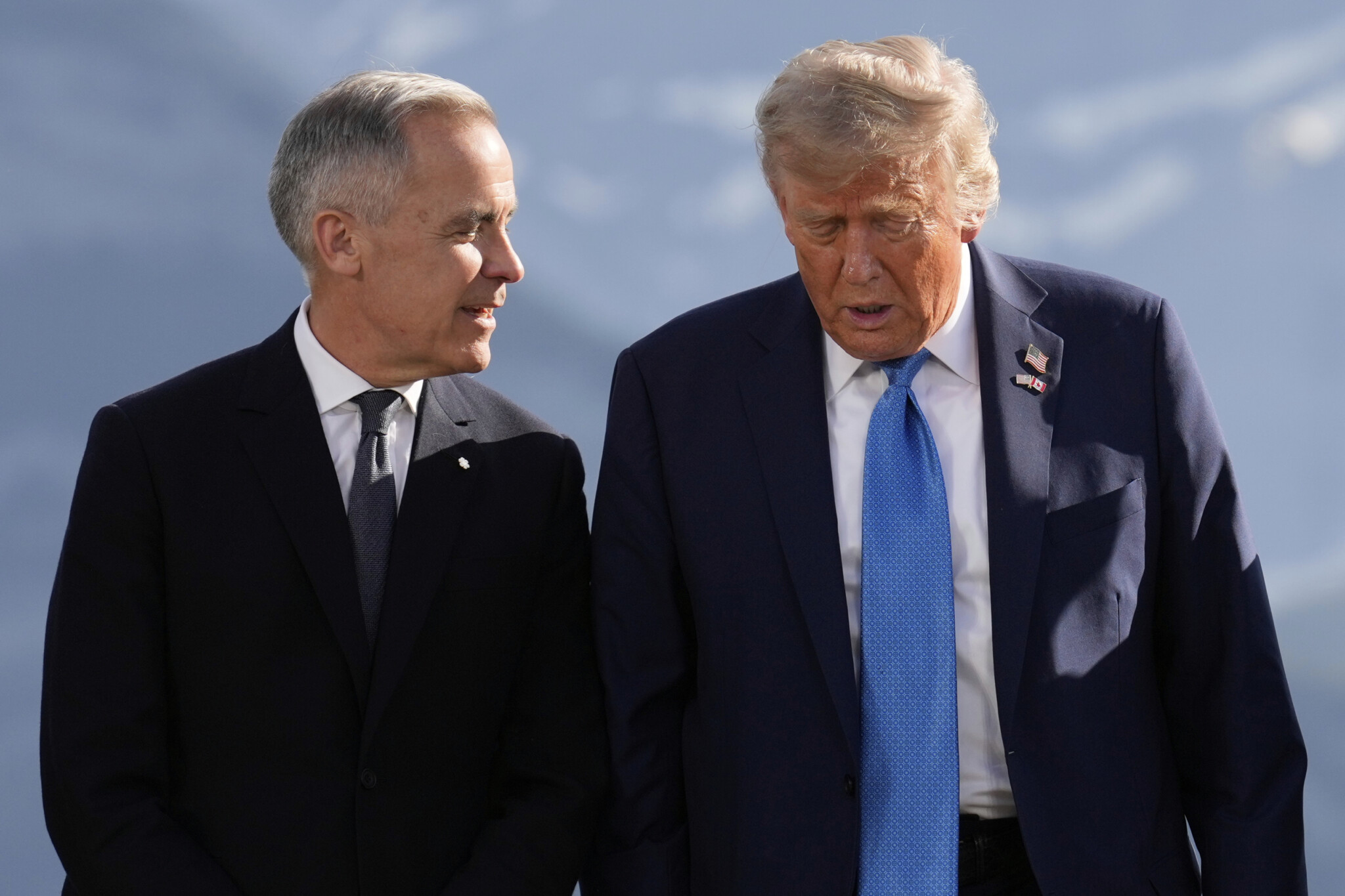
“We are taking the sign out of the window.”
That was the most consequential sentence in Prime Minister Carney’s deservedly lauded speech in Davos this week. In a single phrase, he signalled a break—intellectual, strategic, and moral—with a way of navigating the global order that has shaped Canada’s choices since the Washington Consensus took hold in the late 1980s and 1990s.
The reference, of course, was to Václav Havel’s famous essay on life under communism, in which a shopkeeper places a regime-approved slogan in his window not because he believes it, but because compliance has become the path of least resistance. The sign is not persuasion; it is submission disguised as normalcy. Systems endure, Havel argued, not merely through coercion, but through the quiet acceptance of arrangements that hollow out agency and responsibility.
The force of Carney’s point was not the historical allusion. It was the clarity of the diagnosis.
The global political economy we are now living in—made unmistakably visible by the Greenland episode on the eve of Davos—is defined by transactional mercantilism. Power is exercised through leverage, dependency, and coercive bargaining rather than shared rules. Trade becomes conditional. There are landlords, and there are vassals.
What Carney signalled is that Canada is not condemned to be a vassal.

For decades, access to the U.S. market, embeddedness in trade agreements, and faith in rules-based globalization were treated as sufficient conditions for prosperity. That posture made sense in a world where rules were stable, geopolitics largely background noise, and economic interdependence broadly benign. It makes far less sense in a world where tariffs, export controls, and regulatory barriers can be deployed overnight—even within formally “stable” trade frameworks.
Carney’s speech was effective precisely because it did not soften this reality. There was no illusion that the period ahead will be painless, nor any promise that Canada can simply “adapt” without cost. The tone was one of deliberate realism. This was not a call for optimism, but for seriousness. In that sense, the speech was almost Churchillian: clear-eyed about danger, frank about sacrifice, and grounded in the belief that clarity is a precondition for resilience.
But realism is only the starting point. Vision, however lucid, does not execute itself.
Prime Minister Carney’s speech signals a departure from Canada’s passive approach to the global order, moving away from reliance on rules-based globalization and towards a more transactional mercantilist reality. While Carney’s realism is a crucial starting point, Canada lacks a coherent strategy for building technological innovation and capability at scale. Past policies have favoured neutrality and breadth over strategic depth, resulting in fragile growth. There is a strong need for effective policy design, discipline, and a focus on upstream value creation rather than just assembly, urging Canada to build its prosperity internally.
Carney's 'sign out of the window' metaphor signals a shift from passive global engagement. What does this mean for Canada's future economic strategy?
The article criticizes Canada's past industrial policy as 'neutrality over direction.' How could a more 'disciplined' approach foster innovation and durable advantage?
Carney's speech emphasizes realism and sacrifice. What are the potential political challenges of implementing a strategy that acknowledges these realities?






Comments (3)
Remove the myriad of incentives and replace them with a simple tax structure that rewards growth and development.