
Every February, the International Institute of Strategic Studies publishes its Military Balance, one of a handful of public resources that catalogues the world’s militaries. It’s an invaluable resource, and I’ll usually spend a day thumbing through its pages and seeing all of the developments once it’s released.
It’s an illuminating insight into which countries are taking their geopolitical positions for granted and which are prepared to be serious actors on the world stage. For the past decade, one can clearly see the contours of a massive military buildup that has emerged among Western states.
Since 2014, for instance, Poland’s government has launched a massive modernization of its military forces, acquiring cutting-edge capabilities to deter or fight a potential war with the Russian Federation. Some of the numbers are staggering, such as going from 600 to 900 tanks between 2015 and 2025, or the addition of 16 Patriot medium-range missile systems. The seeds of Poland’s efforts really can be traced back to political decisions made a decade ago when they first began sensing the urgency of their situation, and which are now bearing fruit. Furthermore, Warsaw often eschewed industrial benefits during this buildup, instead prioritizing low cost and quick delivery of the capabilities they were procuring.

Many of these efforts made by Poland and like-minded nations have come in response to the threat posed by China and Russia, whose growth in terms of modernized capabilities is palpable. Particularly concerning is China, which has started fielding new indigenous designs at scale as part of new force concepts and doctrines that leverage technological innovations.One example is the J-20A Fagin, a long-range stealth fighter that seems intended to operate far off of China’s shores to interdict targets. Over the past decade, the People’s Liberation Army Air Force has fielded over 250 of them. Its naval buildup is even more impressive, with it now operating the world’s largest naval fleet and developing greater power projection capabilities.
Enter Canada, whose capabilities over this period have remained largely static, if not declined, due to obsolescence and lack of modernization vis-à-vis our adversaries. A representative case is that Canada’s tactical fighter fleet is in the midst of a major contraction as it retires a large portion of barely serviceable CF-18s in order to transition to the F-35 (which, as documented in these pages, may or may not even happen).
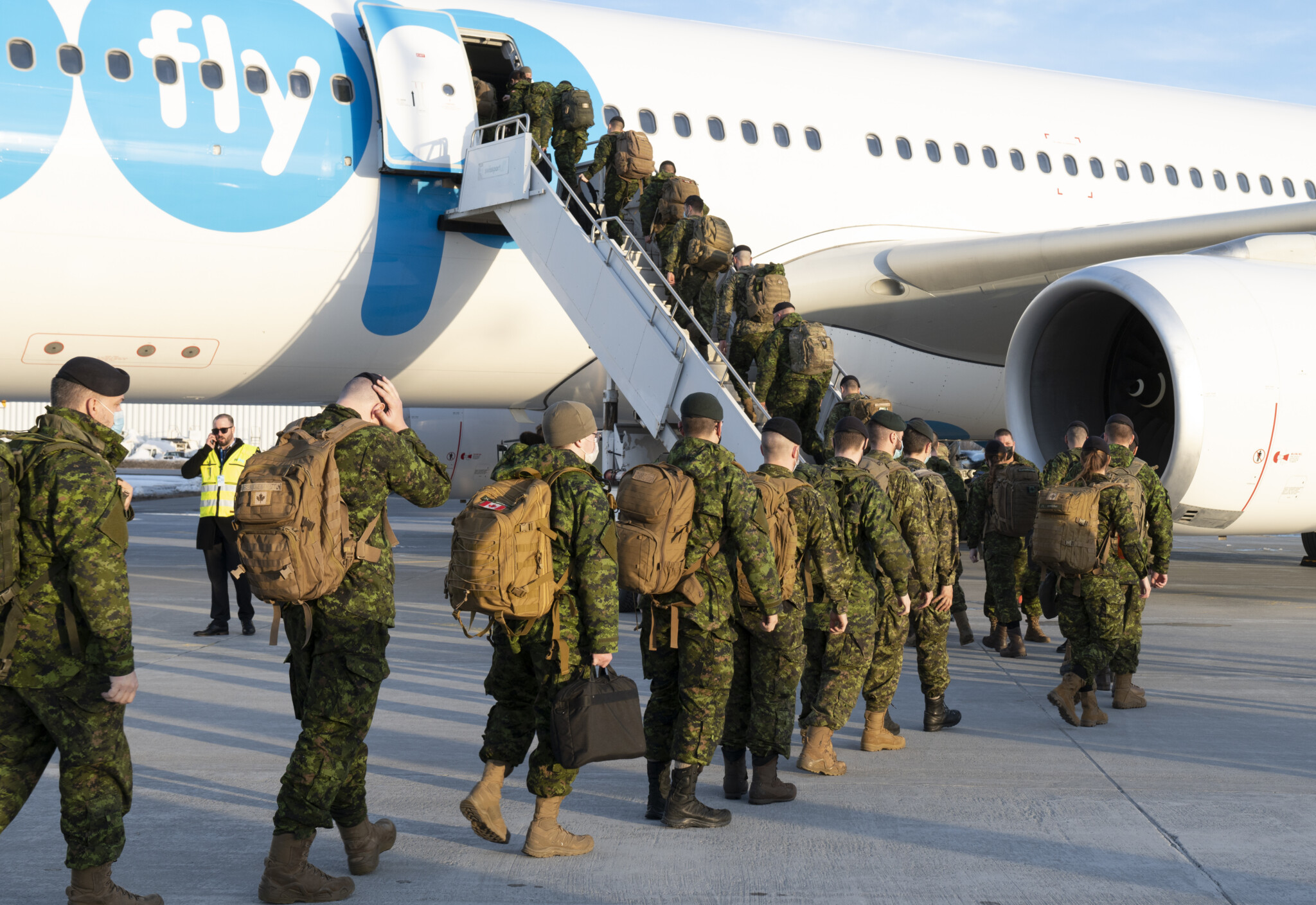
The Canadian Armed Forces’ most significant foreign presence is the 2200 troops currently deployed to Latvia—a pitifully small, embarrassingly ill-equipped force given the economic size of Canada. It is highly reliant on allies to provide it with key capabilities, such as long-range artillery or a large spectrum of air defence capabilities.
Canada is facing significant geopolitical threats, including from Russia and China, which are rapidly modernizing their militaries. While Western nations like Poland are investing heavily in defence, Canada’s military capabilities have stagnated, leaving it ill-equipped to address these challenges. The growing Russia-China military cooperation is a warning that Canada’s current approach, focused on economic benefits in procurement and a misplaced perception of the U.S. as a threat, is dangerously out of step with the escalating global security landscape.
Given Canada's static military capabilities, what are the primary geopolitical threats the article highlights?
How does the article critique Canada's approach to defense modernization compared to allies like Poland?
What is the article's main argument regarding Canada's relationship with the U.S. and its implications for defense?




Comments (11)
It is refreshing to have access to such objectively critical journalism. My dream is that the majority of Canadians tune in. Carny differs from his predecessor in that what he says reflects reality. Sadly, he is similar to his predecessor in that his words are just show.