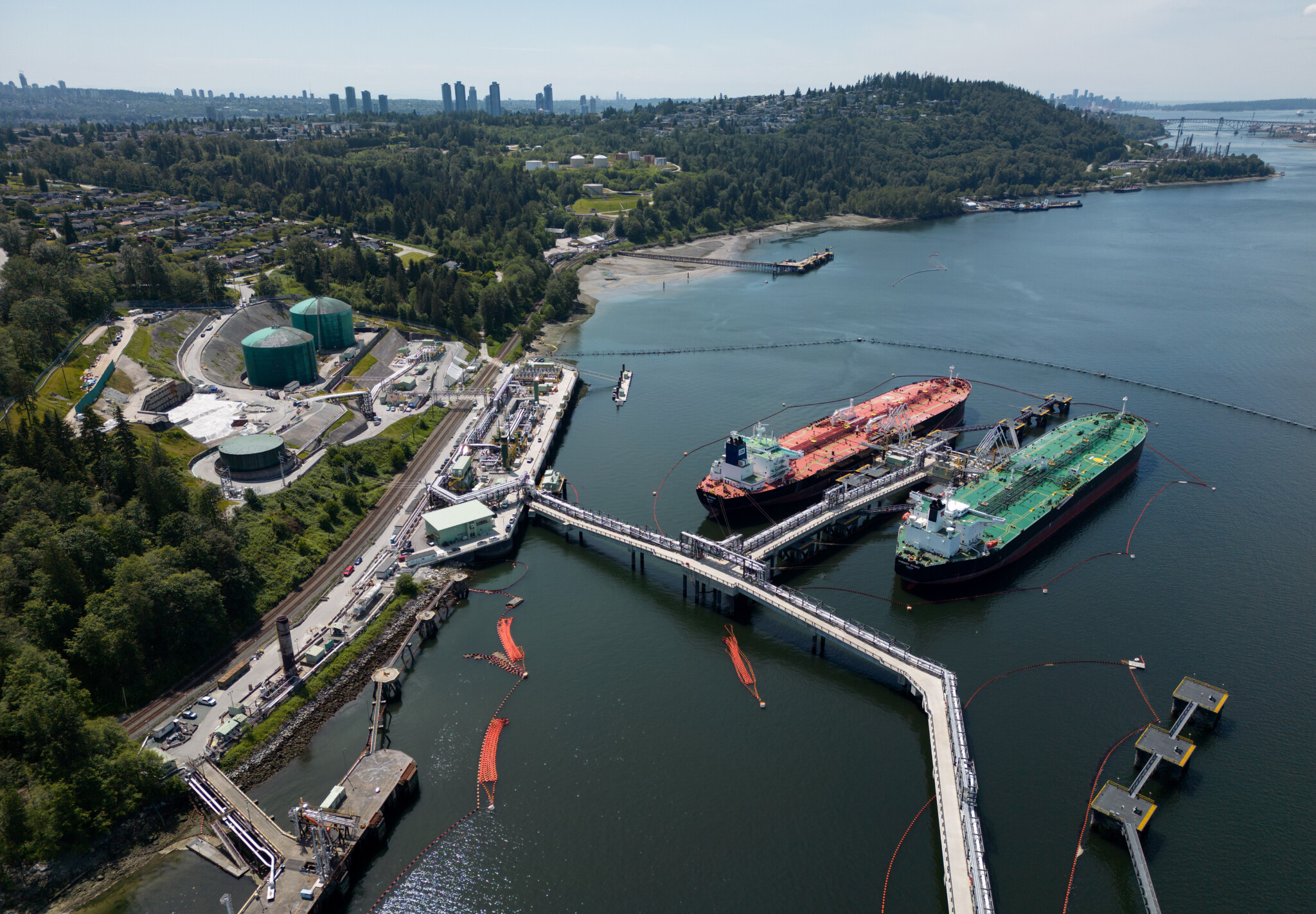
As global oil markets face a shifting landscape, Canada’s oilsands are emerging as a critical long-term energy supplier—just as production from major international sources begins to decline. As U.S. shale output likely peaks, conventional reserves in Mexico and Norway decline, and demand in Asia grows, Canada’s heavy oil resources are attracting renewed investor attention and strategic interest.
The Hub spoke with Heather Exner-Pirot, senior fellow and the director of the energy, natural resources, and environment program at the Macdonald-Laurier Institute, and a special advisor to the Business Council of Canada, to better understand the evolving role of Canadian oil in global energy security. The video was produced in partnership with the Pathways Alliance.
Here are five key takeaways from the conversation:
Major global oil sources are peaking or declining
The global oil supply picture is changing in ways that favour long-term Canadian production. Unlike conventional oil fields that lose supply rapidly, or shale wells that require constant drilling to maintain output, oilsands production is stable and expandable over a century-plus timeframe.
“Mexican production has declined. Norway is probably peaking now or very soonish. And obviously the United States, which I think is a huge deal, probably peaked last quarter in terms of their oil production,” Exner-Pirot explained.
This matters because, at the same time, global demand remains robust.
“Even if you say we use 105 million barrels [a day] and you don’t think we’re going to use much more than that, someone still has to produce 105 million barrels of oil every day,” she explained.
Exner-Pirot added that oilsands’ unique characteristics of not requiring the constant “treadmill” of new drilling positions Canada to fill emerging supply gaps more reliably than many alternatives.

The oilsands have reduced costs and emissions
The oilsands sector has undergone a transformation since the commodity price collapse of 2015, when roughly 100,000 workers were laid off. Through sustained investment in technology and efficiency, producers have cut operating costs to under $20 per barrel—far below the $35 to $45 per barrel costs that characterized the previous boom, when oil traded above $100.
“After the collapse in 2015, it was real tight,” Exner-Pirot said. “But in that 10 years since, they have driven costs down every year to the point now where break-even with the dividend averages around $45 a barrel.”
Emissions intensity has also improved substantially.
“Emissions intensity has gone down, just about every year since 2014. It’s gone down by about a third,” she noted, adding that the sector spends more on emissions reduction research and development than any other industry in Canada.
Compared to other heavy oil sources globally, Canadian barrels now perform competitively.
“If you displace Canadian heavy oil with someone else’s heavy oil, you are going to have more emissions in this world,” Exner-Pirot said.
Asian markets represent the future for Canadian oil exports
While the U.S. market remains vital, the Asia-Pacific region offers strategic advantages for Canadian heavy oil. Asian refineries have been investing in complex facilities designed to process heavy crude, creating structural demand that aligns with Canadian supply.
“Around Asia, they have been investing in refineries that can accept heavy oils,” Exner-Pirot said. “That will make them structurally codependent on a heavy oil supplier.”
The Pacific Basin is undersupplied compared to Atlantic markets, and Canada’s West Coast offers the shortest, most secure route.
“That straight shot that we have from B.C. into the Pacific is shorter and safer,” Exner-Pirot noted.
Importantly, selling more to China doesn’t create the same dependency risk as relying overwhelmingly on U.S. markets.
“Five or 7 or 10 percent of your supply going to China doesn’t make us dependent on China,” Exner-Pirot said. “But it diversifies us from economic coercion from the customer that actually has that ability right now.”
A northwest coast pipeline is economically viable, but requires government de-risking
Both Enbridge and Trans Mountain have announced plans to expand existing capacity by a combined 760,000 barrels per day However, a new northwest coast pipeline faces different challenges, primarily regulatory uncertainty.
“What made Trans Mountain so expensive and is a red flag for everyone is partly the legal delays, the lack of certainty, the fighting between B.C., the city of Burnaby in particular, First Nations,” Exner-Pirot said, citing examples like the halting of construction for four months due to a hummingbird nest.
The government of Alberta’s approach focuses on de-risking the project.
“What Alberta is trying to do, and what I think the Building Canada Act sets up, is to say, ‘We will de-risk, we will get rid of the uncertainty, probably put in some Indigenous equity,’” she explained.
The timeline isn’t urgent, she said, allowing time for proper consultation and planning.
Canadian public opinion on oil and gas has shifted significantly
Perhaps the most significant change has been in public perception. The recent threat of Venezuelan oil displacing Canadian supply in U.S. markets generated unprecedented national attention and concern.
“I had more media calls for that issue than anything else,” Exner-Pirot revealed. “For the first time, Canadians felt ownership for our oil and gas sector and felt threatened for their oil and gas sector. It wasn’t Conservative’s oil and gas sector. It wasn’t Alberta’s oil and gas sector.”
This shift reflects a broader maturation in how Canadians view energy resources. A strong majority of Canadians, 83 percent support expanding our oil and gas exports and 68 percent support a new pipeline to B.C., according to an Ipsos poll from the end of 2025 that surveyed 1,500 respondents.
“The oilsands is our most exquisite resource…And for me, it is the most important economic resource that Canada has by value, that’s objective,” she said. “And it is the most important geopolitical resource that Canada has.”
This story draws on a Hub video. It was edited using NewsBox AI. Full program here.
Canada’s oilsands are positioned to become a crucial long-term energy supplier as global oil production from other major sources declines. With U.S. shale output potentially peaking and conventional reserves in Mexico and Norway decreasing, the demand for Canadian heavy oil is growing, particularly in Asia. The oilsands sector has significantly reduced costs and emissions intensity since 2015 through technological advancements. While the U.S. remains a vital market, Asian refineries’ investments in heavy oil processing create a strategic advantage for Canadian exports. A northwest coast pipeline is economically viable but requires government de-risking to address regulatory uncertainty. Public opinion in Canada has shifted, with increased support for expanding oil and gas exports.
With U.S. shale production potentially peaking, how might Canada's oilsands impact global energy security and geopolitical dynamics?
The article mentions reduced costs and emissions in the oilsands. How have these improvements been achieved, and what are the implications for the industry's future?
What are the main obstacles to building a new northwest coast pipeline for Canadian oil, and what role might government play in overcoming them?






Comments (0)