
When Statistics Canada released the latest Labour Force Survey earlier this month, the headlines were predictable. The unemployment rate fell to 6.5 percent. Overall employment edged down by 25,000. The coverage, as it almost always does, mostly stopped there.
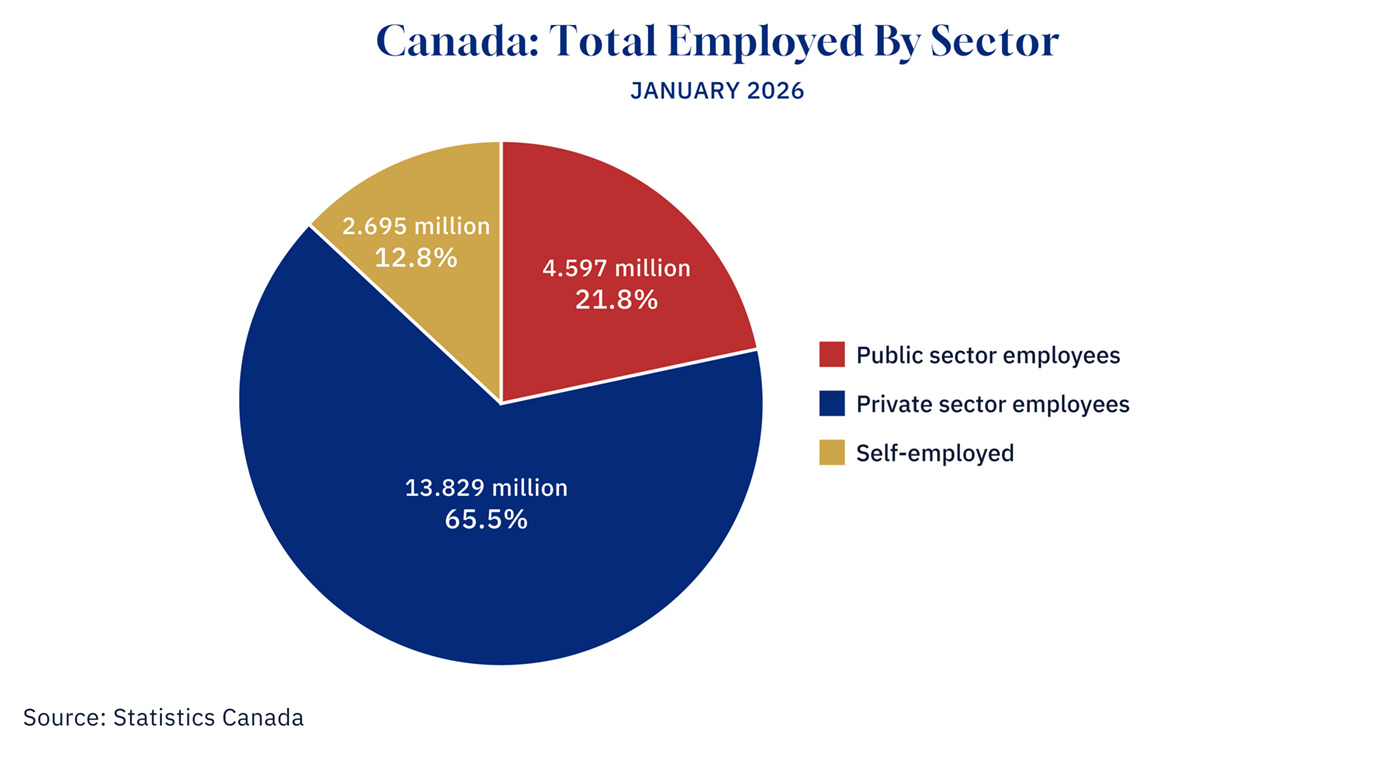
But buried several tables into the same release is a figure that deserves considerably more attention. In January 2026, 4.597 million Canadians worked in the public sector—all employees of federal, provincial, and local governments, government agencies, Crown corporations, and publicly funded establishments like schools, universities, and hospitals.
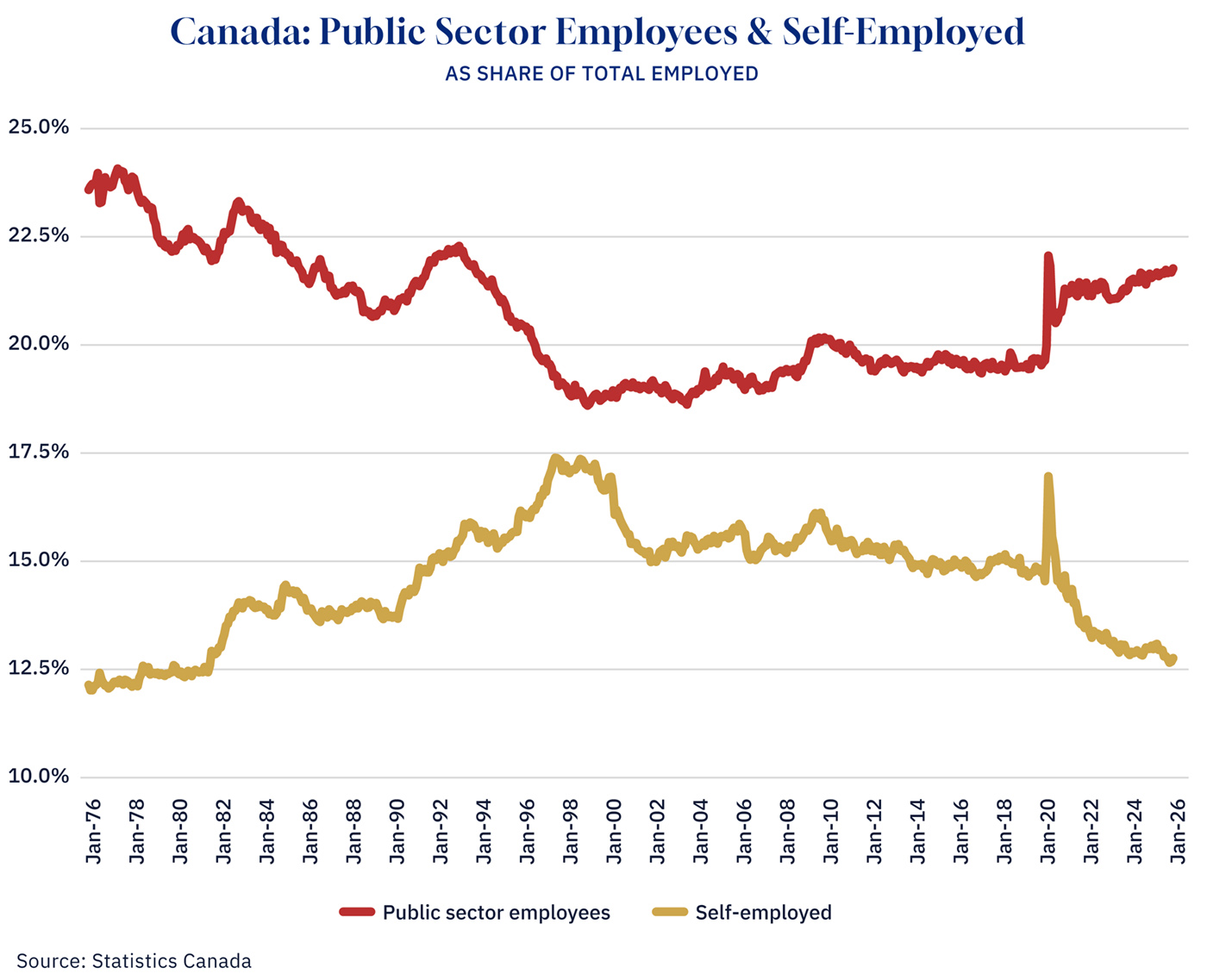
That represents 21.8 percent of everyone employed in Canada. It is a percentage that has been quietly climbing for five years, and it puts Canada on a trajectory back toward territory last occupied before the fiscal consolidations of the 1990s.
The Carney government’s commitment to reduce federal headcount by 40,000 positions has generated considerable debate. And that discussion is worth having. But it addresses only a narrow slice of a much broader shift, one that the monthly labour force data have been documenting in plain sight.
Graphic Credit: Janice Nelson.
A 50-year perspective
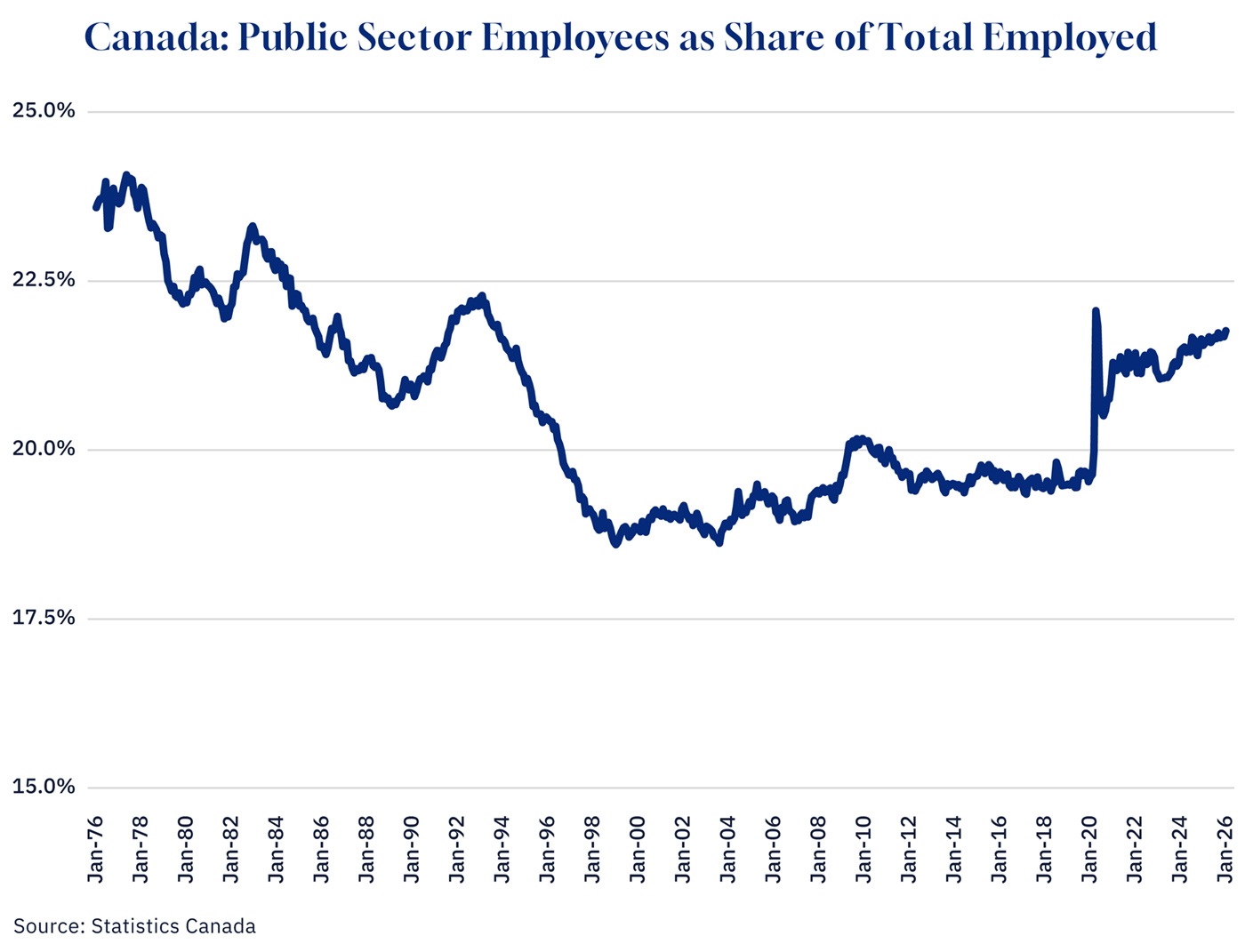
The long view puts the current trend into perspective. When Statistics Canada began tracking employment by class of worker on a monthly basis, public sector employees accounted for roughly 23 to 24 percent of Canada’s workforce—nearly one in four employed Canadians. Through the late 1970s and into the 1980s, that share generally declined. Then came the recession of the early 1990s.
Graphic Credit: Janice Nelson.
As private sector employment contracted, the public sector held steadier, and its share briefly climbed back above 22 percent. By 1993, the federal deficit had reached levels that were widely regarded as unsustainable, and provincial governments were in similar positions. What followed in the 1990s was a significant restructuring of the Canadian public sector.
The federal government, under Finance Minister Paul Martin, cut deeply. Provinces followed with their own consolidations, in some cases more aggressively. The effect on employment was dramatic: the public sector share fell from a peak of 22.3 percent in early 1993 to 18.6 percent by 1999—a reduction of nearly four percentage points.
The two decades that followed were relatively stable. Through the 2000s and most of the 2010s, public sector employment sat in a band between 19 and 20 percent of total employment. The 2008-09 recession produced a modest temporary increase as private sector jobs disappeared faster than public ones, but the share normalized through the recovery. Going into the COVID-19 pandemic in early 2020, the public sector comprised 19.6 percent of employed Canadians—about where it had been 15 years earlier.
Graphic Credit: Janice Nelson.
The pandemic reset that hasn’t reset
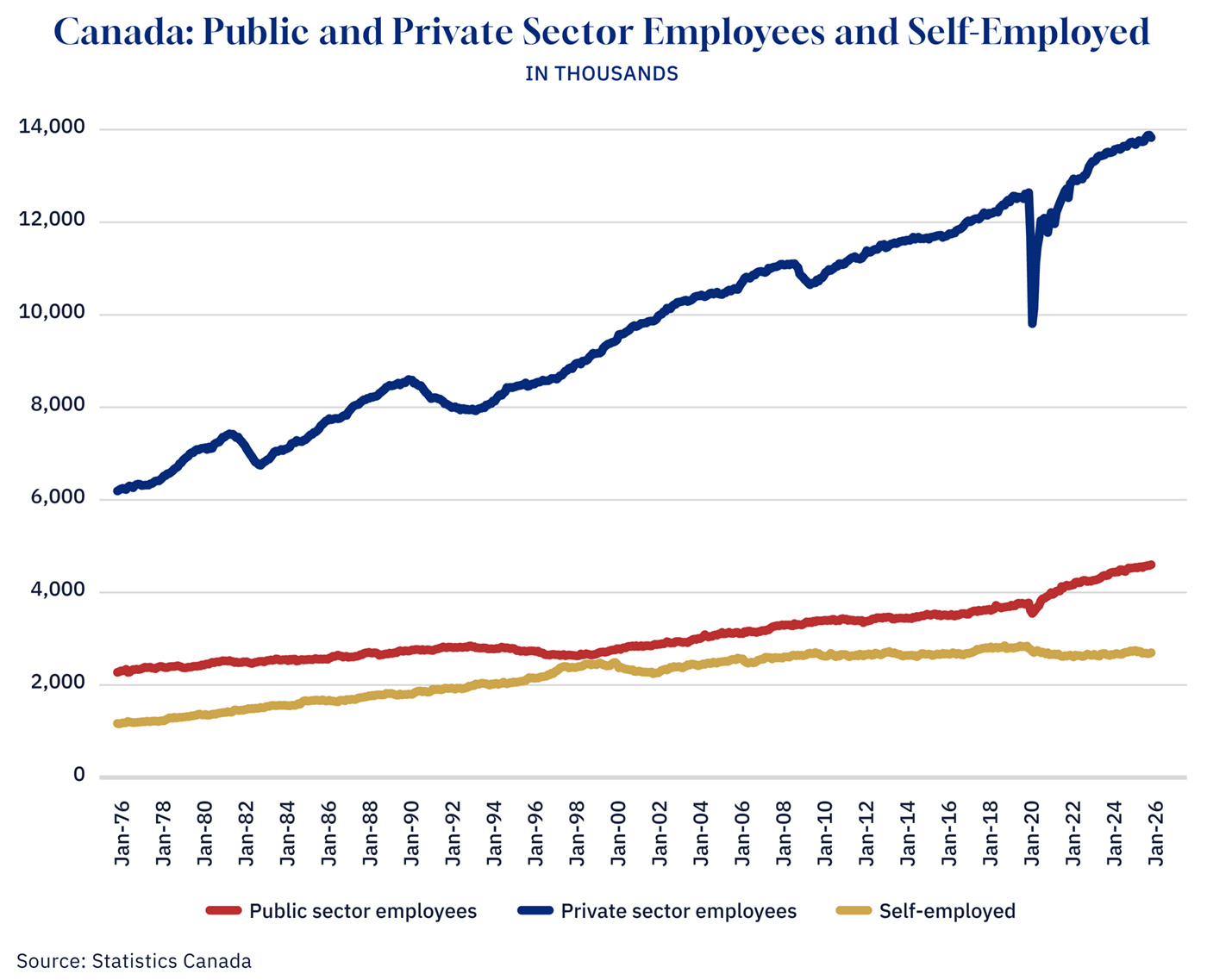
What happened next is the core of the story. The pandemic created an immediate distortion: private sector jobs collapsed faster than public ones in the spring of 2020, briefly pushing the public sector share above 22 percent. That was expected and widely understood as temporary.
What was not expected was what came after. As private sector employment recovered, the public sector share did not return to its pre-pandemic level. Instead, it consolidated at a new, higher plateau. By January 2021, the share had settled at 21.3 percent. It has remained above 21 percent ever since. In January 2026, it stands at 21.8 percent—and if the five-year trend line continues, Canada will return to the 22-plus percent territory last seen in the early 1990s, just before governments decided that level of public sector employment was fiscally unsustainable.
The mechanics of the shift matter. Government hiring accelerated sharply during the pandemic, particularly at the federal level. Provincial and municipal governments also added workers, as did hospitals and universities. Unlike the private sector, which sheds employees quickly when conditions change, the public sector tends to expand more easily than it contracts. The accumulated effect of five years of expansion above the pre-pandemic trend has now produced a structural shift, not a temporary anomaly.
Importantly, these figures count only direct employees. They exclude the contractors and consultants who perform government work but are classified as self-employed or private sector employees, meaning the true scope of public sector activity is larger still.

More workers, less output per dollar
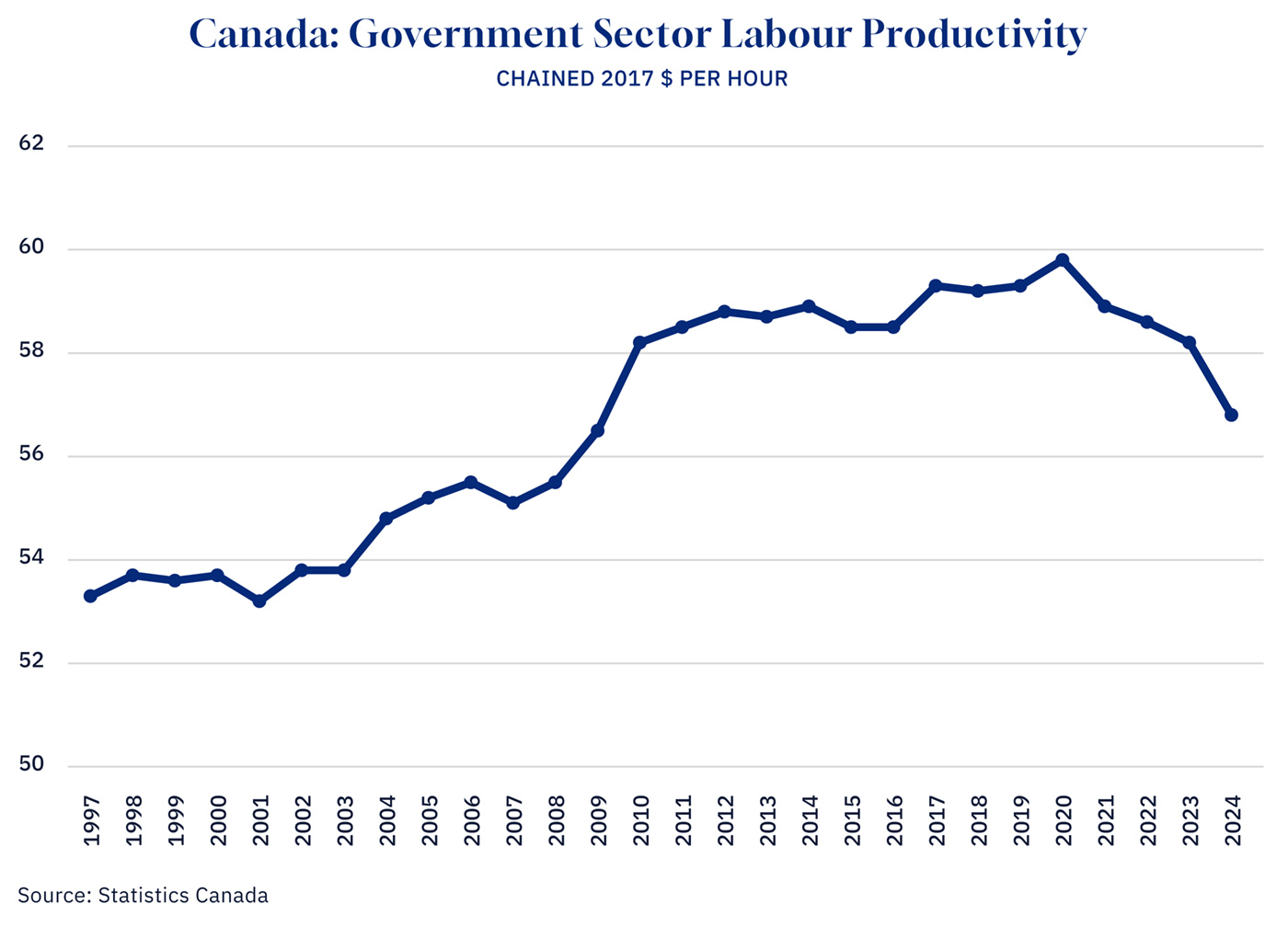
There is another important dimension to this story. Statistics Canada’s labour productivity data for the government sector show that inflation-adjusted output per hour worked in government peaked at $59.80 (in 2017 dollars) and has declined every year since, falling to $56.80 in 2024. That is the lowest reading since 2009, and it comes as public sector employment has been growing.
The juxtaposition is stark: more government workers, consuming a higher share of Canada’s total workforce, are producing less output per hour. Measuring public sector productivity has its challenges, but this still represents a deterioration in what taxpayers receive for their money. Governments at all levels have been expanding employment, while the productive return on that expansion has been falling. Canadians are right to wonder whether they are getting better services in exchange for the expansion.
Graphic Credit: Janice Nelson.
The fiscal arithmetic doesn’t work
The fiscal implications extend beyond productivity metrics. Whatever your view of the appropriate size of government, Canada’s expanding public sector is not being fully financed by current tax revenues. Federal and provincial governments have run persistent deficits for most of the past decade, meaning the growth in public sector employment has been substantially debt-financed. Debt charges, which continue to rise, mean taxpayers are paying not just the public sector salaries, but interest costs on top.
This all creates a sustainability problem. Public services ultimately depend on a productive private sector generating the tax revenues to fund them. But Canada’s private sector performance has been deteriorating on precisely the measures that matter for revenue generation. Business investment per worker has declined. Productivity growth has stagnated. Our competitive position has weakened relative to other countries over the past decade.
The risk is a vicious cycle. As the public sector expands its share of employment, it draws workers and capital from the private economy that must generate the revenues to support that expansion. When the private sector is simultaneously underperforming and the public sector is growing faster than the tax base can sustainably support, the gap gets filled with borrowing.

An employee arrives at the Office of the Prime Minister and Privy Council building in Ottawa, February 17, 2020. Adrian Wyld/The Canadian Press.
Eventually, the interest costs on that borrowing consume resources that would otherwise fund services—or it forces correction through either tax increases that further damage private sector competitiveness, or spending cuts that reduce services, or both.
The disappearing entrepreneur
The productivity problem connects to a broader reallocation of Canada’s workforce that receives almost no attention. As the public sector has grown as a share of employment, self-employment has moved in the opposite direction—and the inverse correlation is striking when viewed over the same 50-year horizon.
Graphic Credit: Janice Nelson.
Self-employment in Canada today accounts for 12.8 percent of total employment, its lowest share in the modern data. In the early 2000s, more than 2.4 million Canadians ran their own businesses or worked for themselves. That number has barely moved in absolute terms for two decades even as total employment has grown by more than six million workers — meaning that as a share of the workforce, entrepreneurship has been crowded out almost continuously.
The public sector competes for the same pool of capable Canadians who might otherwise build businesses. Government employment offers attributes that can be attractive in an era of economic uncertainty: defined-benefit pensions, job security, generous leave provisions, and structured career advancement. The result is a slow reallocation of human capital away from entrepreneurial risk-taking and to the stability of the public payroll.
This matters for Canada’s productivity challenge in ways that rarely surface in the debate about government size. Entrepreneurship and new business formation are disproportionate drivers of private sector productivity growth. When the share of Canadians choosing that path falls by more than a quarter over a generation, the cumulative effect on business dynamism and private investment is real, even if no single year looks alarming in isolation.
View reader comments (10)
What the Carney cuts actually mean
None of this is an argument against public services or the people who deliver them. Teachers, nurses, first responders, and public health workers are essential. A functioning state requires capable people to run it. What’s at issue is proportion and trajectory, not whether these roles should exist.
The federal government’s plan to cut 40,000 positions is a corrective measure worth taking. The federal public service grew by roughly 111,000 positions over the past decade, so the proposed reduction reverses about a third of that expansion. But set against Canada’s 4.6 million public sector workers, those 40,000 positions amount to less than one percent of the total. Call it a start if you like, but calling it “right-sizing” the state gets well ahead of what the numbers support.
And even that understates the challenge. The federal cuts address one corner of a much larger picture. Provinces and municipalities deliver the bulk of direct services to Canadians, and they answer to their own fiscal and political pressures. Hospitals and universities, which together employ hundreds of thousands of Canadians, are governed by provincial policy. No coordinated plan exists across orders of government to address the shift since 2020.
The 1990s offer a useful parallel. That consolidation succeeded because it was coordinated. Federal and provincial governments moved in the same direction over several years, driven by shared recognition that the trajectory had become unsustainable. Reversing the post-pandemic expansion would require governments to hold hiring flat for years while the private sector grows. That takes political will and fiscal discipline that federal commitment alone cannot deliver. So far, neither is evident.
As of January 2026, 21.8 percent of employed Canadians worked in the public sector, a figure that has been steadily rising over the past five years. This trend is approaching levels seen before the fiscal consolidations of the 1990s. While government hiring accelerated during the pandemic, the public sector share did not return to pre-pandemic levels as private sector employment recovered. Simultaneously, government sector productivity has declined, raising concerns about the value taxpayers receive. The expanding public sector, often financed by debt, coupled with a struggling private sector, poses a sustainability challenge.
How does the current public sector employment trend compare to historical patterns in Canada?
What are the potential economic consequences of a growing public sector and declining productivity?
How might the decline in self-employment relate to the growth of the public sector?







Comments (10)
It will be deja vue all over again soon. The finger prints of today are identical to those of the gut wrenching, retrenching of the 1990’s – the bloated government employment as described in this article, out-control public spending at all levels of goverment (deficits), huge debt to GDP ratios (past spending), retrenchment of over priced housing that will leave many borrowers under water, etc.
When the reckoning comes, it’s going to hurt.