
There is an ongoing debate over whether Canada is doing better economically than Alabama, based on their relative GDP per capita, with many on the Canadian Left arguing that our country’s economic performance and quality of life look much better when other factors are taken into account.
Unfortunately, this argument misses the mark. When we expand our comparisons beyond Alabama, it quickly becomes apparent that GDP per capita is, if anything, overstating the relative state of our economy and wellbeing relative to our global peers.
Economists have always recognized that GDP per capita, which measures the total monetary value of all final goods and services produced within a country’s borders within a year, divided by the population, is a limited measure of a country’s development, though it is strongly positively correlated with other development indicators.

This limitation does not make GDP per capita a flawed measure; rather, it is simply not the proper tool for the job. By design, it does not consider how that output is distributed across a population, nor does it directly account for other factors that contribute to a high quality of life, such as clean air and safe streets.
The most well-known approach to constructing a more fulsome quality-of-life index is the United Nations’ Human Development Index (HDI). First published in 1990, the HDI assesses performance across a variety of criteria, including life expectancy, and assigns countries a score between 0 and 1. In 1993, Canada ranked fourth in the world; in the 1990s, it routinely ranked in the top five. Over the next two decades, Canada continued to improve in absolute terms, gaining 0.031 and 0.028 points respectively, but our rankings fell to 10th in 2003 and 13th in 2013.
The latest score, based on 2023 data, places Canada in 16th place overall, having gained only 0.009 points over 10 years.
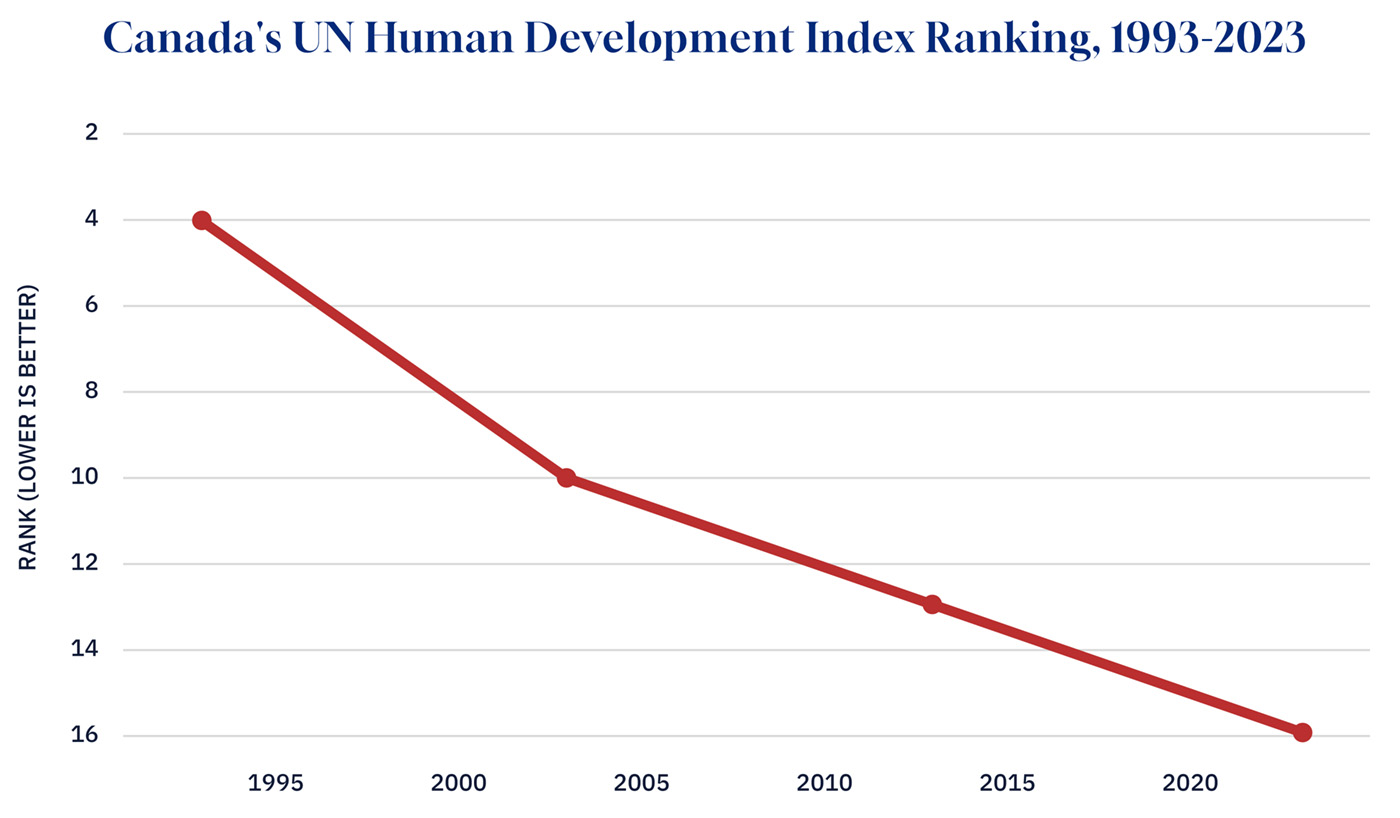
Graphic credit: Janice Nelson.
Our relatively stagnant economy, coupled with deteriorating income inequality and limited gender equality, has left us 0.030 points behind Norway, Switzerland, and Iceland. At our current tepid rate of improvement, it will take Canada over three decades to reach the level of development these countries enjoy today.
Social scientists have also recognized that raw data can only tell you so much and that surveying the population is important for a more complete picture. In 2011, the United Nations launched an initiative to better understand and monitor subjective well-being worldwide. This led to the World Happiness Report, which combines economic data with Gallup World Poll results to assess quality of life across nearly 200 countries.
In the inaugural World Happiness Report, released in 2012, Canada ranked fifth-happiest in the world. In the latest report, issued in 2025, we have fallen to 18th place. Interestingly, our second-highest performing measure is GDP per capita, where we finished 16th.
Some of our poorest performance comes in areas that Canadians often view as strengths: we finished 21st in healthy life expectancy, 44th in inequality, and 68th in freedom. In the rankings, freedom is defined in a much broader sense than freedom from government tyranny, encompassing “option freedom,” that is, the freedom to make life choices, such as moving to another city or buying a home.

Our lack of housing affordability is causing Canadians, particularly young Canadians, to feel less free. The connection between housing affordability, freedom, and happiness was clear in the 2024 report, which found that Canadians over 60 were the eighth-happiest in the world, while those under 30 ranked 58th. Young people are unhappy and unfree, as Canada’s middle-class housing crisis has limited their options.
None of these measures is perfect, so groups outside the United Nations have begun developing their own measures. For example, the OECD Well-Being Monitor assesses 38 of the world’s richest countries across 24 headline indicators measuring material conditions, quality of life, and community relationships. Of the 23 indicators for which Canada has data, we rank in the top third in only seven, including household income. Conversely, we rank in the bottom third for five indicators, including deaths of despair and gender wage gaps.
View reader comments (23)
For most indicators, our performance is mediocre. Ironically, one of our best-performing indicators, household net wealth, and one of our worst, housing affordability, are both directly attributable to Canada’s chronic housing shortages.
This whole debate about whether or not Canada has a higher GDP per capita than Alabama misses the mark because it compares Canada to a single U.S. state, of which we have little in common, and is based on the flawed assumption that Canada’s relative performance looks better when we add additional considerations such as life expectancy and inequality. While that might be true relative to Alabama, when compared to our global peers, a more nuanced examination of the data makes our performance look worse, not better.
Canada should be the greatest nation in the world, and settling for mediocrity is not patriotism—it is giving up on the country. We can and must do better.

Mike Moffatt is the founding director of the Missing Middle Initiative and co-host of the Missing Middle Podcast.
Comparing Canada’s economic performance to Alabama based solely on GDP per capita is misleading. While Canada might appear better by including factors like life expectancy and inequality in such a comparison, this perspective falters when compared to global peers. Canada’s declining rankings in the Human Development Index and the World Happiness Report are due to issues like stagnant economic growth, income inequality, and limited freedom due to housing affordability. Canada’s performance is mediocre compared to leading nations, and settling for mediocrity is not patriotism.
Why does the author argue that comparing Canada's GDP per capita to Alabama's is misleading?
According to the article, in what areas is Canada underperforming relative to other developed nations?
What connection does the article draw between housing affordability and the happiness/freedom of young Canadians?







Comments (23)
Justin Trudeau’s 10 years of wildly excessive immigration levels severely damaged the health care system, the housing market and social services, all of which are fundamental to some of these social indicators. His government’s half-hearted policies on resource developments damaged economic growth potential, exacerbating the other damage. Lost decade indeed.