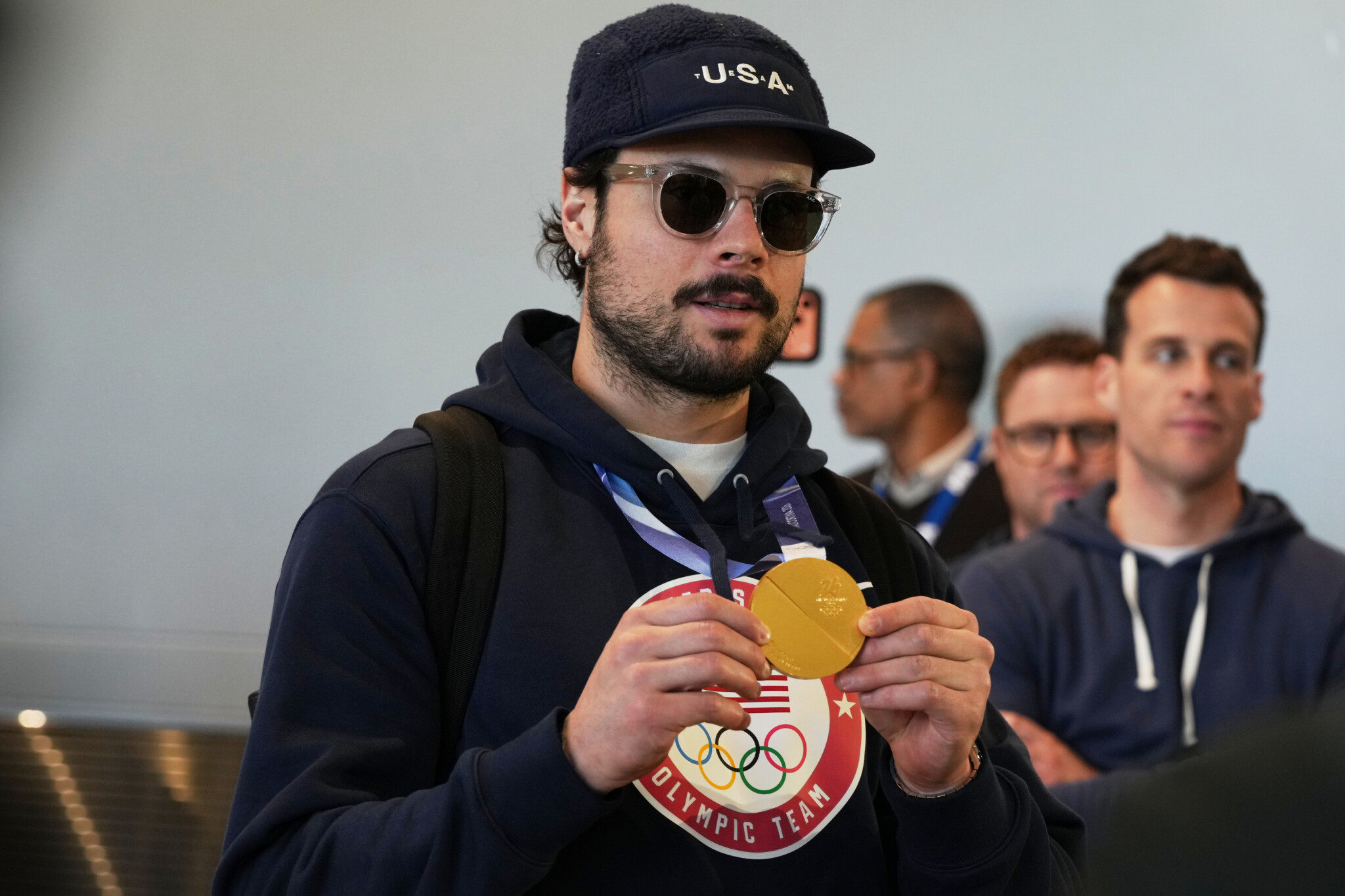
The U.S. Men’s Hockey Team has been under fire from seemingly every angle since their historic gold medal Olympic victory against Canada.
As a proud Canadian, I count myself among the scores of broken-hearted fans who would have loved nothing more than to stick it to the Americans one more time at the Olympics, and (politely) let them wallow in their own misfortune.
Unfortunate for us, the shoe is on the other foot—and Canadians aren’t taking it well.
“Elbows Up” sports columnist for the Toronto Star, Damien Cox, didn’t mince words this week in calling out Toronto Maple Leafs captain, Auston Matthews, for travelling with his team to the White House to be celebrated by U.S. President Donald Trump in the Oval Office.
Visits to the Oval Office are commonplace for sports championship teams in the United States. Every visit comes with a holdout or two for various reasons; sometimes personal, sometimes political. Boston Bruins goaltender Tim Thomas famously boycotted visiting the Obama White House in 2012 after winning the Stanley Cup. The entire Golden State Warriors NBA Championship team in 2017 declined an invitation from Trump. Some players on the 2018 Philadelphia Eagles, 2019 Boston Red Sox, and even Michael Jordan in 1991 (allegedly for a round of golf), have skipped White House visits.

Whatever reasons Matthews had behind his acceptance of the White House visit, the sports media and Toronto sports columnists are furious.
Speaking to the decision to go to the White House, Cox wrote this week, “But it’s also not too much to expect him to proudly represent the Leafs and be supportive of Canada. It’s just not that hard. Mats Sundin always did it, even when leading his native Sweden to Olympic glory. But No. 34 made his choice. We may well one day look back at this as the day when the Matthews era unofficially ended in Toronto.”
For starters, Matthews is an American. He was born in the United States to a mother of Mexican descent. Lived most of his life in Arizona and has played Hockey for Team USA numerous times.
View reader comments (5)
He is, however, an American who is employed (albeit handsomely) by a Canadian hockey team. And this could also be very temporary employment if you look at the NHL Eastern Conference standings.
By walking the path that Cox and others would have suggested, Matthews would have not only been breaking with the team he captained, but would have been allowing himself to knowingly wade into the political debates surrounding the U.S.-Canada dynamic by showing preference to a country in which he was not born, and again, only temporarily employed, in.
Could you imagine the headlines on ESPN? In 2012, the headline read: “Tim Thomas puts himself above his team.”
It, of course, would have been the exact hollow imagery that would have given the “Elbows Up” brigade the serotonin boost that they crave until they found their next target.

To expect an American-born player, after achieving the pinnacle of success in his professional career, to throw that all away for some vacuous statement of solidarity to Toronto and Canada is a stretch.
It is going to take some time to get over the loss to the Americans, and surely Hockey Canada and its leadership will do a thorough post-mortem on what adjustments need to be made in the lead-up to the 2030 Winter Olympics in the French Alps.
But I promise you that post-mortem will be short-lived and will be more forward-looking to the talent, promise, and prospect of a gold medal team.
The Canadian public would be well served to view their relationship with the U.S. through the same lens. Look at how we got here in our relationship, but focus and prepare for a future that will be a vastly different game, where we put our country in a position to control our own destiny.
In the meantime, we should applaud Matthews and Team USA, both men’s and women’s, on their historic run. A distinctively polite Canadian approach. And as such, we’ll prepare to see them in four years while praying to God that it is played five-on-five.
Auston Matthews’ decision to visit the White House with his team after winning a championship was the right one, despite criticism from Canadian sports columnists. As an American citizen employed by a Canadian team, Matthews isn’t obligated to prioritize Canadian sentiments over his team’s traditions. The expectation that Matthews should make a political statement against his team and country of origin is far-fetched. Canadians should focus on future success rather than dwelling on past losses and perceived slights. We need to prioritize a polite and forward-looking approach to the U.S.-Canada relationship.
Is it reasonable to expect athletes on foreign teams to prioritize their team's nation over their own country's politics?
How do team boycotts of White House visits reflect broader political divisions within a country?
Beyond national pride, what other factors might influence an athlete's decision to visit or boycott the White House?






Comments (5)
Both championship games were dominated by the Canadian teams and settled in ridiculous 3-on-3 backyard shinny fashion. That’s where the complaints should lie (along with the Canadian shooters’ repeated failure to go upstairs). The adoption of such “international” rules, including shootouts, is a travesty and cheapens the game. That these rules have bled into professional hockey is no different. There was a time during the regular NHL season when a hard-fought tie was a perfectly satisfactory outcome and had just as much impact on the standings and playoff alignments..