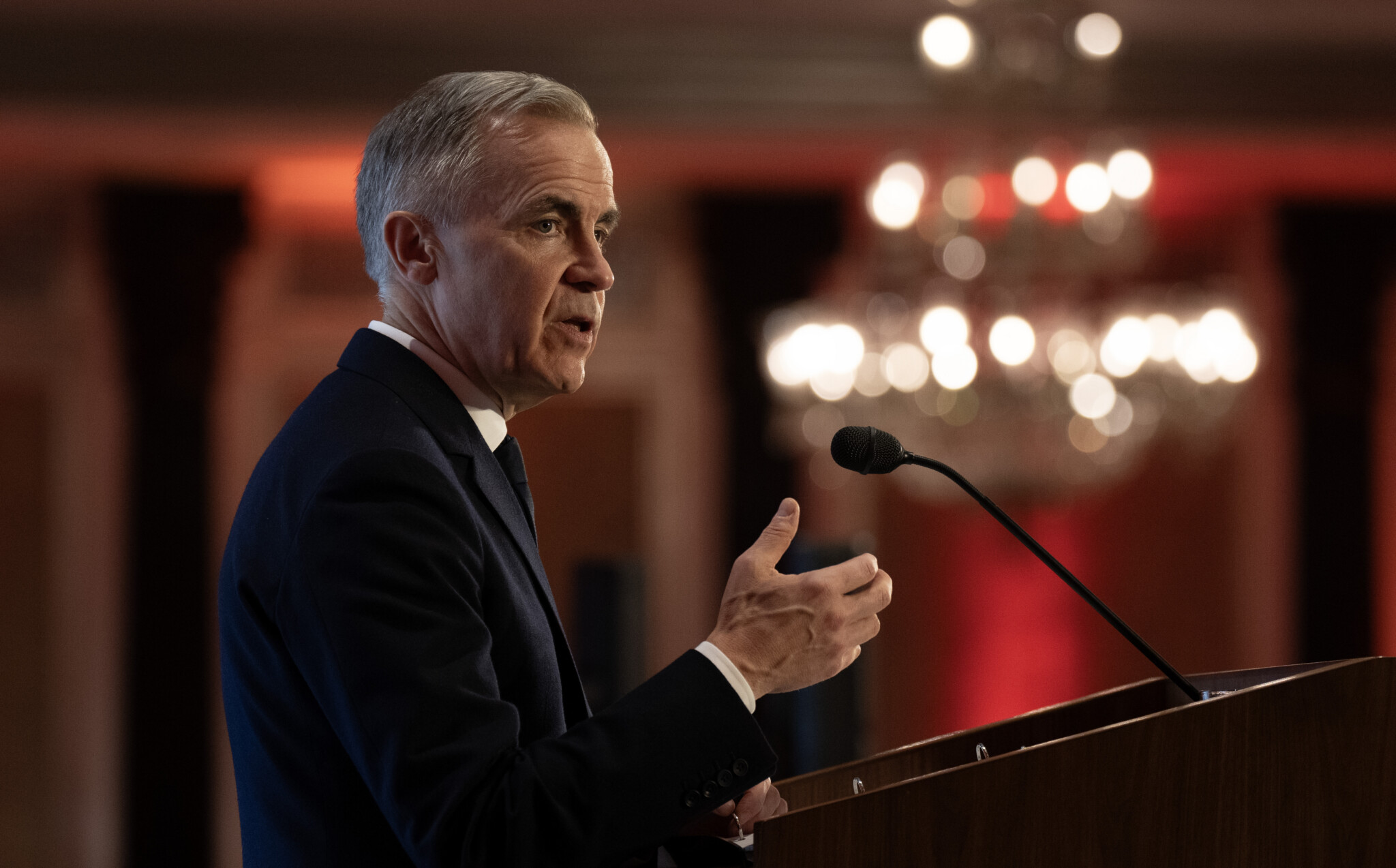
In a move that surprised observers at home and abroad, Prime Minister Mark Carney issued this weekend an unqualified endorsement of U.S. President Donald Trump’s military attack on Iran. For a leader who has cultivated an image of sober, multilateral statesmanship, Carney’s decision to break with Europe—and with his own recently articulated foreign policy doctrine of middle power cooperation—begs the question of what exactly is Canada’s foreign policy almost one year into his premiership.
Let us be clear about The Hub’s position on this war: the Iranian regime is brutal, illegitimate, and its destabilizing actions in the region warrant condemnation and the threat of military action. But the nature of this strike, launched without congressional approval, in the absence of an imminent threat against America or Israel, while active negotiations between the belligerents were underway, flouts international law and the conventions of a rules-based international order.
Yet here is Canada, a nation that has long prided itself on manifesting a coherent, principles-based foreign policy, lending its credibility to Israel and America’s war on Iran that is, by any fair measure, unilateral and illegal. This is all the more puzzling considering how Carney, up to now, has consistently aligned Canada with Europe on issues like Palestinian statehood and the sovereignty of Greenland, all in opposition to the U.S. and in both instances courting the disapprobation of President Donald Trump.
Why this jarring shift? Why has our prime minister suddenly and self-evidently broken with the very “middle powers” he wooed and wowed at Davos mere weeks ago? After all, the prime minister’s past approach to conflict in the Middle East has been circumspect and measured. When Israel struck Iran late last year, Ottawa’s response was balanced and restrained. This weekend’s statement, by contrast, bore all the hallmarks of a personal, prime ministerial rewrite that cut through the usual diplomatic caution of Global Affairs Canada and its proclivity to hedge the head of government’s response to a global crisis.
One explanation is politics. There is a large domestic constituency at play: the Iranian-Canadian diaspora, concentrated in ridings around the Greater Toronto Area. These communities, rightly enraged by the brutality of the regime in Tehran, have been vocal in their support for regime change. In the last election, these were battlegrounds where the Conservatives overperformed. For a Liberal prime minister eyeing a spring election, aligning with Iranian Canadians’ anti-regime sentiment is a low-cost signal to a key voting bloc.
View reader comments (14)
But there is a more cynical, and perhaps more accurate, interpretation: this is foreign policy on the cheap. Canada is not being asked to provide troops, jets, or munitions—things it conspicuously doesn’t have. Endorsing the strike costs nothing in blood or treasure, while potentially paying dividends on trade files or securing goodwill with a transactional White House. It is a tactical nod, a pragmatic gesture in an era where the old rules no longer apply.
Yet this pragmatism collides with the principles Carney himself has espoused. In his Davos speech, the prime minister delivered a sweeping diagnosis of the global order’s demise at the hands of unilateral great powers. He warned that the rules-based system is crumbling under the weight of great power competition, and he called for middle powers to band together to assert their collective sovereignty on the important issues of our time, from climate to AI to multilateral trade and global governance. Yet his post-Davos foreign policy maneuvering has been all but devoid of the “principled pragmatism” he extolled in the Swiss Alps. From cutting deals with Beijing to cozying up to Qatar and India, the Carney doctrine seems mostly a series of opportunistic gambles for international influence with authoritarian regimes that either don’t share Canada’s values or are actively undermining our democracy.

Fair enough. Canada needs new friends. Hedging sometimes requires truck and trade with less savoury regimes and leaders. But his unqualified endorsement of Trump’s latest war puts Canada, for the first time, in the starring role of actively undermining the “new world order” he claimed he wants to rebuild as a “principled pragmatist.” Put another way, by lining up shoulder to shoulder with the alpha and omega of global disorder and raw power, Donald J. Trump, Carney demonstrated that when a major test of his middle-power thesis arrived, his instinct was not to triangulate or resist, but to fall in line.
At moments like these, one cannot help but recall the actions of former Liberal prime minister Jean Chrétien. Facing George W. Bush’s push for war in Iraq, Chrétien demurred. He understood that Canada’s credibility, its historical skepticism of unilateral American power, was an asset not to be squandered. That decision became a defining part of his premiership. Carney’s decision this weekend might be the start of a different, less flattering legacy.
In sum, pragmatism without principles may offer short-term tactical wins, but it could also extract a heavy price: Canada rendered into a vassal state, pushed and pulled by Great Power priorities and diaspora politics, with only the cold comfort of distant memories of a time when the country had a principled view of geopolitics and how the world should work.

Rudyard Griffiths is the publisher of The Hub.
Prime Minister Mark Carney’s endorsement of Donald Trump’s military action against Iran has sparked controversy, diverging from Canada’s traditional foreign policy of multilateralism and middle-power cooperation. This decision contrasts with Carney’s previous alignment with Europe on issues opposing the U.S., raising questions about the consistency of Canada’s foreign policy under his leadership. The move is particularly puzzling given Carney’s recent Davos speech advocating for middle powers to assert their collective sovereignty. Possible explanations include appealing to the Iranian-Canadian diaspora for political gain and a pragmatic attempt to secure trade advantages with the U.S. However, this pragmatism clashes with Carney’s own principles, potentially undermining Canada’s credibility and transforming it into a vassal state influenced by Great Power priorities.
Why did PM Carney endorse Trump's military action against Iran, given his previous foreign policy stances?
What are the potential long-term consequences of Canada's shift towards a more pragmatic, less principled foreign policy?
How does Carney's endorsement of the strike contradict his Davos speech about middle powers and the crumbling rules-based system?



Comments (14)
What nonsense. There is only one principle in Canadian foreign policy, what gets votes. You only have yourself to blame if you thought that that idiotic Davos speech of typically Canadian anti-American splenic discharge meant anything concrete. The hub itself featured how many articles in the aftermath asking whither the walk to go with the talk? Shame on you if you bought any of what was being sold.
Shamelessness aside, a mild kudos to Carney for flip flopping to the right position vis-à-vis the Islamic Republic and its hopefully swift transit to the history books.