
Canucks are known for slugging quite a few beers back on a night out, but according to new numbers, the average Canadian is now indulging much less in recent years.
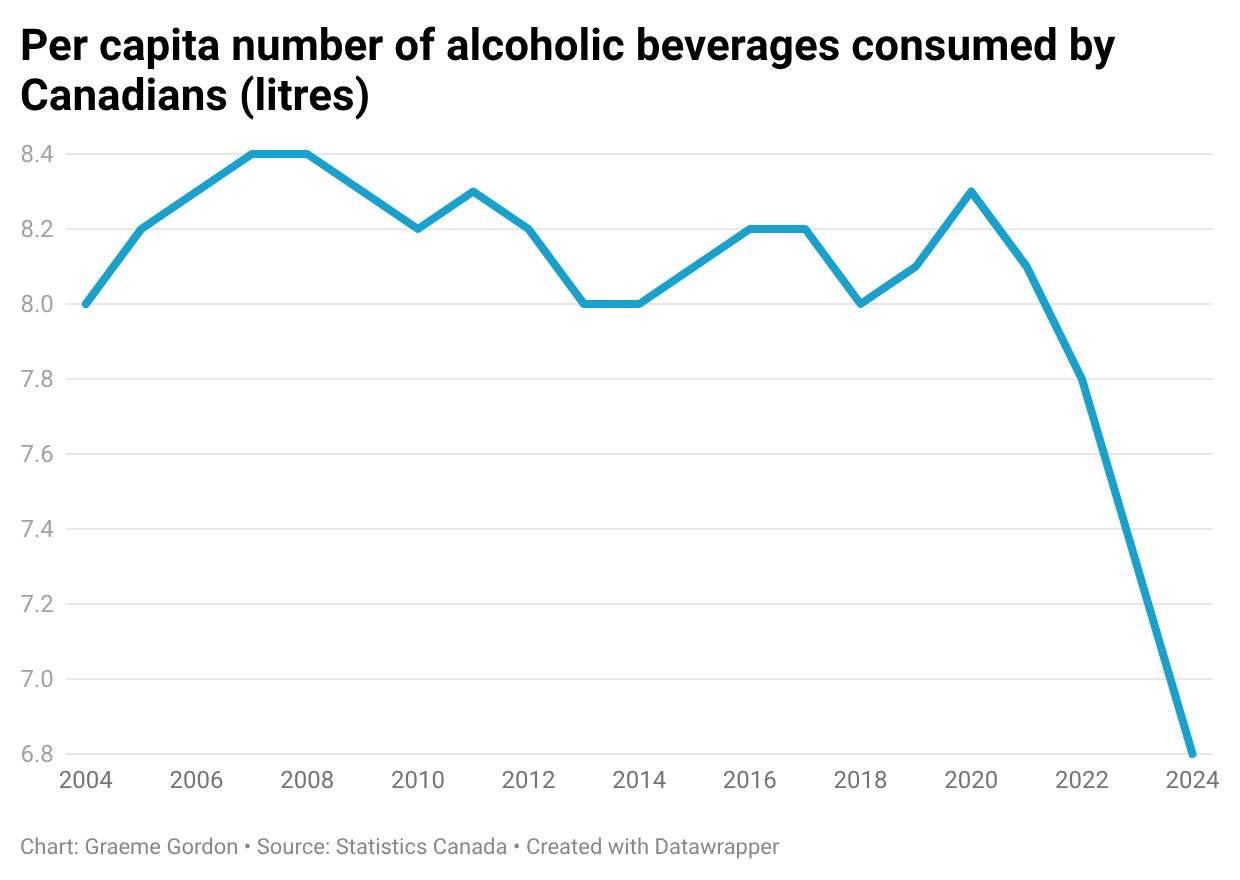
For the fourth year in a row, the Canadian per capita consumption of alcohol has fallen, hitting a 20-year low of an average of 6.8 litres of alcohol per person according to newly released Statistics Canada data for 2024-25. That’s a drop of 1.5 litres from a peak of 8.3 litres of alcohol consumed per person, back at the start of the pandemic in 2020.
Alcohol historian and Carleton University professor Rod Phillips believes there are several factors influencing Canadians to hit the bottle much more infrequently.
“Drinking has declined among younger cohorts in particular, and studies suggest that one reason is an acceptance that alcohol is unhealthy,” said Phillips. “There’s a vigorous debate about how much is unhealthy, but it’s fair to say that there are no health benefits from drinking alcohol. To this extent, abstaining is the healthiest option, and that message seems to have taken hold among younger age-groups more than older drinkers.”
In 2023, the Canadian Centre on Substance Use and Addiction (CCSA) released a study and guidance report that found no amount of alcohol is completely safe for health. The buzzkill report found that even three to six drinks per week presented a moderate health risk and increased cancer risk (especially breast and colon cancers).
“Health is not just a matter of the cancers and cardiac diseases linked to alcohol consumption, but also a sense of wellbeing—avoiding hangovers and the feeling of tiredness that often follow drinking,” Phillips added.
The alcohol historian has also noticed a cultural shift where many gatherings no longer include tippling, but instead more and more teetotaler attendees.
“I think a non-alcoholic culture has developed. Many people no longer think of alcohol as a precondition of socializing and having fun,” Phillips told The Hub. “Look at the early morning dance parties, without any alcohol, becoming popular in Europe.”
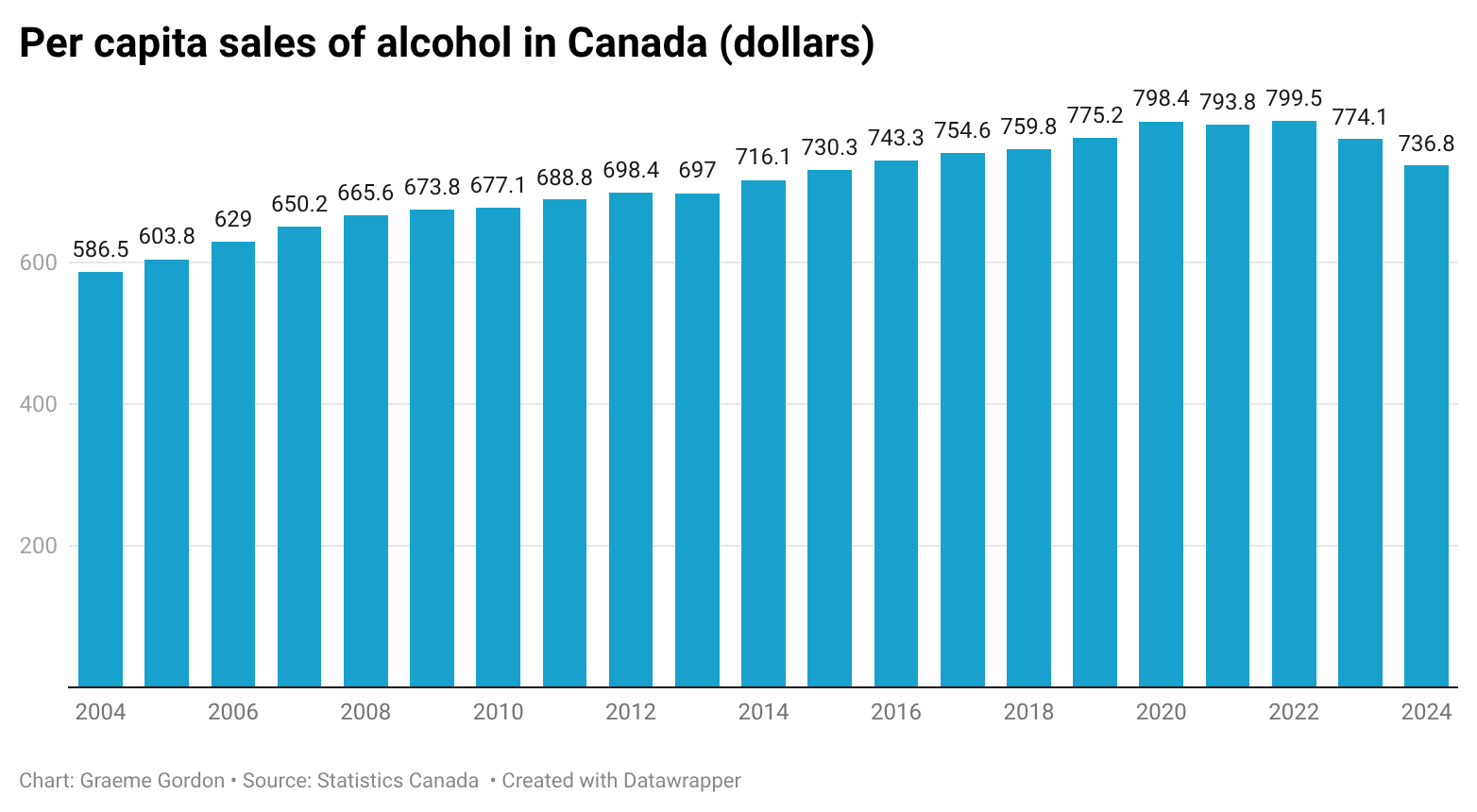
In Canada, the average Canadian still spends a significant amount on booze, however. Including all types of alcoholic drinks, the average Canadian spent $736.80 in the 2024-25 fiscal year. That’s down from a peak of per capita alcohol expenses for Canadians of $799.50 back in 2022-23.
In total, $25.8 billion worth of alcoholic beverages were sold in Canada in 2024-25, a drop of 1.6 percent from the previous year.
Phillips believes another explanation for reduced alcohol consumption is affordability.
“People are spending less on alcohol and treating it as an unnecessary expense within the universe of commodities and services competing for purchase. At the same time, sales of non-alcoholic beverages are robust and growing…” he added.
Sales of spirits have taken the greatest hit in Canada, especially with U.S. alcohol bans in most provinces (Canada used to be the largest export market for U.S. alcohol) due to the trade war starting at the tailend of the 2024-25 fiscal year (Saskatchewan and Alberta have since lifted their bans).
“There are shifts in preferences of different products, with beer and wine stable and spirits declining,” Phillips explained. “One thing peculiar to Canada is a growing preference for Canada-produced alcohol products. This largely reflects the provincial bans on American alcohol. How much and how long that holds up will largely depend on U.S. tariff policies.”
Spirits sales had the most sobering decline, down by 3.2 percent to $6.7 billion. Whisky (29.6 percent of total spirit consumption), vodka (22.9 percent), and liqueurs (15.4 percent) were the most popular hard drinks of choice. Meanwhile, coolers and ciders were the only category of alcoholic beverages to increase sales.
The boycott on American booze has been helping domestic sales, despite the larger trend of overall decline in sales. Patriotism helped Canadian wine sales, too, which rose to $2.3 billion or a 1.9 percent increase, while imported wine sales declined for the first time since 1992. Coolers and ciders grew their share of the overall pie, up to 4.8 percent from the previous year, with $2.4 billion worth of drinks sold.
Beer sales at liquor stores, government agencies, and retail outlets stayed relatively steady, with a marginal decline of 1.6 percent for total sales of $9.1 billion. Beer holds the biggest share of the Canadian market at 35.1 percent, or a little over a third of all alcoholic beverage consumption in Canada.
Canadian alcohol producers’ share jumped to 60.6 percent of total alcohol sales in Canada, inching up from 59.0 percent from the prior year.
On top of the declines in alcohol sales, per capita consumption is also down partially due to new immigrants to Canada from cultures where drinking is much less common or completely banned.
“Undoubtedly, the arrival of immigrants from non-drinking populations reduces the volume of alcohol consumed per capita in Canada…,” explained Phillips, although admitting the effect is marginal. “Many immigrants to Canada come from Asian countries, India and China especially, where alcohol consumption is low.”

Graeme Gordon is The Hub's Senior Editor and Podcast Producer. He has worked as a journalist contributing to a variety of publications, including CBC,…
Statistics Canada data reveals a continuing decline in alcohol consumption among Canadians, reaching a 20-year low of 6.8 litres per person in 2024-25. This marks a 1.5-litre drop from 2020. Experts attribute this trend to increased health awareness, particularly among younger generations, and a growing non-alcoholic social culture. While overall alcohol spending has decreased to $736.80 per person, total sales still reached $25.8 billion. Sales of spirits have declined significantly, influenced by trade disputes and a preference for Canadian-produced alcohol. Conversely, coolers, ciders, and Canadian wine have seen increased sales, reflecting shifting consumer preferences and patriotic purchasing.
How might the decline in alcohol consumption impact the Canadian economy, considering the significant revenue generated from alcohol sales?
With the rise of non-alcoholic culture and health concerns, what strategies could alcohol companies use to adapt and maintain their market share in Canada?
Given the increase in Canadian alcohol sales due to import bans, what are the potential long-term political and economic consequences of these trade policies?







Comments (6)
Baby boomers are also getting to the point where they can’t drink as much as they once did.