
Canada’s immigration scoring system no longer reflects the country’s economic reality.
It used to. I came to Canada from Columbia in 2018 through its Express Entry program, which was established in three years earlier to prioritize high-skilled immigrants based on merit. From the beginning, it was regarded as one of the best in the world for its emphasis on human capital, predictability, and transparency. A true merit-based immigration model built around measurable economic potential.
For context, Express Entry was designed as Canada’s main system for selecting skilled immigrants. At its core lies a simple idea: instead of reviewing immigration applications in the order they arrive, the government ranks candidates based on measurable factors such as education, work experience, language ability, and age. The goal was for the strongest candidates to rise to the top and then receive invitations to apply for permanent residence.
From the initial launch of the Express Entry system, there were several pathways candidates could use to qualify for permanent residence. One of them is the Canadian Experience Class (CEC): a stream designed for people who have already studied or worked in Canada and gained skilled work experience. This program followed a straightforward logic of prioritizing individuals who had already integrated into the labour market and proved they could succeed in this country.

However, the real complexity lies in how the candidates are scored. As a part of entering the Express Entry candidate pool, applicants who wish to be considered are ranked using the Comprehensive Ranking System (CRS), a scoring formula that assigns points for various skills, work experience and human capital factors. Throughout the year, the government conducts regular “draws” and invites the highest-scoring candidates to apply for permanent residence from the Express Entry pool.
In theory, the system rewards the strongest profiles first. But, in today’s Canada, it does anything but. One aspect of the Trudeau government’s significant increase in immigration levels that has gone underdiscussed is the extent to which it necessarily put downward pressure on the Express Entry scoring system and effectively lowered its standards.
This trend was reinforced last month when the government announced further changes to Express Entry, including new categories for this year. While these changes were framed as a new and better way to tackle Canada’s pressing labour needs, they are merely adjustments layered onto a system that doesn’t mirror what the country’s economy needs.
Consider this: a 34-year-old senior software engineer loses points for his age without gaining any additional ones for having multiple years of experience in a highly skilled occupation. Meanwhile, one extra year of foreign work experience will give higher points than an extra year of Canadian work experience, putting those candidates who only have Canadian work experience at a disadvantage.
The net result of these developments is to undermine the basic strengths of the Express Entry model. The most recent changes amount to applying a band-aid to a system in need of a broader repair. In theory, categories were meant to meet economic needs with targeted immigration. In practice, they’ve introduced volatility and internal contradiction.
The clearest example of this is Francophone immigration outside Quebec. The 2025 Immigration Levels Plan set an 8.5 percent target for French-speaking permanent resident immigration outside of Quebec (with targets set to rise annually in later years, going up to 10.5 percent by 2028).
Because language isn’t assessed in family or humanitarian streams, this target falls disproportionately on economic immigration (more specifically, Express Entry). The result has been consistent, sustained, frequent Francophone draws throughout 2025. At the same time, the CEC draws were fewer and smaller than the Francophone draws, despite targeting Canadian-educated graduates with local work experience. Some 48,000 invitations were issued under this Francophone category in 2025—42 percent of the Express Entry pool—bigger than most other categories combined.
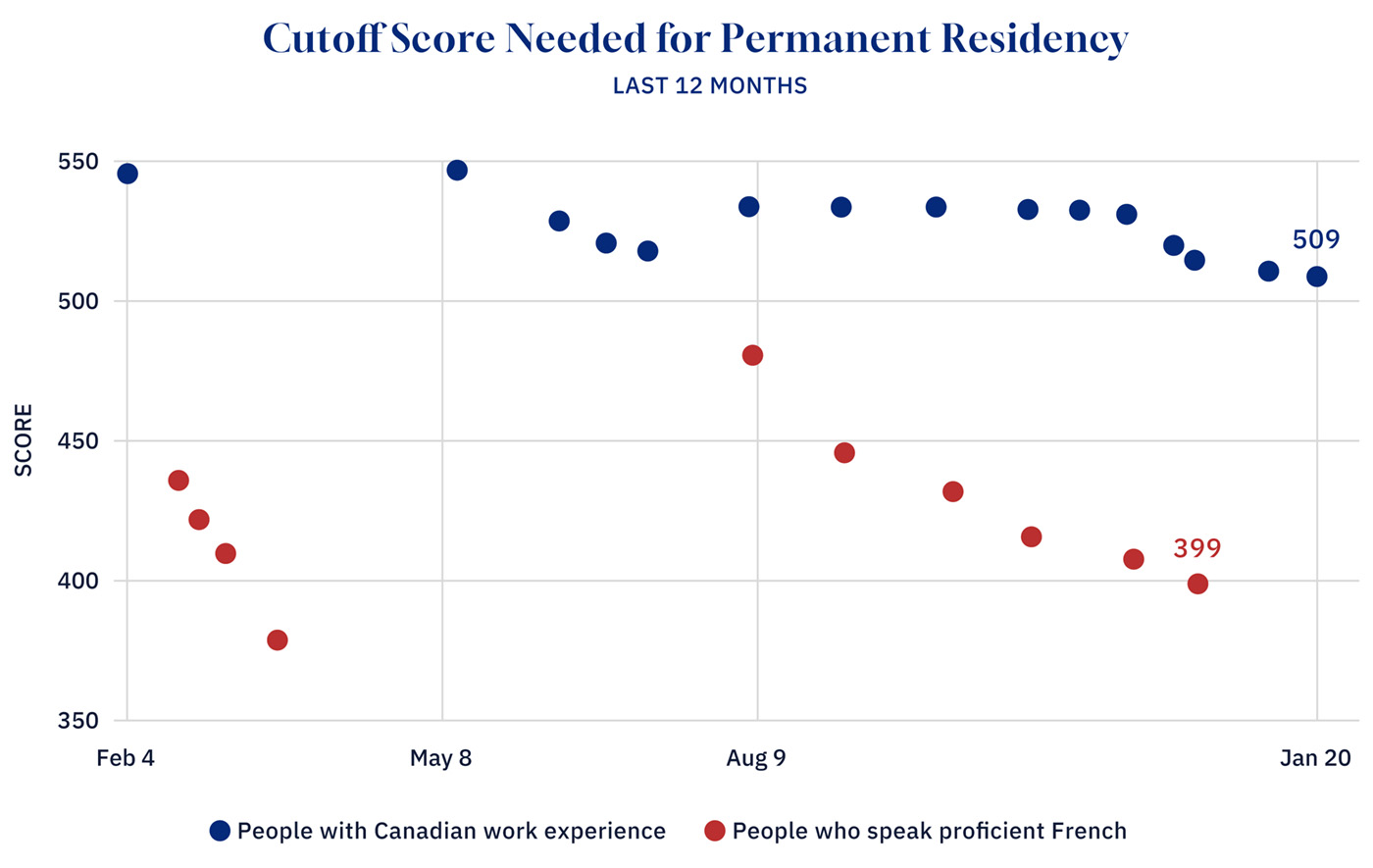
Graphic Credit: Janice Nelson.
This mapping of the draw data (courtesy of Build Canada) shows a persistent and dramatic gap between CEC and Francophone cutoff scores throughout 2025. We saw a more than 100-point CRS score difference between the two categories on average throughout the entire year. In a system where even five points can make a big difference, this kind of gap highlights a huge structural flaw.
In other words, people who studied, worked, and built lives here find themselves at a disadvantage. Not because of skill or contribution, but because they don’t speak French.
Additionally, we witnessed the quiet collapse of the STEM category. There have been no STEM draws since April 2024. And, furthermore, 19 key tech occupations have been removed from the eligibility of this category altogether, while “Insurance Brokers” were added to the list. Canadian-educated engineers, developers, and AI graduates, many of whom are already embedded in our labour market, now face worse odds of securing permanent residence than applicants selected primarily for language.
This debate has reached the House of Commons and generated strong public reaction. Canadians are openly questioning whether Express Entry still functions as a merit-based economic system.
As a recent witness at a hearing of the House of Commons Standing Committee on Citizenship and Immigration (full statement here), I asked these precise questions: Why are we making a policy shift that does not align with what the Canadian stakeholders and population have been requesting?
In multiple government consultations, stakeholders overwhelmingly prioritized economic immigration and addressing labour shortages. STEM ranked high. Francophone immigration ranked low. Yet policy has moved in the opposite direction.
View reader comments (0)
The gap between what’s said and what’s done becomes even clearer when you look at the lack of transparency. The 2025 federal budget announced two “one-time” permanent residence pathways. One was for the economic class and the other for protected persons. Both were framed as targeted, temporary measures. However, only one was clearly explained.
The economic pathway was quantified in the budget tables: 33,000 admissions across 2026 and 2027. But the protected persons pathway wasn’t itemized there at all. Its true target of 115,000 admissions over the same two years only appeared later in the 2026-2028 Immigration Levels Plan.

Together, these new measures add 74,000 permanent residents to both 2026 and 2027. Which pushes the actual 2026 target to 454,000 admissions, not the 380,000 figure most people saw highlighted in the plan. The pattern of emphasizing some numbers and initiatives while quietly adding in others has become familiar. And regardless of the intent behind it, it seriously affects how the immigration system operates.
Which brings us to the current reality: The immigration minister is facing sustained public criticism and growing skepticism towards immigration as a whole.
When “skilled immigration” no longer consistently selects skilled people, the system loses its purpose. What follows is resentment toward the immigrants themselves and the government alike.
Canada doesn’t need vague assurances and new Express Entry categories. It needs a return to first principles: immigration as a long-term human-capital strategy. A new, redesigned system. Stable, understandable pathways. Rewarding real skill. Big picture economic needs. Predictable draws. Full transparency around initiatives and targets. Most importantly, we need consultations that actually shape outcomes, rather than being conducted performatively.
Express Entry worked when it rewarded highly skilled candidates clearly and consistently. It’s what Canada’s reputation was built on.
If we don’t make structural changes soon, the question won’t be where our once-renowned immigration system went. It’ll be why the best candidates would still bother choosing us.
Nino Melikidze critiques the current state of Canada’s immigration system, arguing that it has deviated from its original merit-based principles. She highlights concerns about lower standards, internal contradictions, and a lack of transparency. Changes, such as prioritizing Francophone immigration outside Quebec and the quiet collapse of the STEM category, are seen as undermining the system’s effectiveness. She argues that these shifts disadvantage skilled candidates and create public skepticism towards immigration as a whole. Melikidze calls for a return to a transparent, predictable system that prioritizes skilled immigrants based on economic needs and human capital.
How has the Express Entry system changed, and what are the consequences of these changes according to the author?
Why does the author criticize the focus on Francophone immigration outside Quebec within the Express Entry system?
What specific actions does the author suggest to improve Canada's immigration system, and why are these changes necessary?







Comments (0)