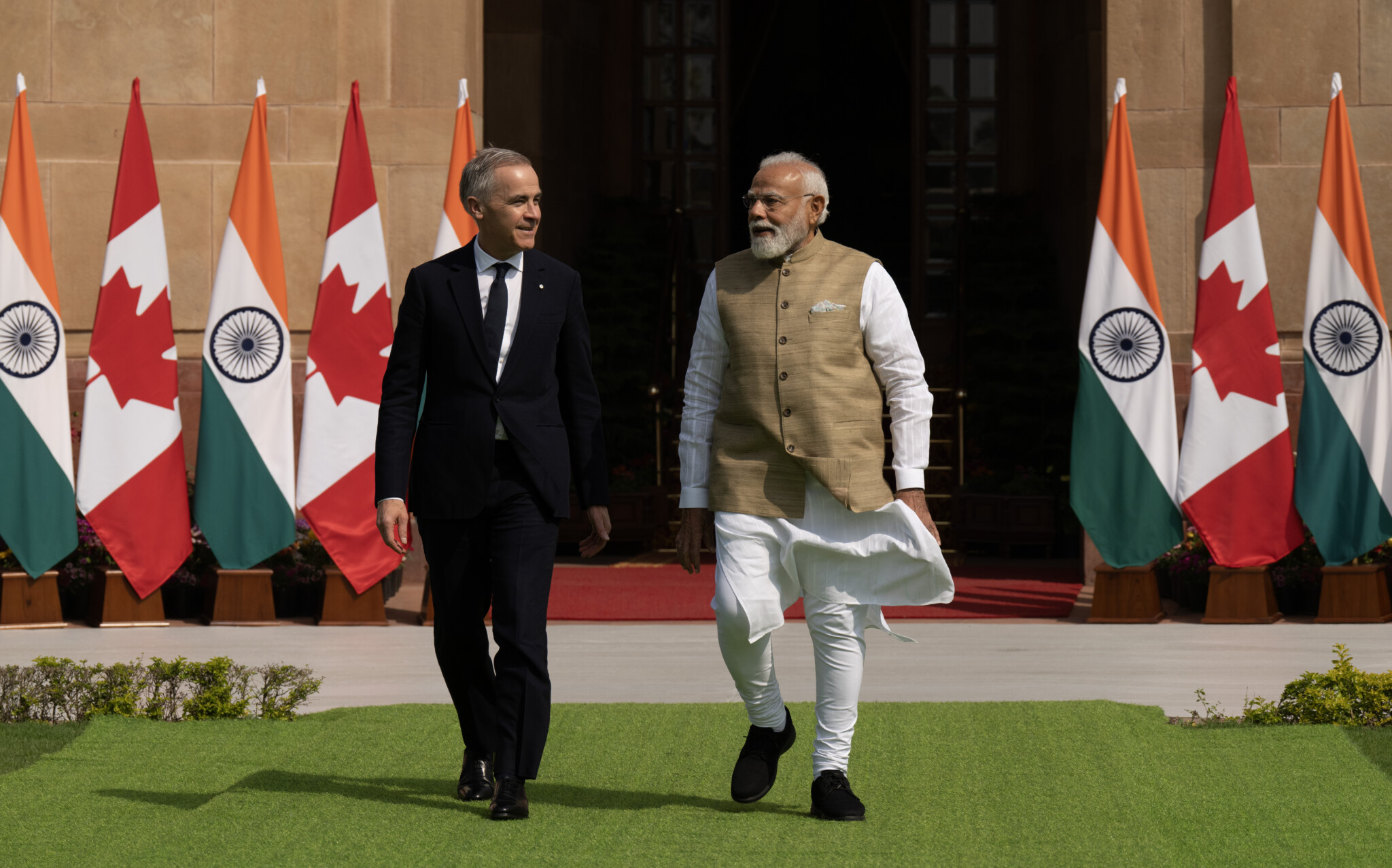
Prime Minister Mark Carney travelled abroad again last week as part of his broader agenda to diversify Canadian trade flows and attract foreign investment. Friday’s trip to Norway and the U.K. followed his recent trips to Australia, Japan, China, and India.
Carney’s extensive travel schedule has drawn attention from his critics and defenders alike. Conservative leader Pierre Poilievre accused him “pranc[ing] around abroad while Canadians pay the price at home.” Defenders emphasize that the prime minister’s jet-setting must focus on economic benefits back home, with the results clearly explained to Canadians. “It makes sense for people to look at these trips and ask whether they’re advancing trade,” said Roland Paris, a UOttawa professor and former Liberal adviser.
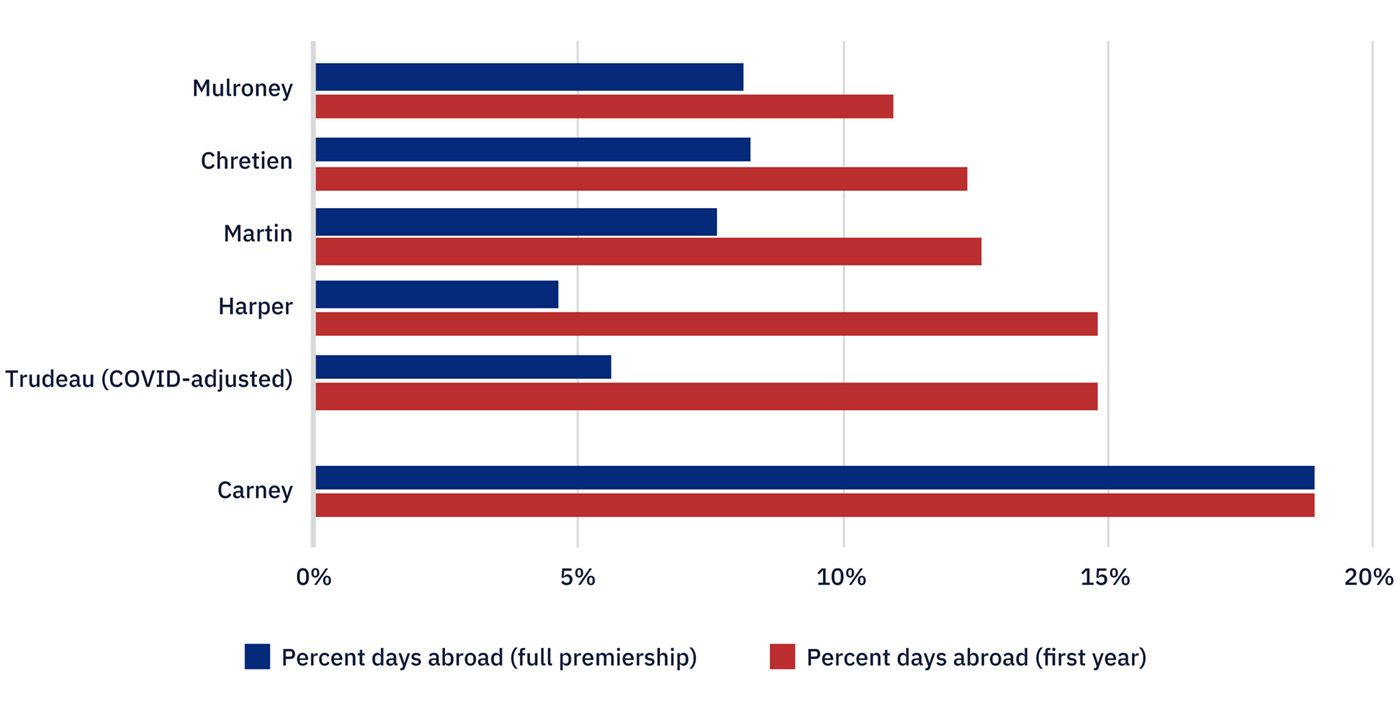
Carney has now spent 68 days travelling abroad—about 20 percent of his first year in office. Jean Chretien, who made long “Team Canada” trade visits a cornerstone of his foreign policy, spent about 8 percent of his premiership abroad; Stephen Harper, for whom “three days is a long trip,” spent less than 5 percent of his time as prime minister outside Canada. Some variation is to be expected between leaders as Canadian diplomacy changed and prime ministers increasingly spent more time at international summits. But Carney’s 19 percent figure is a huge outlier, even when accounting for busier-than-normal first-year schedules.
Days abroad for Canada’s last six prime ministers
Graphic Credit: Janice Nelson.
These trips are trade missions, and they should rightly be judged by the deals and investment dollars they bring home to Canada. But in China and India, Carney may have had the secondary political goal to disentangle the Liberal brand from the Trudeau era, a recent past marked by hostage-taking, murder, and mutual allegations of domestic political interference. This could have big implications in the next election, in which Chinese and South Asian Canadians will play a big role in determining the government.
Stopping Conservative momentum
There are 63 ridings in Canada where at least 10 percent of residents identify as either South Asian or Chinese, most in the suburban belts around Toronto and Vancouver. The Liberals currently hold 49 of these seats, which are likely to be the most important battlegrounds in the next election.
View reader comments (18)
In 2025, the Conservatives made big progress in these traditionally Liberal constituencies. Steady gains and a collapse of NDP support produced eight Conservative pickups, and the Liberals held on to 14 ridings by fewer than five points. Of the 74 ridings where the Conservatives gained more than 11 points in 2025, 39 percent are ridings with significant Chinese or South Asian populations.
High-level diplomatic visits are a tried-and-tested way of talking to immigrant communities. Less than 40 percent of new Canadians say they follow current events daily, while 90 percent report consuming news from their home country, mostly through social channels. This is consistent with research showing that immigrants seek out news from their countries of origin and (at least at first) only incidentally receive exposure to political news from their new country. Carney’s visits made the front pages of The People’s Daily and The Hindu as well as diaspora papers like Ming Pao, which covered the trip for its final print edition.
The electoral long game
Diplomacy can be fraught when diaspora politics transcends national origin, religion, and race. Hong Kong and Sikh civil society organizations oppose high-level talks with Mandarin- and Hindu-nationalist governments while allegations of foreign interference and repression in Canada remain unresolved.
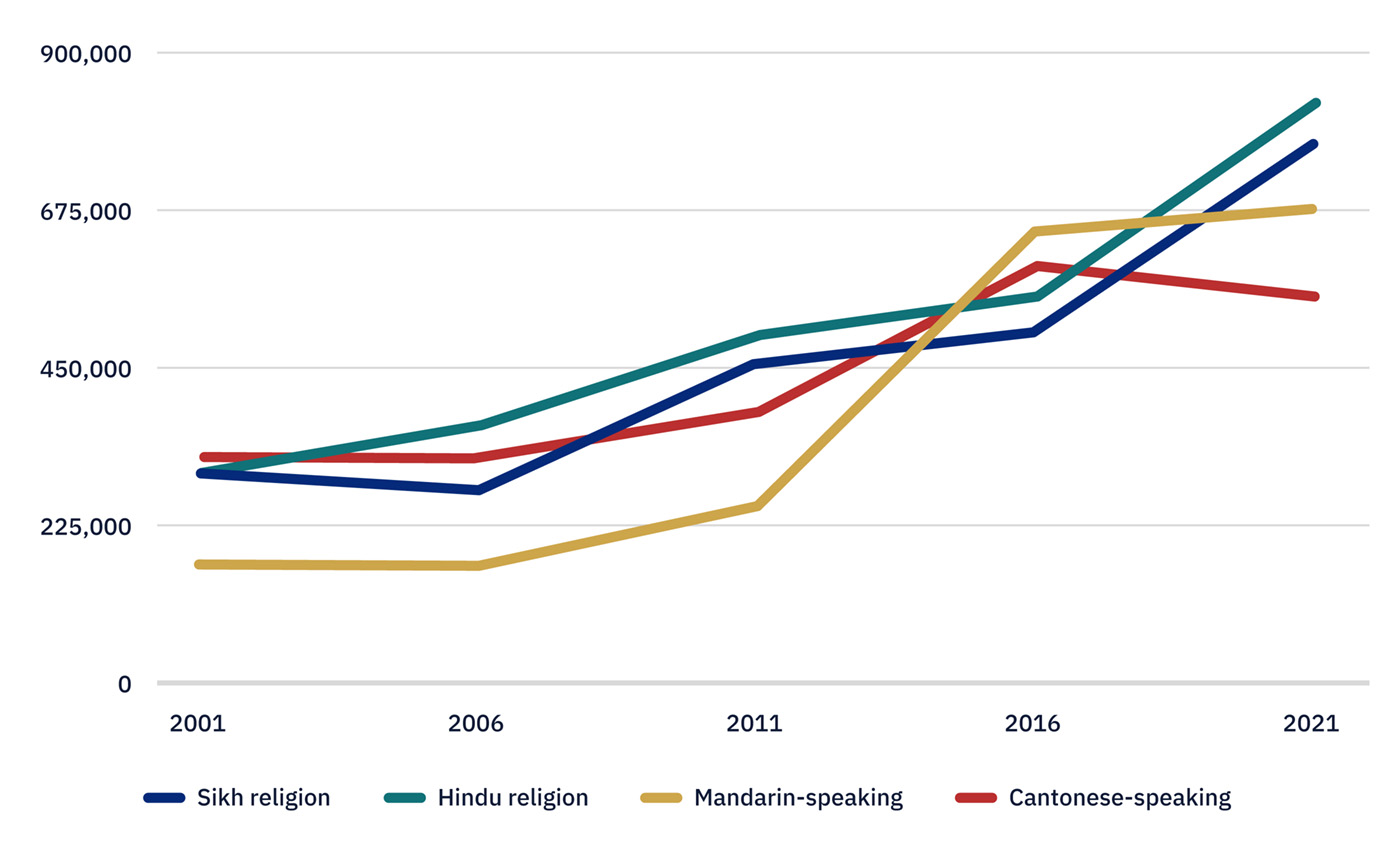
But warming relations between Ottawa, Beijing, and Delhi simply reflect the electoral math of Canadian immigration trends. Since 2001, each of the Hindi, Sikh, and Mandarin-speaking populations has tripled, while the Cantonese-speaking population has declined. Back then, Richmond and Brampton were represented by four MPs; now, they have nine (all are MPs of colour).
Changes in Canada’s Chinese and South Asian populations, 2001-2021
Graphic Credit: Janice Nelson.
Most importantly, Carney’s reset appeals directly to a new generation of immigrant Canadians who are refusing to be defined politically by census categories: Chinese-Canadians often oppose both the Communist Party and anti-Asian racism, and Indian-Canadians take pride in their religion and national identity but oppose Hindu nationalism. For many second-generation immigrants, issues like Hong Kong and Khalistan barely register. The symbolic politics of Carney’s visit elides these issues and targets a new generation of Canadians who identify with and are proud of China and India, but whose political concerns focus on housing, public services, and the cost of living.
In politics and in life, immigrants to Canada just want the stability upon which to build a new life. Seeing news of security in the bilateral relationship between their old and new countries—in both English and their mother tongues—signals security about their possible futures in either country. Seen in this light, Carney’s travels abroad may ultimately go a long way towards bringing home a Liberal majority government.
Read more at https://arbuthnotlab.substack.com/.
Prime Minister Mark Carney’s extensive international travel, exceeding that of his predecessors, is under scrutiny. While critics like Pierre Poilievre question the cost, supporters argue it aims to boost Canadian trade and investment. Carney’s trips to countries like China and India may also serve a political purpose: to strengthen the Liberal party’s standing among Chinese and South Asian Canadians, crucial voting blocs in upcoming elections. These communities often rely on news from their home countries, making diplomatic visits a strategic way to connect. Carney’s efforts target a new generation of immigrants focused on issues like housing and cost of living, aiming to secure their support by demonstrating stability and bilateral relations.
Is PM Carney's extensive travel justified? What metrics should be used to evaluate its success?
How might Carney's focus on engaging with diaspora communities impact the next Canadian election?
What are the potential risks and rewards of Carney's approach to foreign policy and diaspora engagement?







Comments (18)
Please, get your ducks in a row at home. Remove the BS industrial carbon tax that ALL Canadians are paying. Remove all the BS protectionism within the Canadian supply chain burdening ALL Canadians with much higher food costs.