
Conservative leader Pierre Poilievre sat down for a wide-ranging conversation on The Joe Rogan Experience (JRE) podcast this week, using the platform to address U.S. President Donald Trump’s tariffs and annexation threats, pitch Canada as a critical resource partner, and outline his vision for a freer, more prosperous country.
The three-hour discussion touched on everything from fitness and martial arts to monetary policy, assisted dying, and the opioid crisis, but the core message was clear: Canada and the United States are better off as sovereign allies and trading partners than adversaries.
Poilievre, who only weeks ago announced he is going to be going to speak to almost anyone who will have him on their platforms, no matter what side of the political aisle they’re on, appears to be going on a charm offensive. He appeared on former CBC’s The National host Peter Mansbridge’s podcast The Bridge two weeks ago and received positive press coverage.
An appearance on Rogan’s podcast is on another whole level of viewership, given that it is the most popular podcast in the world, including in Canada. Rogan’s platform was an opportunity for Poilievre to get out his alternative vision for Canada’s future. It also comes at a time when Poilievre could use a boost in popularity. Recent polls have shown the Liberals pulling away from the Conservatives, some with margins of nearly a 20 percentage point gap between the two parties.
Poilievre juxtaposed his beliefs in reducing and simplifying government with Carney’s belief in technocracy and expanding international trade beyond the U.S.
Here are the top six takeaways from Poilievere’s conversation with Rogan.

Rejecting annexation, embracing partnership
Poilievre was unequivocal in his response to Trump’s repeated suggestions that Canada could become the 51st state.
“Canada’s not for sale. We’re never going to be the 51st state,” he said. “You’re a patriot as an American, I’m a patriot as a Canadian. It’s where my grandfather arrived. It’s where our collective ancestors put on military uniforms and sailed to fight wars.”
But rather than dwell on the repeated previous provocations, Poilievre quickly shifted to areas of cooperation. He argued that Trump’s tariff threats are counterproductive and that both countries would benefit from removing trade barriers.
Rogan divulged that he spoke to President Trump on the phone about his comments. The president told Rogan he liked how people were reacting to the 51st state talk.
“‘At first I was joking,” Rogan recounted Trump saying. But then people were like, ‘It’s a good idea,’” Rogan said, imitating Trump’s voice. Rogan and Poilievre agreed it was “a crazy thing to say,” even for the eccentric president.
Poilievre then framed the U.S.-Canada relationship in economic terms: Canada has resources America needs, and trade restrictions only drive up costs for American consumers.
Canada is a nation of immigrants and a nation of laws
Poilievre used Rogan’s platform to draw a careful line on immigration that separates his approach from the Liberal government’s more expansive record.
He acknowledged that Canada brought in over 1 million people per year for two years running, which he told Rogan would be the per capita equivalent of the United States absorbing more than 10 million people annually.
“It really caused a housing shortage, like some places where you have 26 of these students living in one basement,” he said. “So we’re trying to unwind that now.”
His solution was neither mass deportation nor the kind of aggressive ICE enforcement seen under the Trump administration. Instead, Poilievre called for orderly, lawful enforcement of visa and work permit expirations.
“When their work permit and their visitor visa runs out, then we have to encourage them to head back lawfully,” he said. When Rogan pressed him on whether Canadians supported that approach, Poilievre was confident.
“We’re a nation of immigrants, but we’re also a nation of laws.”
The Conservative leader also drew a personal distinction on refugees, noting that his own wife came to Canada as a refugee from Venezuela, while arguing that people claiming refugee status who are not genuinely endangered in their home country are straining social services that Canadians themselves don’t always receive.

David Reid drives a seeding rig past oil and gas pumpjacks as he plants a wheat crop on the family farm near Cremona, Alta., Tuesday, May 6, 2025. Jeff McIntosh/The Canadian Press.
Canada as a resource superpower
Poilievre spent considerable time making the case that Canada is an indispensable supplier of energy, minerals, and materials critical to U.S. security and affordability. He noted that Canada is the fourth-largest oil producer in the world, a top supplier of uranium, and holds 10 of NATO’s 12 defined defence minerals.
Poilieve pointed out how Canada could help offset spiking oil prices due to the Iran war by supplying the U.S. with cheaper, reliable oil.
“You’ve got $5 a gallon [oil] right now in lots of places in America. I want to produce more so we can sell 2 million more barrels of Canadian oil into the U.S. market,” Poilievre said. Canada currently supplies the U.S. with roughly 4 billion barrels per day.
The Conservative leader also defended the Alberta oil sands, arguing against the notion that it’s somehow dirty oil.
“It’s the best resource in the world…You guys have shale here, but you know, as the years go by, you get less and less out of a shale reservoir. We have very little decline,” Poilievre explained to Rogan.
“You could be out in a forest hunting, and you wouldn’t even know that under your feet they’re extracting it through a whole system of pipes where they inject steam vapor. That loosens up the oil, it sinks down, it goes into another pipe, comes up to the top, and you can have beautiful pristine nature [unaffected]…It’s been a really disgusting PR campaign by extremist environmentalists and frankly, some of our competitors to try and make our industry look bad,” Poilievre explained.
He also highlighted Canada’s role in supplying aluminum for military-grade vehicles and lumber for homebuilding.
“A tariff does not bring production to America. It raises the price of the aluminum and therefore the F-series truck,” he said, referencing America’s best-selling Ford vehicle.
Poilievre argued that removing tariffs would lower costs for American workers and families, while strengthening North American security.

Big government and inflation
Poilievre’s calls to shrink government was perhaps his most passionate moment of the entire interview.
The Conservative leader laid out his theory of inflation with a simple analogy that cut straight to the heart of his contrast with the Liberal’s governing approach.
“Fifty years ago, a barber and a waitress could buy a house with a big yard for a dog and raise four kids. Meat and potatoes on the dinner table every night,” he said. “And now an accountant and a lawyer can’t do that. Why is that?”
His answer: governments have been printing and borrowing money on a scale that destroys the purchasing power of ordinary people, while enriching much of the wealthy.
“This is the biggest fraud perpetrated on the working class people in the last hundred years,” he told Rogan. “This is the biggest wealth transfer from the working class to the elites, from the have-nots to the have yachts.”
He used the example of the American money supply rapidly growing and outpacing the supply of homes, explaining why housing has become unaffordable for an entire generation.
Carney, meanwhile, is currently governing with a projected deficit approaching $78 billion, far beyond what even the Trudeau government had forecasted.
Poilievre’s remedy is a “pay-go” law modelled on the Clinton-era approach, where every new dollar of spending must be matched by a dollar of savings, forcing politicians to live with the same scarcity ordinary Canadians face every day.
“Instead of making the single mom, the senior, or the small business owner live with scarcity,” he said, “I want the politicians and bureaucrats to live with scarcity.”
Addressing the opioid crisis
Poilievre addressed Canada’s opioid crisis, which has claimed more than 50,000 lives over the past decade. He criticized pharmaceutical companies like Purdue Pharma for fueling addiction and called for massive investments in abstinence-based treatment programs.
“These dirtbag companies should be paying hundreds of billions of dollars to cover the treatment and recovery of the people whose lives have been ruined by this,” he said.
Poilievre emphasized the role of fitness and purpose in recovery, praising treatment centres that incorporate physical exercise and group therapy.
“I went to one treatment centre in Saskatchewan, and they had the guys lifting weights. The bureaucrats said, ‘Why are you spending money on weights?’ Poilievre said, ‘These guys started to see their biceps grow and they’re like, ‘I want to look like this, and if I take drugs, I’m not going to look like this.'”
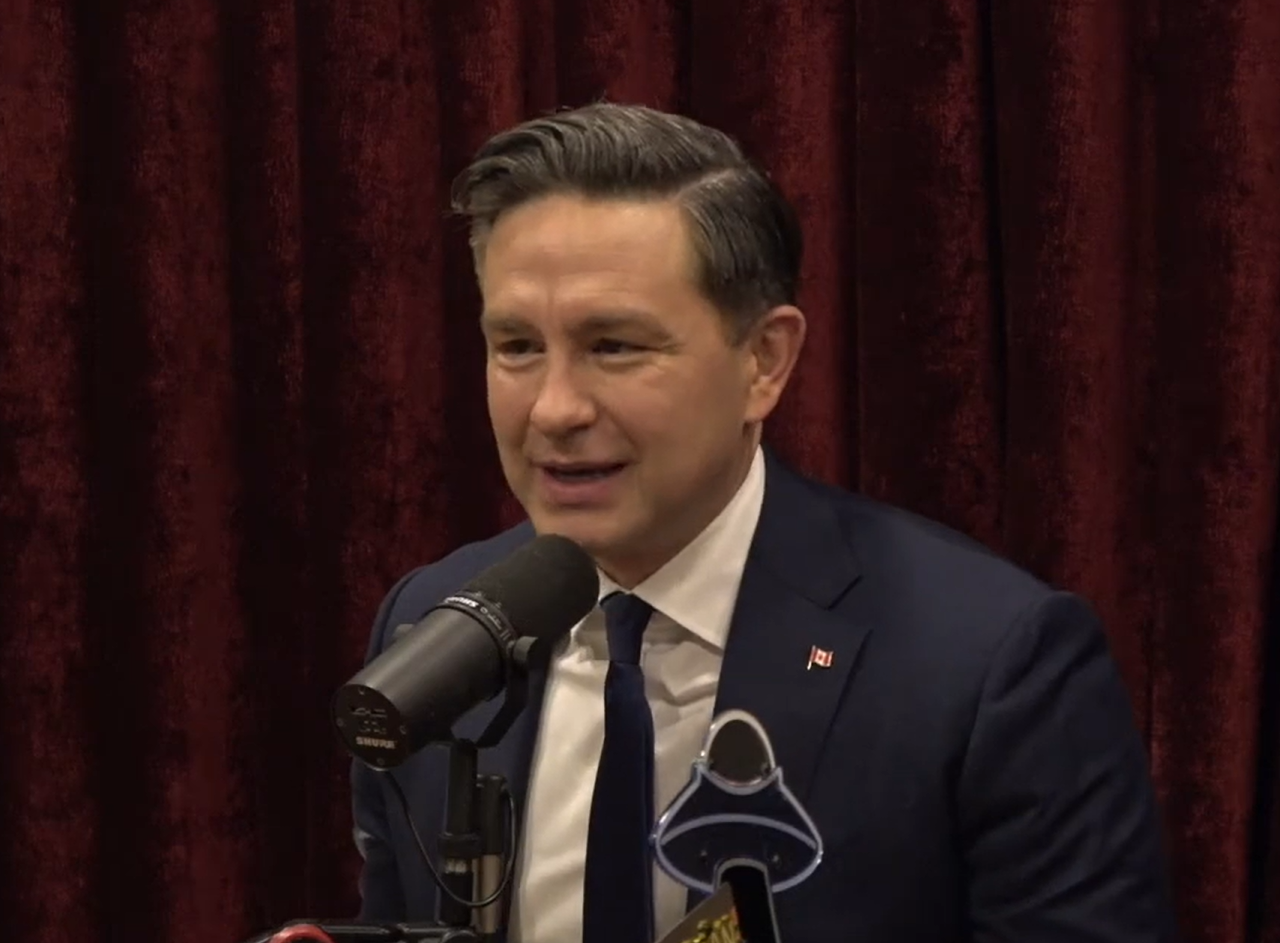
Poilievre speaks with Joe Rogan. Source: The Joe Rogan Experience on YouTube.
Trusting the common person over ‘experts’
One of the most revealing threads running through the conversation was Poilievre’s deep skepticism of credentialed expertise and his corresponding faith in the judgment of ordinary Canadians.
It is a theme that defines his contrast with Carney, a former central banker and technocrat, perhaps more clearly than any single policy position.
Poilievre told Rogan that during the COVID-19 pandemic, when governments were printing money and economists were assuring everyone that inflation would not follow, it was the tradespeople and mechanics he was speaking with in his community who got it right.
“I’d have mechanics say, ‘We’re going to have inflation,'” he recalled. “And I would say, ‘Yeah, it makes sense to me.’ And I’d go back to Parliament Hill, and the experts would all say, ‘No, no, there’s not going to be any inflation.’ And sure enough, all that money filtered into the economy, bid up all the goods we buy, and everybody got smoked with higher prices.”
Poilievre told Rogan that he wants to simplify government so that it doesn’t overstep and restrict people’s personal and financial freedoms.
“The common guy knows how to make his own decisions, and we need to empower him to do that.”
He extended the same logic to criminal justice and drug use, noting that soft-on-crime and safe supply policies pushed by academic experts have failed everywhere they have been tried.
For Poilievre, the answer to almost every problem highlighted in the interview saw him circling back to the same principle: get government out of the way and trust Canadians.
“If you cannot trust a man to govern himself, how can you trust him to govern for others?” he said.
This story was edited using NewsBox AI.
Conservative Leader Pierre Poilievre discussed his vision for Canada on The Joe Rogan Experience, emphasizing a stronger U.S.-Canada partnership. He rejected the idea of Canada becoming the 51st state and advocated for removing trade barriers. Poilievre addressed immigration, calling for orderly enforcement of visa expirations, and positioned Canada as a crucial resource supplier for the U.S., particularly in energy and minerals. He criticized big government and inflation, proposing a “pay-go” law to control spending. He also addressed the opioid crisis, advocating for abstinence-based treatment. Poilievre contrasted his approach with technocratic governance, emphasizing trust in the judgment of ordinary Canadians over experts.
How would Poilievre's plan to increase Canadian oil production impact the US economy and energy independence?
What are the potential economic consequences of Poilievre's proposed 'pay-go' law for government spending?
How does Poilievre's immigration policy differ from the current Liberal government's approach, and what are the potential impacts?






Comments (7)
His was an honest down to earth perspective on the fundamentals that churns an economy and society. We have let our governments dictate the how, where, what of our lives for far to long that a majority of Canadians do not have the ability to see the forest for the trees. We have been progressively programmed to look to the government and its experts for guidance and assistance and the answers to our daily needs and challenges and have forgotten how to think for ourselves. Our present situation is another example of this narrative where we have fallen to believe that our government exists to shape our lives for the better when in fact it has been the opposite. Well done Pierre! Brilliant!