
In an era of increasing international instability, nation-building resource projects now dominate Canadian political discourse. Pipelines fill Question Period. Governments speak of unlocking critical minerals, building LNG terminals, and accelerating major project approvals.
But while Ottawa and the provinces debate resource extraction, entrepreneurship—the heartbeat of innovation, job creation, and economic growth—is in sharp decline. And almost no one in the policy conversation is talking about it.
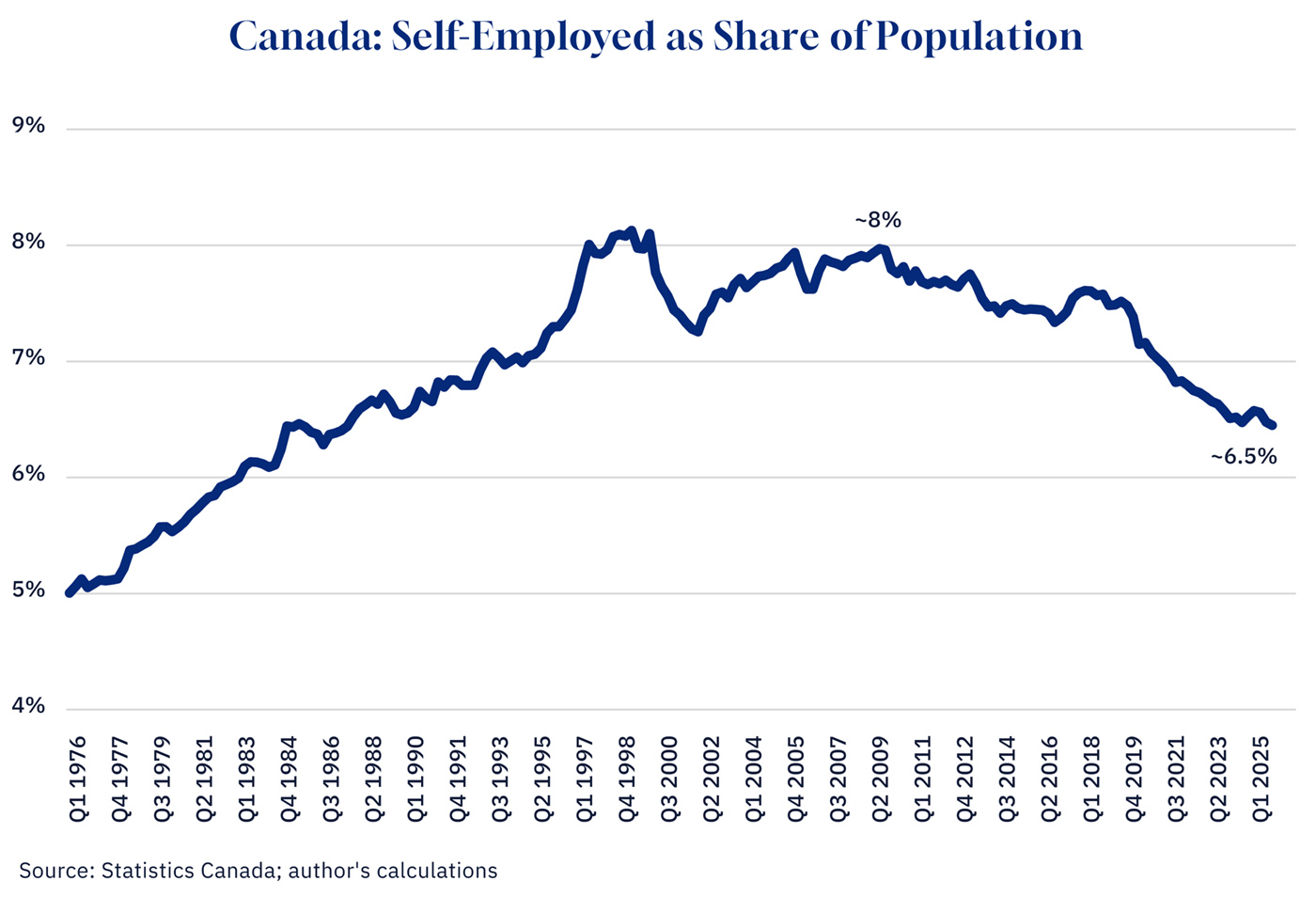
Yet the evidence has been accumulating for years. Self-employment now accounts for just 12.8 percent of total employment, the lowest share in 45 years. The absolute number of self-employed Canadians sits at roughly 2.7 million, essentially unchanged from 17 years ago despite substantial population growth. When measured against the total population, the share of Canadians working for themselves has steadily contracted.
Graphic Credit: Janice Nelson.
These figures mask an even sharper reality. Self-employment includes everyone from ambitious founders building scalable firms to professionals working solo gigs. What matters for economic dynamism is the former: businesses with employees, growth ambitions, and the capacity to challenge incumbents. On this measure, the collapse is striking. The number of self-employed Canadians with paid employees per thousand working-age adults fell 57 percent between 2000 and 2022, dropping from 3.0 to just 1.3.
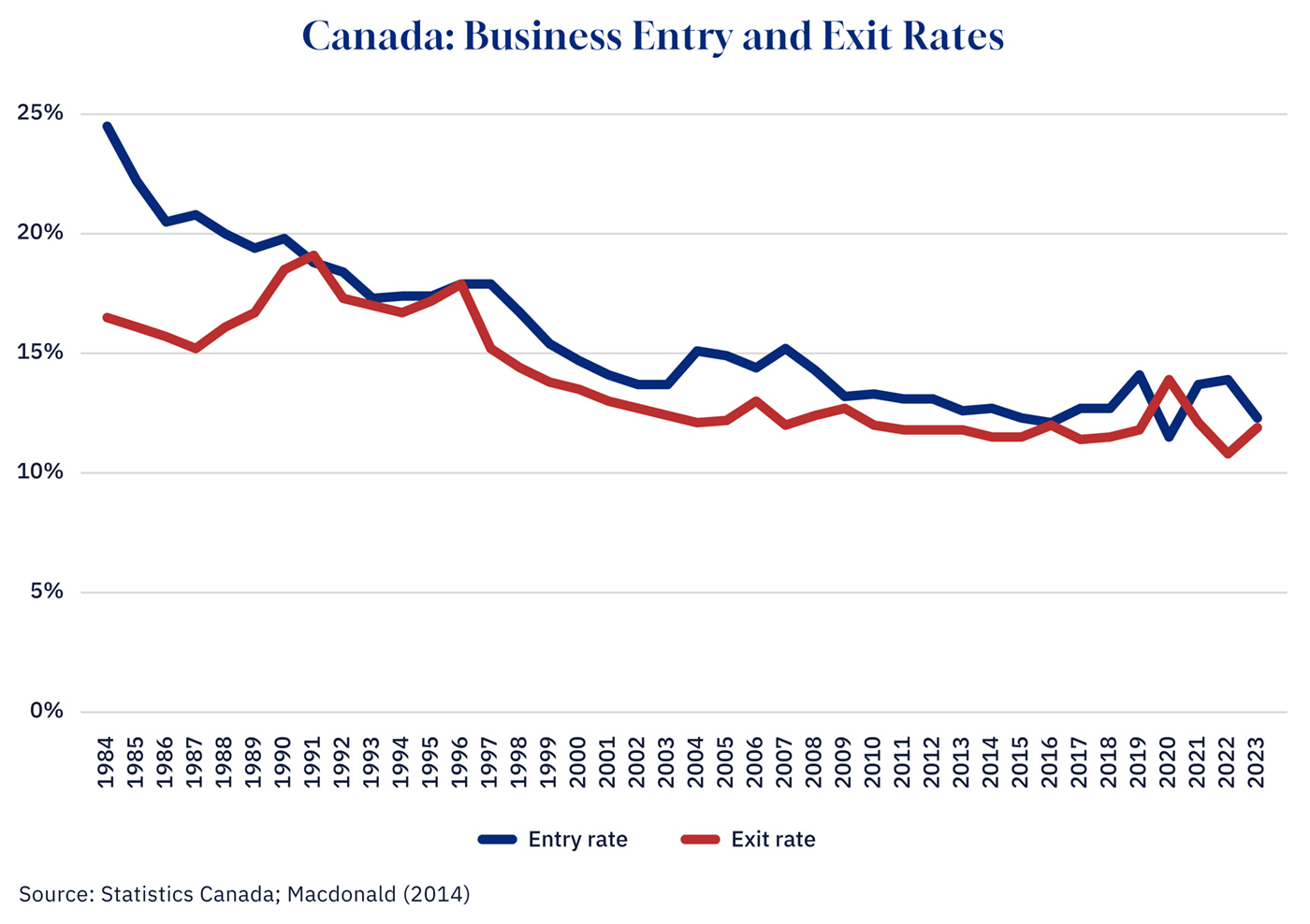
Business entry rates tell the same story. In 2023, new firm creation sat at 12.3 percent of all active businesses, well below the 15.2 percent recorded 16 years earlier and a fraction of the nearly 25 percent Canada achieved in the early 1980s. Exits have also declined, pointing to an economy where creative destruction isn’t happening at robust rates.
Graphic Credit: Janice Nelson.
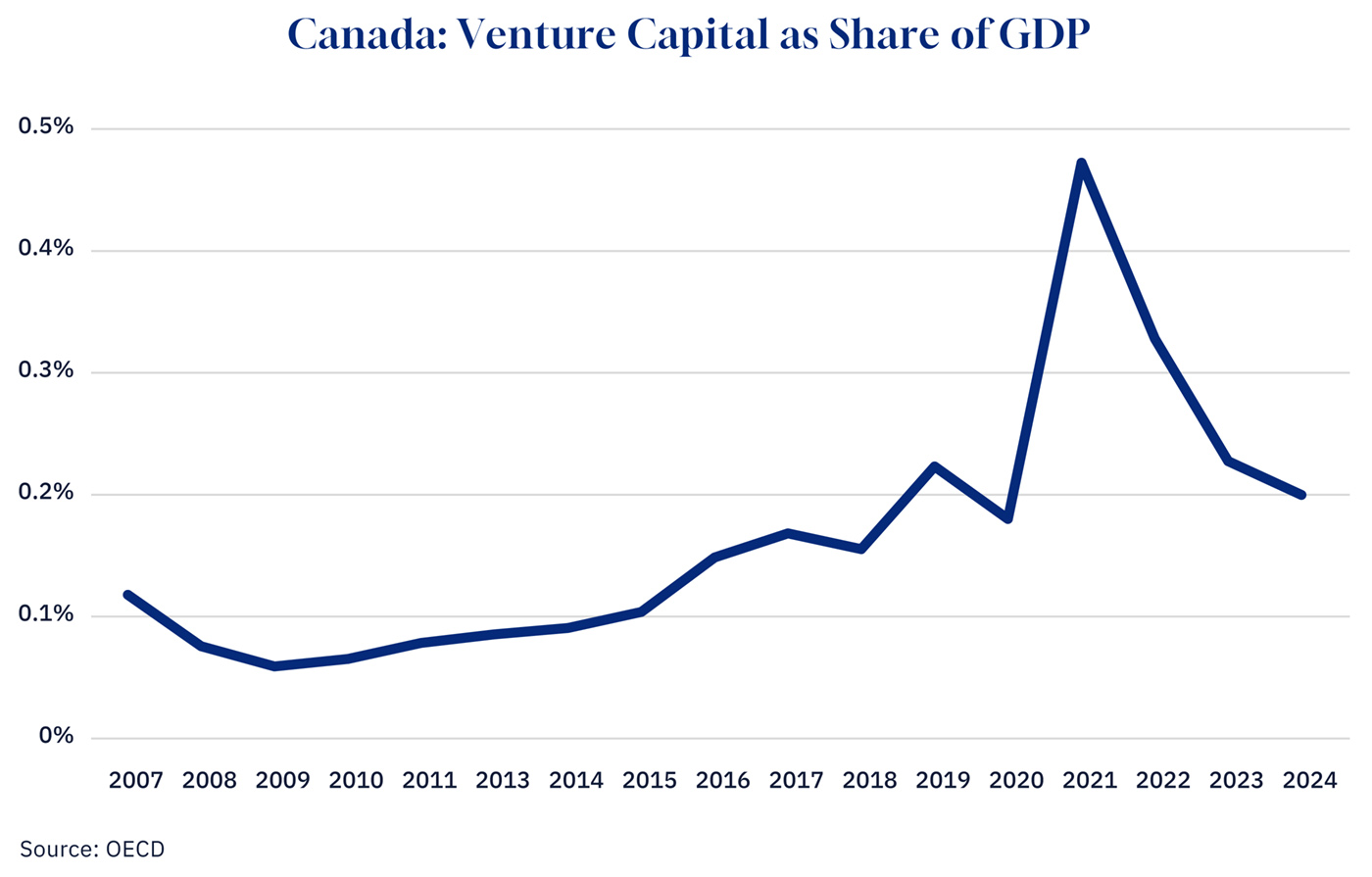
Venture capital investment, often a leading indicator of entrepreneurial ambition, has also cratered. As a share of GDP, it dropped from nearly 0.5 percent in 2022 to 0.2 percent in 2024—a decline of more than half in just two years. Canadian venture funds are struggling to raise capital, and what little they deploy is pooling into a handful of large bets rather than spreading across a broad base of early-stage companies.
Graphic Credit: Janice Nelson.
A recent report from the National Angel Capital Organization quantifies the cost. Canada’s three largest startup ecosystems—Toronto-Waterloo, Vancouver, and Montreal—collectively lost $66 billion in ecosystem value between 2019 and 2024, translating to an estimated 133,000 fewer high-quality startup jobs. While Canadian ecosystems grew at roughly 2 percent annually during this period, leading global peers posted growth rates between 9 and 17 percent. The report identifies an annual funding gap of at least $141 million at the seed and pre-seed stages, with seed rounds in Canada’s major tech hubs running 40 percent smaller than comparable U.S. ecosystems.
The exodus to the U.S. compounds the problem. In 2024, for the first time, more Canadian-educated founders who raised significant capital started their companies in the U.S. than in Canada, according to research from Leaders Fund. Only one-third of startups founded by Canadians that raised more than $1 million last year were actually based in Canada, down from two-thirds between 2015 and 2019. Nearly half now operate from the U.S.—double the share from five years ago.
Late last month, Y Combinator—a prestigious startup accelerator—struck a nerve in tech circles when it briefly removed Canada from its list of acceptable incorporation jurisdictions. The reversal came within days, but the message had already landed: even Canada’s most promising entrepreneurs are being pulled south by stronger ecosystems, lighter regulatory burdens, and deeper pools of growth capital.
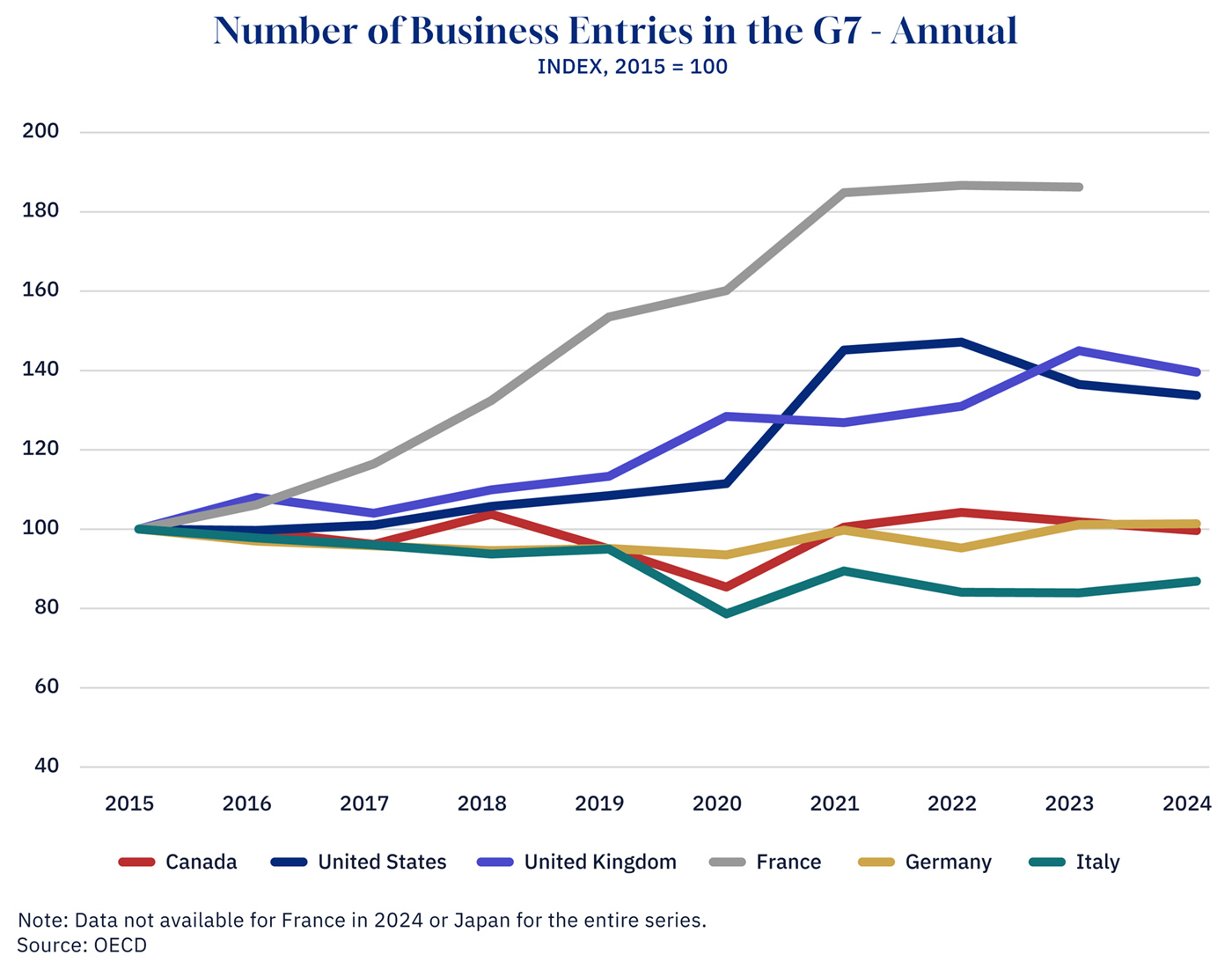
The international comparison is sobering. In 2015, OECD data shows Canada created roughly 191,000 new businesses. By 2024, the figure was essentially unchanged at 190,399, despite significant population growth. Over the same period, the U.S. saw business entries rise 34 percent, the United Kingdom 40 percent, and France 86 percent. On a per-capita basis, Canada now generates fewer new businesses than it did a decade ago and trails most of its peers.
Graphic Credit: Janice Nelson.
Without new employer-firm formation, innovation stalls, productivity stagnates, and established players entrench their positions.
Canada has many advantages: world-class universities, strong institutions, and access to talent. But advantages don’t automatically translate into outcomes. Estonia, Ireland, Singapore, and Israel all built dynamic entrepreneurial ecosystems through deliberate policy choices: regulatory reform, competitive tax structures, and environments where risk-taking is rewarded rather than punished.
Expediting major resource projects matters. But so does generating competitive new firms that challenge incumbents and drive productivity growth. The causes of Canada’s entrepreneurial decline are varied and the solutions complex, but the first step is to recognize we have a problem.
Entrepreneurship in Canada is declining, despite its importance for innovation and economic growth. While political focus is on resource projects, key indicators like self-employment rates, new firm creation, and venture capital investment are down. The number of self-employed Canadians with employees has significantly decreased, and new business creation is well below historical levels. Venture capital investment has also plummeted. Canadian startups are increasingly choosing to incorporate in the U.S. due to stronger ecosystems and lighter regulations. Canada needs to recognize and address this decline through policy changes that foster a more supportive environment for entrepreneurs.
Why is the decline in Canadian entrepreneurship a problem, according to the article?
What factors contribute to Canadian entrepreneurs choosing to start businesses in the U.S. instead of Canada?
What policy changes does the article suggest Canada could implement to revitalize its entrepreneurial ecosystem?







Comments (0)