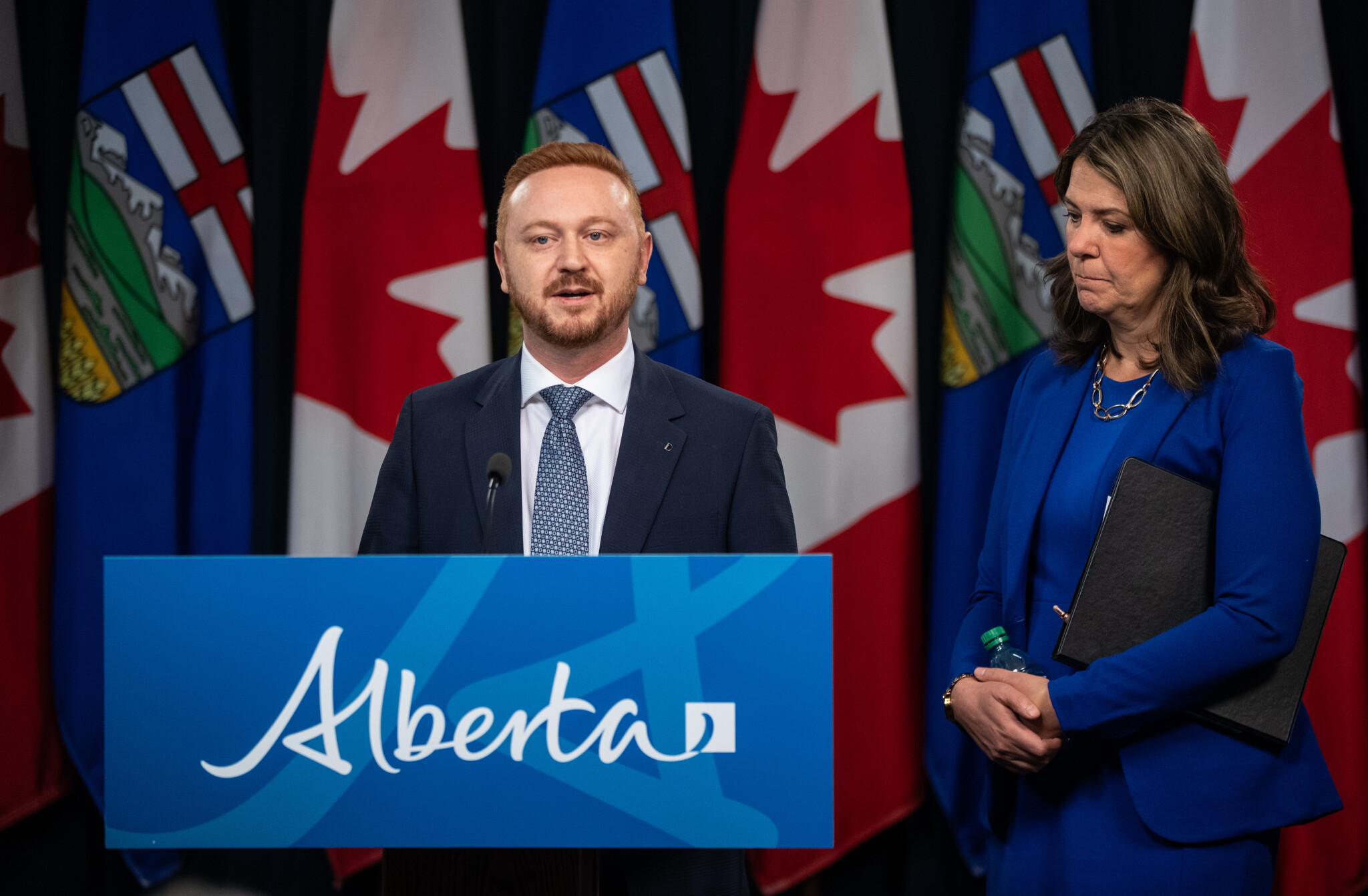
Alberta Premier Danielle Smith’s Bill 18 is an effort to put common-sense limits on MAiD in Canada. These measures are sorely needed. More than 100,000 Canadians will have died by injection within a decade of Ottawa’s Medical Assistance in Dying bill coming into effect under the Trudeau Liberals in 2016.
The proposed Alberta legislation would ban patients from accessing MAiD for mental illness. Canadians have expressed serious concern about this element in federal legislation, forcing several delays in implementation, the latest one until 2027. Bill 18 would also prohibit in Alberta all other forms of Track 2 MAiD, which is for patients whose death is not reasonably foreseeable and was legalized by Ottawa in 2021. The Alberta bill defines a reasonably foreseeable death (Track 1 MAiD) as one that is expected to occur within 12 months.
Bill 18 would also mandate the presence of a family member when MAiD takes place, which might be the biggest change to its actual delivery. Beyond this, Bill 18 does not touch the clinical aspects of MAiD delivery itself.

It’s less obvious what the impact of Bill 18’s proposed adjustments to patient eligibility criteria and clinician behaviour will be. No question, these will shift the norms and culture around MAiD, but it is hard to see how they will measurably decrease services.
For example, Bill 18 would ban initiating a conversation with patients about whether they had considered MAiD or telling patients that they should consider MAiD. These are good to see, but it is hard to imagine how they would be enforced in all but the most obvious and egregious cases, for example, veterans being offered MAiD when they cannot access a medical lift for their residence. Bill 18 also bans advertising for MAiD and creates more protection against forcing clinicians to participate.
Alberta’s Bill 18 aims to place “common-sense limits” on Medical Assistance in Dying (MAiD) within the province. The bill proposes banning MAiD for mental illness and Track 2 MAiD (for those whose death is not reasonably foreseeable), mandating family presence during MAiD, and prohibiting clinicians from initiating conversations about MAiD with patients. There are concerns about potential conflict with the federal government, which may view MAiD as an essential service, similar to abortion, and pressure Alberta to relax its restrictions.
How might Alberta's MAiD limits in Bill 18 create tension with the federal government, given past disputes over healthcare access?
What are the key differences between Canada's MAiD approach and California's assisted suicide model, and what impact has this had on death rates?
Beyond patient eligibility, what specific changes does Bill 18 propose regarding clinician behavior and the overall culture surrounding MAiD in Alberta?





Comments (12)
The Liberals will probably go after Alberta. It’s probably more of a symptom of the Canadian pathology than a particularly partisan one in this case though. Modern Canadians have lost the ability to accomodate differing views on complex moral issues. Better the purity of the nihilistic vacuum to the messiness of feeling an issue through by consensual deliberation and compatibility with personal values. No one can criticise you if you don’t express an opinion seemingly. Once the court points out room for equivocation on a topic, Canadians frantically tear up the floorboards.
Perhaps its an internalization of the near constant sneering directed towards the boisterous goings on to the South, where ideologies frequently clash. Or maybe its due to the scars wrought by Québec separatism, where a difference of opinion has been learned to be a theat to the Great White Northern imperial project. Likely both. In any case, by expressing an opinion, Alberta becomes a target for that intolerance. But, unlike the Americans or Québec, Albertans can be punished for their impertinence with little blowback.
It’s sad, because this is the precise kind of cultural difference between jurisdictions that Canada’s 1867 constitution was designed to endure, but the post-1982 one can no longer seem to bear.
The Charter has triggered a slow motion abandonment of the principles on which the country was founded. The Christian ones that informed all of the constitution’s original drafters to be sure, but in this case it’s really the parliamentary ones that Canadians claim as a supposedly sacred differentiator with the hated Americans, federal pluralism and legislative supremacy. Alberta is acting plainly within the rights afforded by those principles and instead of being viewed with a shrug by people it to whom it does not concern, Alberta has stuck its head up and must be pounded back down. The sentiment will go, “How dare those nasty Albertans dare to be heterodox? Let’s put them in their place!”
Not only is this likely to be another example the ongoing failure of the Charter. It will also likely turn out to be evidential of just how closed off Canadian attitudes are from the rest of the world. There is a maddening irony at play that on this and on trans issues Alberta is trying to move towards the global norms, but Canadians are trying to drag Alberta back to a set of supposed “universal principles” that are actually uniquely Canadian festering aberrations (the vacuum) recently discovered by an unconstrained activist court.
The Charter is a failed experiment. And Canadians’ wilful blindness to that fact as much as the Pandora’s Box of undemocratic judicial activism itself is part of what’s driving this country apart.