
If hockey is Canada’s favourite rivalry with the United States, economic performance is a close second. In recent weeks, the debate over Canada’s lagging prosperity relative to the U.S. has heated up again, with renewed discussion about whether Canadian provinces are, in fact, poorer than Alabama.
Many have countered that GDP per capita—the most common metric used to proxy living standards—is flawed and that another, better measure of prosperity tells a very different story: the United Nations’ Human Development Index (HDI). This measure, which combines indicators of health, education, and income to assess overall well-being within a jurisdiction, shows Canada tends to do well compared to U.S. states.
Still others have pointed out that while Canada’s HDI scores have improved slightly over time, its global ranking has slipped, from a top-five country throughout the 1990s to something closer to the middle of the pack among its peers by 2023.
But HDI can obscure what’s really going on. Its health and education measures rely on simple proxies that emphasize quantity over quality, while its income component, GNI per capita, shares many of the same limitations as GDP.

To get a clearer picture, it’s worth revisiting our analysis of the OECD’s How’s Life? database, which offers a broader and more detailed view of prosperity and, unlike the HDI, reports results across individual indicators.
Since that time, more recent data have come out, but the story hasn’t changed: Canada’s growth trajectory relative to the U.S. is concerning, particularly when it comes to the measures most closely tied to income and work.
Specifically, over the past decade, Americans have seen much stronger financial gains compared to here at home. Average after-tax incomes stateside have risen by about 22 percent, and median net wealth has more than doubled.
In Canada, the progress has been far slower—about 8 percent and 57 percent, respectively. So, while some may criticize per capita GDP as an incomplete, abstract measure of income and prosperity, these OECD findings suggest that its decline is showing up in people’s paycheques, savings, and financial security.
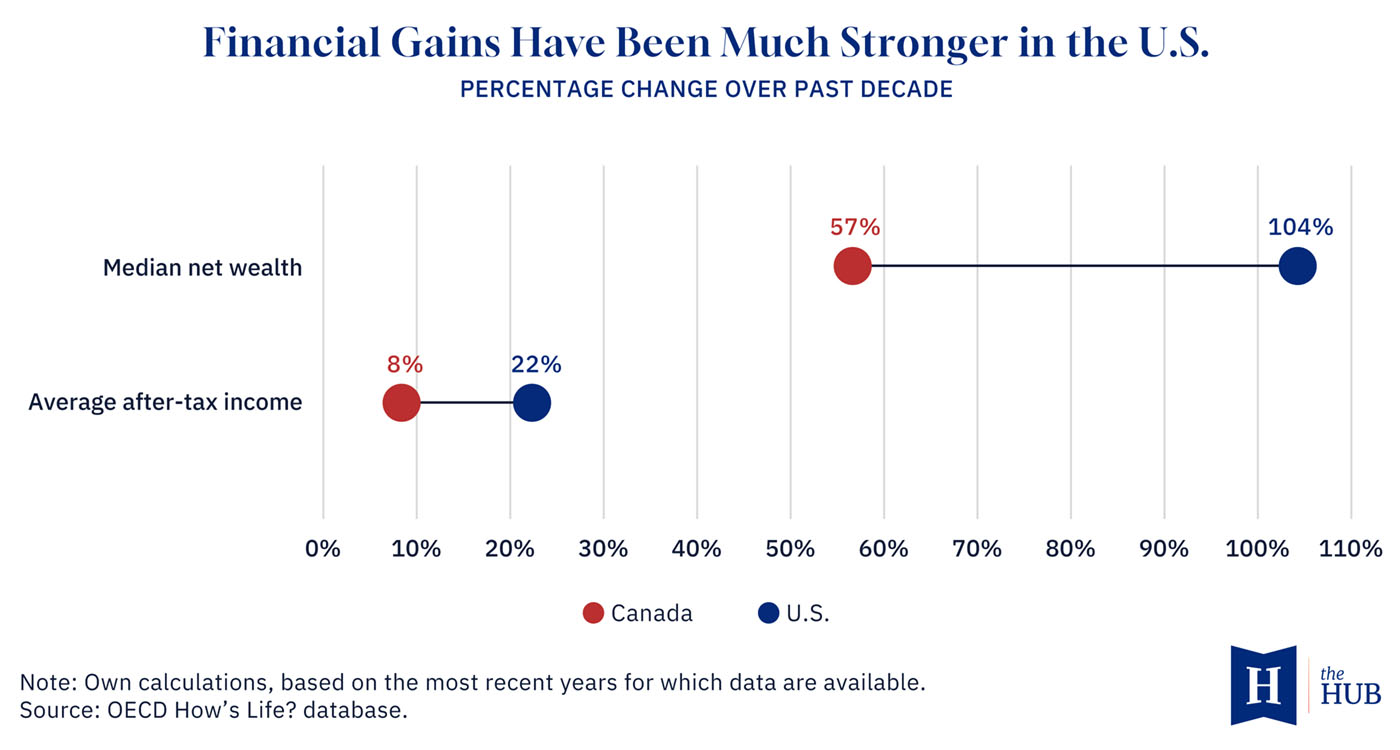
Graphic Credit: Janice Nelson.
There are also worrying signs in areas where Canada traditionally performs well. Some measures of physical health and social support have deteriorated over the past decade, and safety concerns have grown along with rising reports of violent crime. While these trends are not unique to Canada, they challenge the notion that broader well-being measures paint an entirely reassuring picture.
Health and safety outcomes in Canada still compare favourably with those in the United States. But the current trajectory should not encourage complacency. Paired with a widening gap on measures of income and wealth, it may even help explain why younger Canadians report much lower levels of well-being relative to their global peers than older Canadians do.
A version of this post was originally published by the Business Council of Alberta.

Alicia Planincic is the Director of Policy & Economics at the Business Council of Alberta. She regularly provides insight and analysis on…
Canada’s prosperity is lagging when measured against other peer countries, and particularly the U.S. While the Human Development Index (HDI) often portrays Canada favourably, the HDI has limitations and obscures underlying issues. The OECD’s “How’s Life?” database reveals concerning trends, particularly in income and wealth. Americans have experienced significantly stronger financial gains in the past decade compared to Canadians. Furthermore, there are worrying signs in areas where Canada traditionally excels, such as physical health and social support. Canada’s current trajectory should not encourage complacency, especially considering the widening income gap and its potential impact on younger Canadians’ well-being.
Beyond GDP, what alternative measure is often used to assess Canada's prosperity, and what are its limitations according to the article?
How does Canada's income and wealth growth compare to the U.S. over the past decade, and why is this concerning according to the author?
Besides economic indicators, what other worrying trends in Canada are mentioned, and how might these trends impact younger Canadians?







Comments (0)