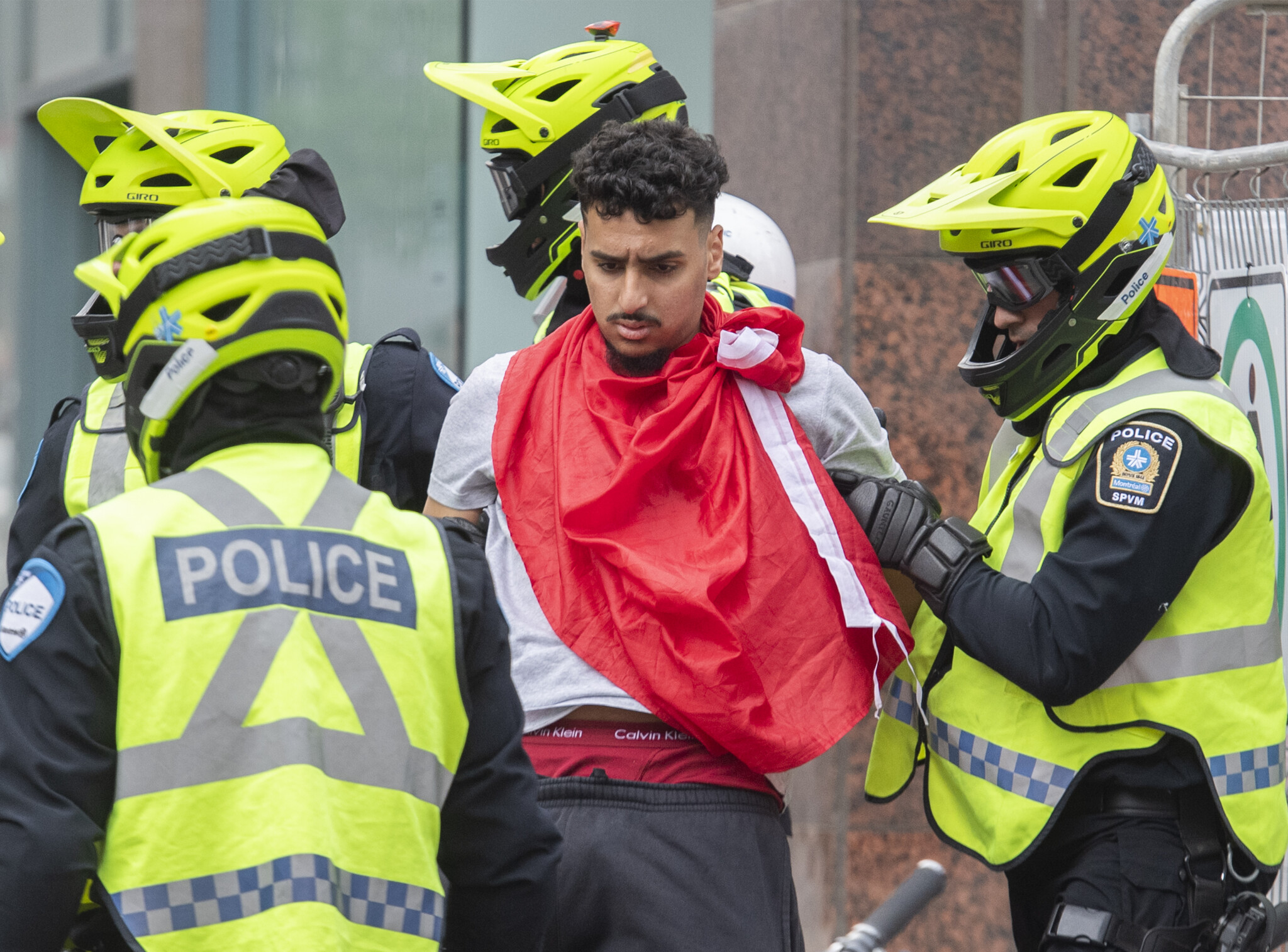
Tom Stamatakis is president of the Canadian Police Association. He represents more than 60,000 front-line officers. He has decades of experience in public-order policing. He has personally navigated riots, international summits, and the full chaotic repertoire of crowd dynamics. He is, by any reasonable measure, exactly the sort of person whose voice ought to count for something when Canadians ask why their streets have become a theatre of tolerated intimidation.
And what does Mr. Stamatakis have to say for himself?
That it’s complicated.
His recent piece in The Line is a tour de force of contextual elaboration dressed up as insight. The Charter makes things legally ambiguous, he writes. Courts scrutinize operational decisions with the luxury of hindsight. Political leaders offer no guidance and then distance themselves when things go wrong. Prosecutors decline charges. The media creates unfair narratives. Online mobs dox officers. Arresting a single agitator in a hostile crowd can escalate rapidly.
All of this is true. None of it is news. And not one word of it tells us what we can and should do about all this.

There is a peculiar genre of institutional writing that might be called the Lament of Structural Complexity. It is always impeccably reasonable. It always acknowledges the legitimate concerns of critics and provides extensive context for why things are the way they are.
And it always, always stops precisely at the threshold of saying anything that might actually change them. Mr. Stamatakis has written its Canadian magnum opus.
He tells us that front-line officers have submitted reports recommending charges related to protest incidents, only to see those cases go nowhere. He decries the absence of clear legislative and policy frameworks from governments. He notes that his association has been calling for such frameworks for years, but that these calls have gone largely unanswered.
Here is the problem with that. If there are specific policies obstructing enforcement—Crown guidelines that instruct prosecutors to decline certain classes of charges, force directives that prohibit officers from moving on particular categories of offence, bail, and sentencing rules so toothless that arrest becomes pointless—then those policies can be changed, but only if they are named, and only if the public knows precisely which lever is broken and who is responsible for fixing it.

President of the Canadian Police Association, Tom Stamatakis, speaks with media after a news conference in Vancouver, B.C., Monday, Sept. 16, 2024. Ethan Cairns/The Canadian Press.
Mr. Stamatakis has spent years watching this system fail. He has sat through disciplinary hearings, commissions of inquiry, and prosecutorial reviews. He knows exactly where the blockages are.
Yet he produced a thousand words of defensive yet atmospheric complaint without identifying a single specific policy that should be amended, a single Crown directive that should be rescinded, a single threshold that should be codified. His supposed defence of police inaction in the face of increasingly violent protests in our streets is simply a fog machine aimed at the very accountability he claims to want.
Meanwhile, the consequences of this institutional paralysis accumulate with grim results.
As my colleague Graeme Gordon has reported, Toronto synagogues are now spending as much as $500,000 annually on security, with some congregations watching their costs nearly double since October 7, 2023, diverting funds directly from education, programming, and community life. Rabbi Debra Landsberg of Temple Emanu-El, one of three GTA synagogues shot at in a single week, put it as plainly as language allows: “When you reach the point where you have to make decisions about security versus programs, the life inside the building, that’s a problem.”
That is what the complexity costs, in dollars and in spirit.

Statistics Canada found that 70 percent of all religion-motivated police-reported hate crimes across the country targeted the Jewish community in 2023. Seventy percent. Not a plurality or even a majority. Nearly the entire category of these condemnable acts in Canada has a single primary target. This is the context in which Mr. Stamatakis assures us that policing large demonstrations is complex.
He does make one distinction worth engaging with. Criminal attacks on places of worship, he says, are different from large protest environments; the former investigated as serious offences, the latter complicated by Charter-protected activity. Fair enough, as far as it goes. But the two phenomena are not sealed off from each other. The culture of tolerated intimidation in one feeds the culture of emboldened violence in the other. Hatred that is performed publicly without consequence does not remain merely performative. As I have argued in these pages before, hatred rarely advances by force alone; it advances by permission.
This is what Mr. Stamatakis’s piece most conspicuously ignores: Canadians already know that something is badly wrong. They see the disorder in their streets. They have watched mobs march through Jewish neighbourhoods for months without consequence, and then watched synagogues get shot at. They do not need to be persuaded that the situation is serious. What they lack, and what ordinary citizens cannot reasonably be expected to supply for themselves, is the policy prescription of someone who knows the system from the inside, who can point at the specific broken mechanisms and say, “This policy, this directive, this prosecutorial habit, this legislative gap. Fix that, and hold to account the people responsible for it.”
View reader comments (8)
Mr. Stamatakis had that knowledge and that platform, but instead of using it to convert public frustration into targeted, actionable demand, he converted it back into ambient unease. A sophisticated explanation of why urgency is so difficult to act upon is the abdication of leadership. Not to mention, it is simply unhelpful.
The law against incitement to violence is not new. The law against criminal mischief is not new. The law against intimidation is not new. The Criminal Code today is voluminous; it needs to be enforced. And where enforcement genuinely is blocked by identifiable policies, those policies need to be named, loudly, and repeatedly, until they are fixed.
Canadians deserved that from him, as we do from all those in positions of influence at this precarious moment in time. More pressingly, so did those walking past 20 bullet holes in their synagogue’s front lobby on a Saturday morning, wondering if their country still intends to protect them.
The first responsibility of the state is the protection of its citizens. That remains true even when it’s complicated.
Fault Lines examines the pressures pulling Canadian society apart and the principles that can hold it together. We look beyond headlines to understand how institutions, communities, and democratic norms are fraying. Our mission is to show how better choices can repair what is broken.

Stephen Staley is the Director of Fault Lines and a longstanding contributor to The Hub on Canadian policy, culture, and civic life. He is…
Tom Stamatakis, president of the Canadian Police Association, should be critiqued for his explanation of the complexities of policing protests. Stamatakis, while acknowledging the challenges faced by law enforcement, fails to identify specific policy changes needed to address the issue of tolerated intimidation and violence, particularly against the Jewish community. With his extensive experience, he should be providing concrete solutions instead of offering vague explanations. There are real-world consequences of this inaction, such as increased security costs for synagogues and the prevalence of hate crimes. We need specific, actionable policy recommendations to ensure the protection of all citizens.
Why does the author criticize the police union president's statement on policing protests?
What economic impact is highlighted in the article as a consequence of the current situation?
According to the author, what is needed to address the issues with policing protests effectively?



Comments (8)
What’s striking here is not just the critique of police leadership, but the pattern it reveals across institutions.
We increasingly see a form of institutional speech that explains why action is difficult without clarifying what action is required. The result is not simply inaction, but a diffusion of responsibility. Everyone acknowledges constraint; no one names the decision.
The author is right to insist that governance requires more than contextual explanation. But the deeper issue may be structural. In systems where legal, political, and reputational risks are tightly coupled, institutional actors may avoid specificity not out of ignorance, but because naming a lever is itself a commitment to using it.
The challenge, then, is not only better leadership, but restoring conditions under which institutions can act without incurring disproportionate risk for doing so.