As provincial budget season winds down nationwide, we are left with the fiscal remains of the day as estimates of budget deficits assault our senses. With the 2025-26 fiscal year wrapping up, every provincial government is reporting or expected to report a budget deficit.
For example, Ontario’s deficit came in below what was projected at only $12.3 billion, but next year’s shortfall is now larger than initially projected at $13.8 billion. As numbers go, being a few billion dollars off from year to year, given the turbulent economic times, is to be expected. After all, borrowing from C.D. Howe, in the end, what is a billion dollars these days, anyway?

Yet, deficits are only part of the story when it comes to provincial and now even federal finances because of the practice of what is termed accrual accounting with capital budgeting. Essentially, what this involves is the separation of operating and capital budgets, where the operating budget focuses on revenues minus expenses, and capital expenditures are recorded separately, with the net debt capturing the full impact of the increase in borrowing.
To put the numbers in perspective, for 2025-26, the federal government incurred a deficit of $78.3 billion but added $86.8 billion to its net debt. In the same fiscal year, the provinces collectively incurred a combined deficit of $42.1 billion but added a total of $81.4 billion to their total net debt.
While long a private sector approach, Ontario and British Columbia began the practice in the 1990s, and other provinces followed suit in the 2000s. The federal government indicated expanding its move to this type of capital budgeting in Budget 2025.
The move has pros and cons. Large capital infrastructure projects have benefits and costs spread over time, and placing them entirely in a current year’s operating budget puts them on current taxpayers, creating a one-time deficit spike.
View reader comments (10)
More to the point, the deficit includes debt charges and amortization costs of capital projects, but not the full borrowing requirements, which are shifted to the capital budget and appear in the net debt.
As a result, reported deficits are only partial deficits, with a full reporting of the amount borrowed in a given fiscal year being the sum of the operating deficit plus the additional increase in the net debt over and above the amount of the operating deficit. What this does over the long term is place an emphasis on the operating deficit when it comes to budget season and media optics, but downplays the true amount of borrowing as reported in the increase in net debt.
This is usually, conveniently, buried at the back of the budget. This creates an incentive for governments to spend and borrow more than they otherwise might have if the full size of the deficit and borrowing were more upfront.
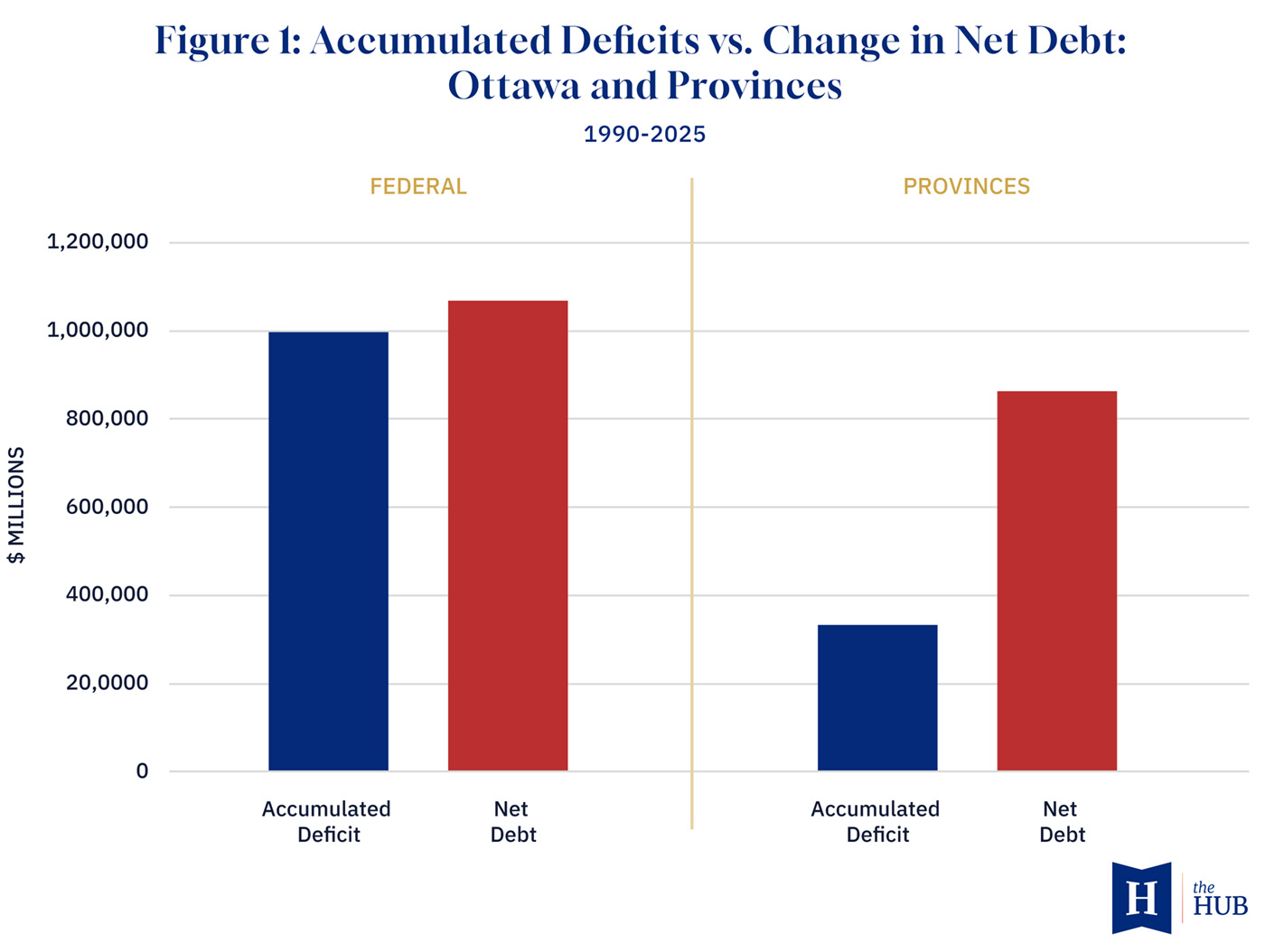
Is there any evidence that increases in net debt exceed operating deficits? Figure 1 uses data from the Fiscal Reference Tables updated to include 2025-26 results from assorted budgets to plot the accumulated deficits and the change in the net debt for Ottawa and the provinces from 1990 to 2025. The federal government during this period sees its increase in net debt closely match the accumulated deficits, though going forward, that will inevitably change.
Graphic credit: Janice Nelson
The provinces, on the other hand, accumulated combined deficits of approximately $333 billion from 1990 to 2025, but saw an increase in net debt of $863 billion.
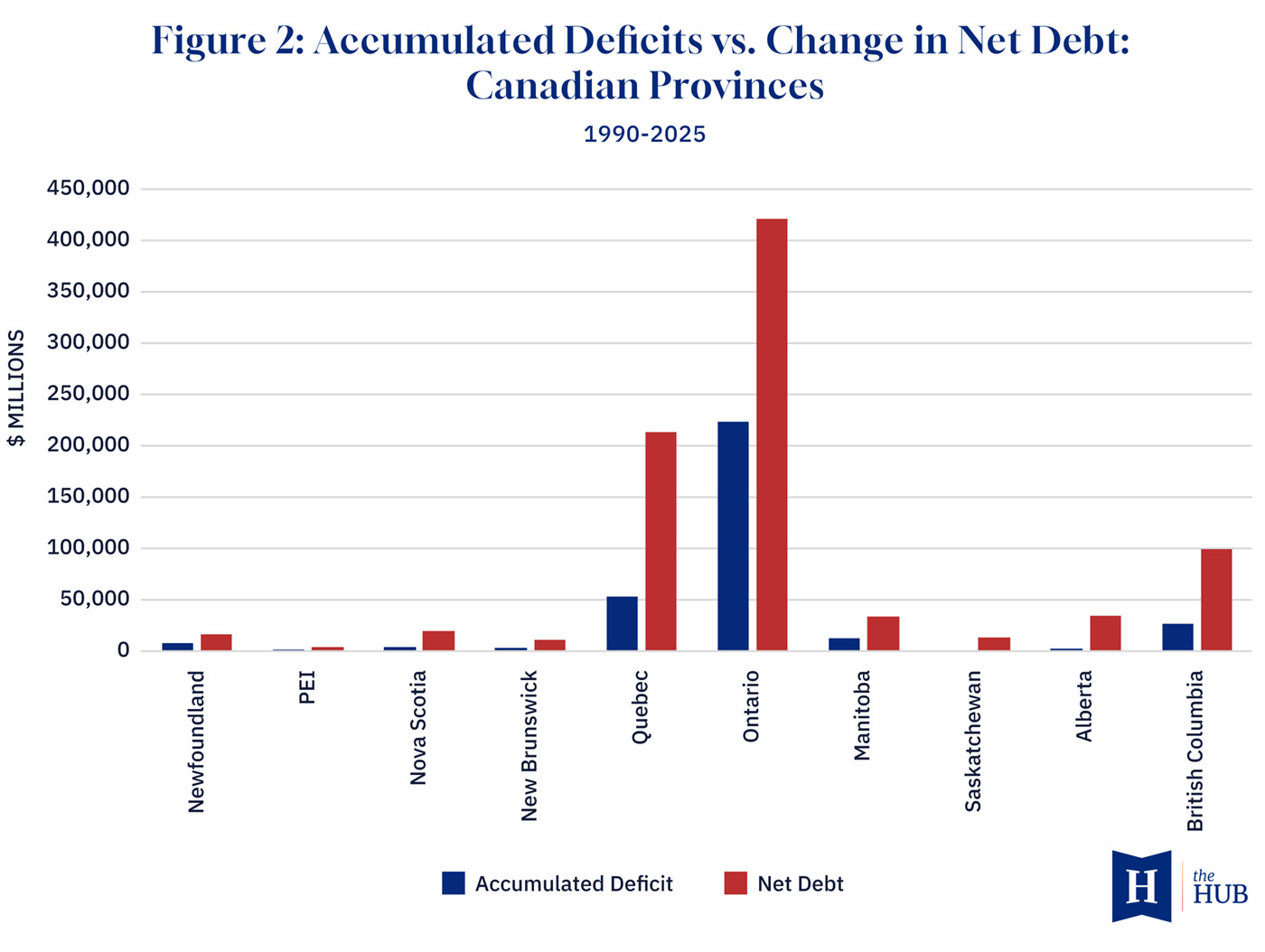
Figure 2 breaks down the accumulated deficits versus the change in net debt over the 1990 to 2025 period by province. Notwithstanding differences in the absolute size of the figures across the provinces, the result shows that every province has its net debt increase more than its accumulated deficits. For some of the larger provinces, the results are quite dramatic.
Graphic credit: Janice Nelson
Ontario, for example, accumulated provincial deficits of $224 billion from 1990 to 2025 but saw its net debt rise by $421 billion. Quebec accumulated deficits of $53 billion, but net debt increased by $213 billion. British Columbia accumulated nearly $27 billion in deficits but saw its net debt increase by $99 billion. Alberta, with its typical boom and bust resource revenue cycles, managed just over $2 billion in accumulated deficits but still racked up $34 billion in net debt.
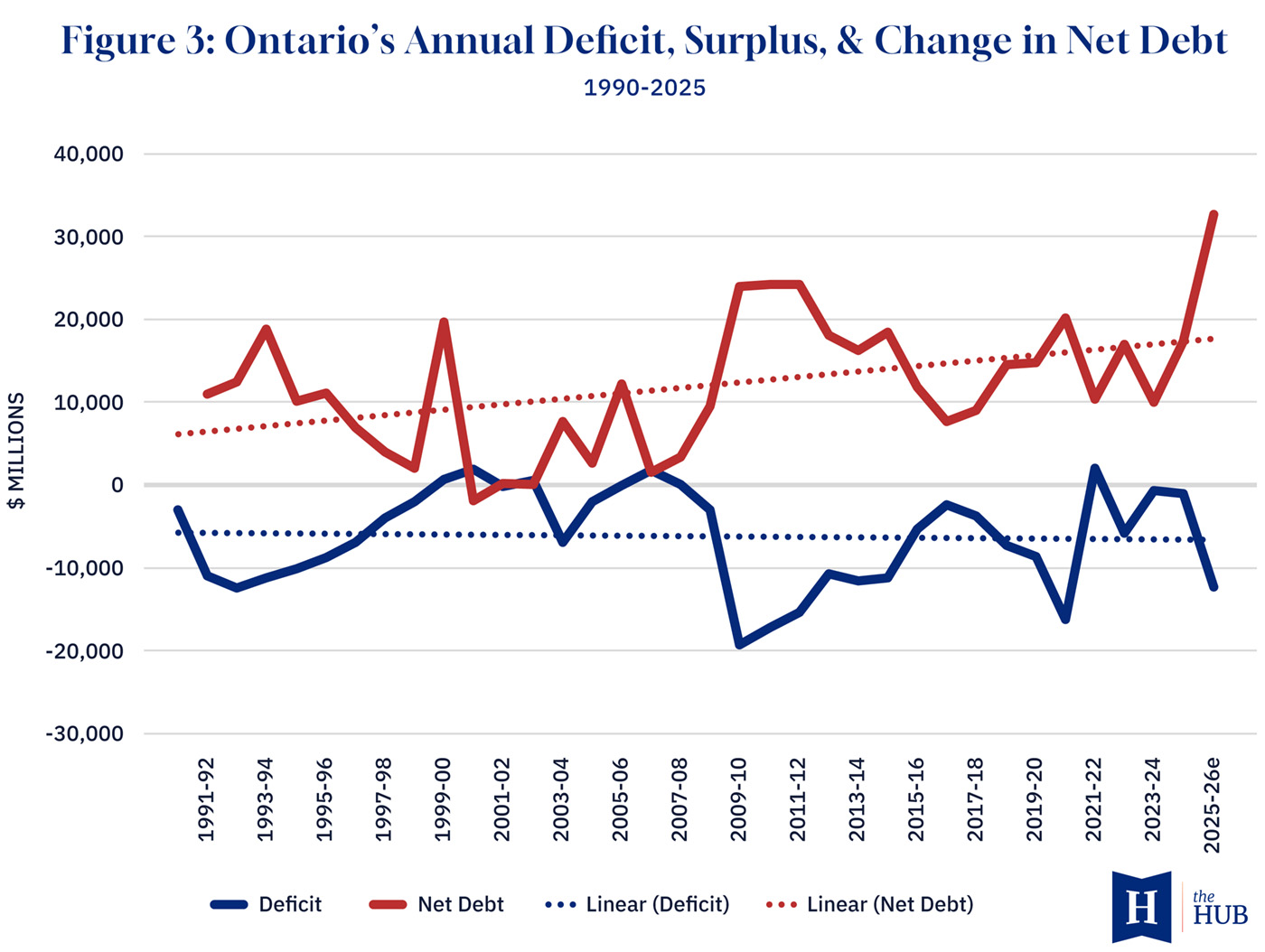
Are the provinces engaging in fiscal illusion when it comes to their finances? The best evidence is from Ontario, a pioneer in the move to separation of operating and capital budgets. Figure 3 plots the annual budget deficits reported by the provincial government and the change in net debt for the 1990 to 2025 period and adds a linear trend for each series. Over time, Ontario deficits have indeed fluctuated, but they have not trended much up or down. The additions to the net debt, on the other hand, exhibit a distinct upward trend.
Graphic credit: Janice Nelson
Now of course when it comes to the bottom line in accounting practice, having a distinction between the operating and capital budgets is the preferred solution given that it spreads the cost of long term assets over time rather than in the current budget period and in a sense is generationally fairer in that the debt service costs are borne by people benefiting from the infrastructure over time.
Moreover, much is made of the importance of renewing capital infrastructure as an incentive for economic growth, though in the case of Ontario, the size of the increases in net debt and the growth rate of real per capita GDP have been trending in opposite directions for some time.
However, the practice as currently reported also presents the deficit as a fiscal red herring, given that it understates what one can term the true deficit.
The solution? In the absence of a completely different way of dealing with capital costs over time, such as employing sinking funds, the solution is to improve transparency in reporting. That is, when budget summaries of revenues and expenditures are presented, along with the lines showing deficit to GDP and debt to GDP ratios, there should also be a line below the reported deficit/operating balance that shows the increase in net debt.
The media, in particular, should take it upon themselves to ask for and report both the operating deficit and the increase in net debt. Taxpayers and citizens should see what the increase in borrowing is going to be upfront, so they can match the full cost of the capital spending with the benefits trumpeted in the capital projects that are announced.

Livio Di Matteo is Professor of Economics at Lakehead University and a member of the CIHI NHEX Advisory Panel. The views expressed…
There is a serious discrepancy between reported budget deficits and the actual increase in net debt in Canada, both federally and provincially. The practice of accrual accounting, separating operating and capital budgets, obscures the true extent of government borrowing. While this approach has benefits in spreading infrastructure costs over time, it also leads to an underestimation of the total borrowing. Governments are incentivized to spend more due to the downplaying of net debt increases. We need greater transparency in financial reporting, with a focus on both the operating deficit and the increase in net debt to gain a clearer picture of government finances.
How does accrual accounting hide the true size of government borrowing, and what are the potential consequences?
The article suggests Ontario's net debt is trending upwards while per capita GDP growth is slowing. What does this imply about the effectiveness of capital infrastructure spending?
What solution does the author propose to improve transparency in government financial reporting, and why is it important?







Comments (10)
There is no incentive for the feds or the provinces to rein in spending. Everybody has their hand out, and in the current political environment, nobody is going to get elected promising cutbacks. The situation will change when there is a catastrophic economic collapse, and the governments don’t have a choice. Unfortunately, if that happens, it may provide the opportunity for a demagogue from either the left or right (knowing Canada, it will probably be the left) to use the crisis to come to power and attempt to stay there by circumventing the electoral process. Don’t think it can’t happen here.