
Clearance rates for violent crime have declined in every Canadian province and territory over the past decade, with nearly half of all reported violent offences now going unsolved as rising caseloads outstrip police capacity, according to a new analysis published in The Hub.
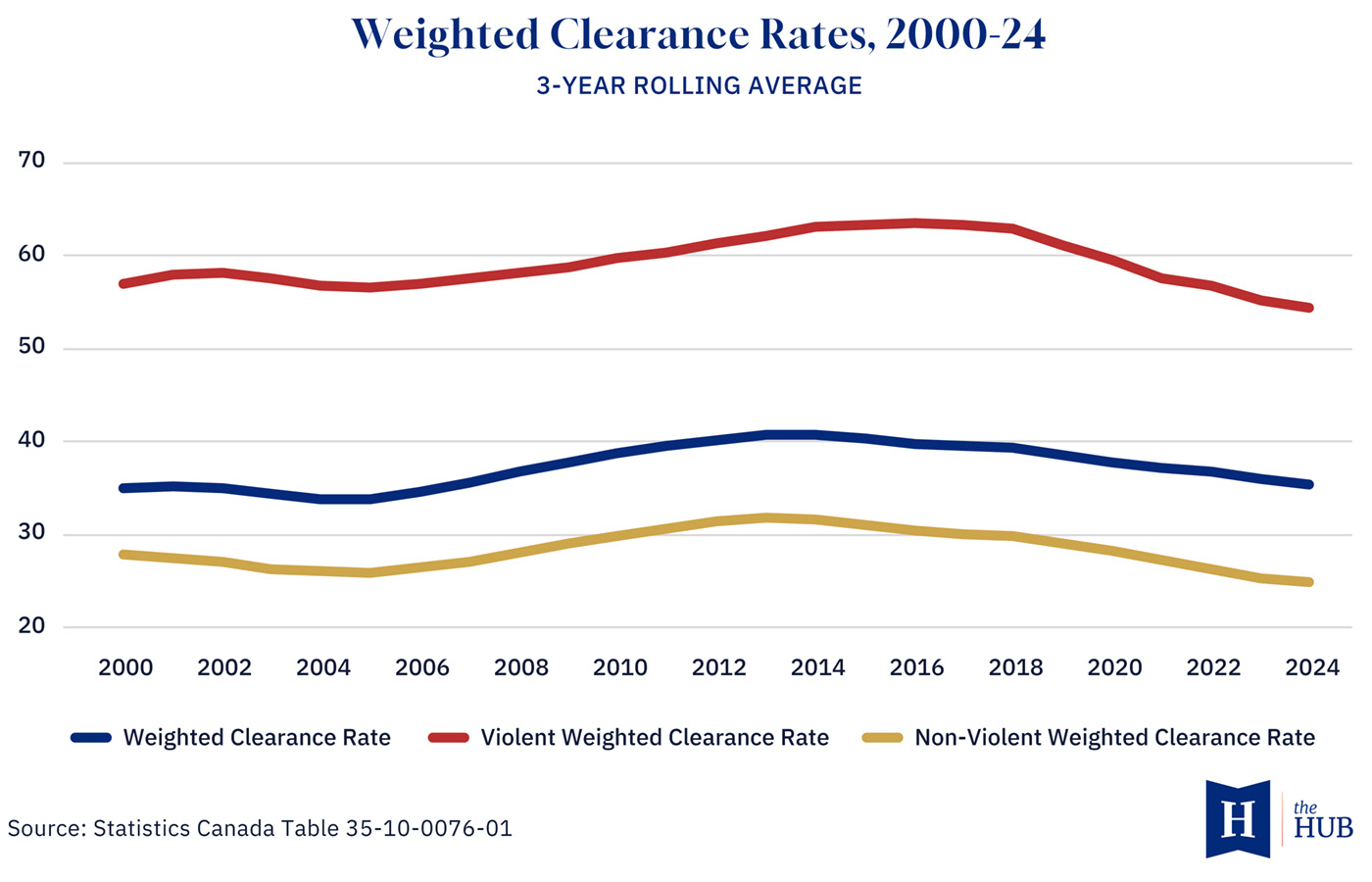
The findings, compiled by University of Guelph associate professor Dave Snow, show that British Columbia’s rolling average clearance rate—the share of reported crimes solved by police—fell below 40 per cent for the first time in 2024, the lowest of any province. The national figures reveal a clear inverse relationship between violent crime severity and clearance rates, stretching back two decades.
Graphic Credit: Janice Nelson.
“Alongside increased violence, trial delays, and a strained bail system, police are also solving fewer crimes—yet another sign of a system stretched beyond its capacity,” argued Snow.
The Statistics Canada data traces a pattern tied directly to crime volume. When violent crime severity fell between 2005 and 2015, clearance rates rose. But when severity climbed again between 2015 and 2024, clearance rates dropped.
Major investigations—homicides, shootings, and other high-priority incidents—require large teams and take a long time to solve, pulling resources away from other files. As violent incidents multiply, the data suggests police have less capacity to investigate and close each case.
View reader comments (0)
A decline in police officers per capita has compounded the problem. Christian Leuprecht, a defence and security scholar at the Royal Military College and Queen’s University, has previously noted that Canadian police-to-population ratios have not kept pace with Canada’s demographic growth, a structural gap that leaves forces stretched thin during periods of rising crime.
Leuprecht has warned that this widening divide between policing resources and population growth risks expanding the gap between reported crimes and resolved ones unless additional capacity is brought to bear. Now with finite resources spread across a growing volume of serious cases, non-violent clearance rates have also fallen, even though non-violent crime severity increased only modestly over the last decade, rising from 68 to 71 on Statistics Canada’s crime severity index.
Regional variation exists, but does not alter the national trajectory. The largest drops in violent clearance rates over the decade occurred in the territories, Atlantic Canada, and British Columbia. Meanwhile, Quebec and Ontario saw comparatively smaller declines of seven and five percentage points respectively.

Canadian cities tell a similar story. Among the 20 largest census metropolitan areas (CMAs) tracked by Statistics Canada, clearance rates dropped in nearly every one. Mid-sized cities such as St. Catharines, Kitchener, London, Victoria, and Moncton experienced especially steep declines. Windsor, Ont., stood out as the sole outlier, with violent clearance rates rising by nearly 10 percentage points — though its non-violent clearance rate moved in the opposite direction, falling from 30 to 23 per cent.
Specific violent crime categories illustrate the scale of the challenge.
“Extortion cases in Canada have exploded over the past decade, mainly in B.C., Ontario, and Alberta, rising more than 300 percent nationwide in the last decade and nearly 500 percent in B.C. alone,” The Hub reported, following a January investigation into extortion linked to transnational organized crime in Surrey, B.C., Brampton, Ont., and Calgary.
Police task forces and the Canada Border Services Agency have stepped up enforcement in response, including allocating $30.4 million to allow for 20,000 removals this year, but concerns remain that many extortion incidents go unreported, further undermining the reliability of clearance statistics.
The clearance rate decline sits within a broader pattern of rising violence documented separately by Snow.
“The analysis shows the naysayers are wrong: Violent crime severity increased considerably in every province and nearly every major city over the last decade,” he observed.
The combined Statistics Canada data—falling police-to-population ratios, rising crime severity, strained courts, and an overburdened bail system—all point in the same direction, raising questions about whether the criminal justice system can keep pace with the demands being placed upon it.
This story was edited using NewsBox AI.
A new analysis reveals a concerning trend: clearance rates for violent crimes in Canada have declined across all provinces and territories over the past decade. This means nearly half of all reported violent offenses are now going unsolved. The study, conducted by University of Guelph’s Dave Snow, highlights an inverse relationship between violent crime severity and clearance rates, suggesting that rising caseloads are outpacing police capacity. Factors contributing to this decline include increasing violent crime severity, trial delays, a strained bail system, and a decline in police officers per capita. Extortion cases have also seen a dramatic increase, particularly in B.C., Ontario, and Alberta, further straining resources.
With violent crime clearance rates falling, what are the potential long-term consequences for public trust in the Canadian justice system?
The article mentions a decline in police officers per capita. How might increasing police funding and recruitment affect crime clearance rates and overall public safety?
Given the significant rise in extortion cases, particularly in certain provinces, what policy changes could be implemented to address this specific type of crime more effectively?







Comments (0)