‘Entrepreneurs do not fall out of the sky’: Zita Cobb on building Canada’s economy from the ground up
Shorefast founder and Hunter Prize judge believes all struggling communities have something to offer
Canada may not have an asset problem so much as a failure to recognize what it already has, according to Newfoundland entrepreneur Zita Cobb.
“We keep saying this: Canada has what the world needs and wants, and yet we don’t get the economic momentum that we expect we should have,” Cobb told Alberta Edge. “The part of the puzzle we haven’t really solved is this thing called development.”
That, in Cobb’s telling, is how assets become stranded.
An eighth-generation Fogo Islander, she grew up in a remote Newfoundland fishing community before leaving to study business at Carleton University. A cross-country trip after graduation landed her in Calgary in 1979, where she began her career at Texaco during Alberta’s oil boom.
She later moved into telecommunications, eventually becoming chief financial officer of JDS Fitel and a senior executive at JDS Uniphase before retiring from the technology sector in 2001. She returned to Fogo Island and founded Shorefast with her brothers, using business to help rebuild an economy battered by the collapse of the cod fishery.
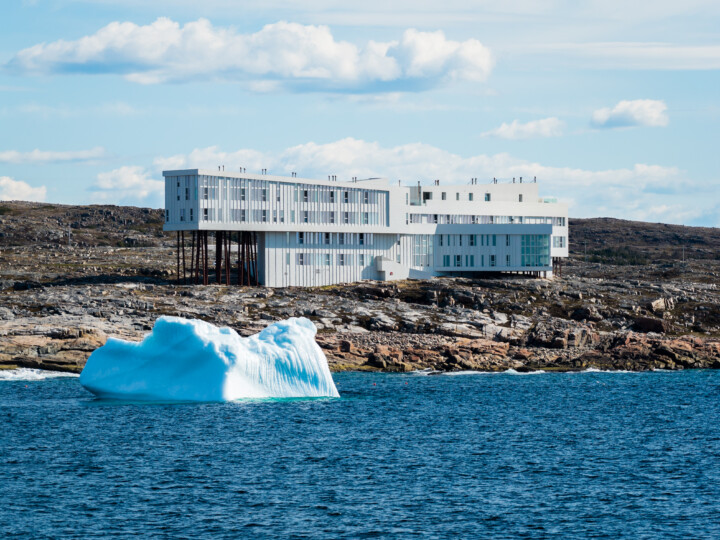
Its best-known venture is the Fogo Island Inn, a luxury boutique hotel that opened in 2013 and has become an unlikely global destination on an island of roughly 2,200 people.
“Everything you eat and touch and smell—we probably made it, we harvested it, we caught it, we shot it.”
But Cobb argues the lesson isn’t that every struggling town needs a fancy inn.
“It’s not what we did. It’s sort of how we did it,” she said. “It’s not a formula. It’s a process.”
That process starts with what Cobb calls a place-based, asset-based approach: asking what people in a place know, what they have, and what they can do with it.

The Fogo Island Inn, left, is a luxury hotel on Fogo Island, N.L., founded by entrepreneur Zita Cobb, right. Credit: Justin Parsons/Fogo Island Inn (left). Valerie Howes (right).
On Fogo Island, that meant building a business around the island’s culture, landscape, craftsmanship, and hospitality—and deliberately keeping its spending close to home. More than half of every dollar spent at the inn stays on Fogo Island, and more than 96 percent remains in Canada, according to Shorefast.
Cobb believes the same thinking can apply almost anywhere. Shorefast is now working with communities elsewhere in Canada, and Cobb has begun exploring the approach in Alberta’s Battle River region, where she sees potential in everything from agriculture and entrepreneurship to rural health.
She says Alberta already possesses one advantage, which is a culture that understands markets and wealth creation.
“I didn’t get the sense any time I was there that we were waiting for someone to come from central Canada and solve the problems or take the opportunities,” Cobb said.
Now a judge for this year’s Hunter Prize, which is focused on Canada’s decline in entrepreneurship and business dynamism, Cobb argues the country needs more of that instinct—but applied at the community level.
“Entrepreneurs do not fall out of the sky,” she said. “They’re born somewhere. They’re raised somewhere.”
Zita Cobb argues that Canada’s economic challenge isn’t a lack of assets, but a failure to recognize and develop the resources, knowledge, and people already rooted in communities across the country. The Newfoundland entrepreneur, who began her career in Calgary’s oilpatch and went on to build the acclaimed Fogo Island Inn in her hometown, explains how place-based economic development can turn local strengths into wealth-generating opportunities. A judge for this year’s Hunter Prize, Cobb also reflects on Canada’s decline in entrepreneurship and what it will take to create the conditions for more people to build businesses where they live.
This podcast is generously supported by Don Archibald. The Hub thanks him for his ongoing support.


Comments (1)
Wow, this is just a stunning interview.
Economic literacy, communitarianism, geographic determinism, subsidiarity, vernacular architecture, the embedding of culture in economy and economy in culture, the organic benefits of private enterprise, the truth of Canadian regionalism, the conscious dialogue between past, present and future. What an amazing and comprehensive small-c conservative portrait and critique of Canada.