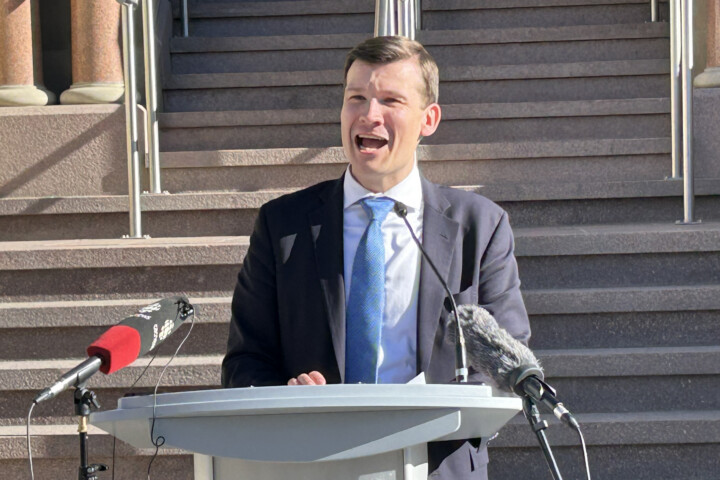
‘Focus on the fundamentals’: Calgary Mayor Jeromy Farkas on how government can work again
- Calgary Mayor Jeromy Farkas champions a pragmatic, post-partisan governing style focused on execution and evidence.
- Farkas emphasizes coalition-building, even with former opponents, as essential for achieving results.
- Key early mandate tests included managing a water infrastructure crisis and passing a budget with reduced tax hikes.
- The mayor followed through on a promise to repeal Calgary’s blanket housing rezoning policy.
- Ending foreign national flag-raising at city hall was a move to defuse civic tensions.
- Farkas believes municipal politics is uniquely effective due to its focus on core services and proximity to citizens.
Episode description
Calgary Mayor Jeromy Farkas reflects on his first 100 days in office and makes the case for a more pragmatic, post-partisan style of governing—one rooted in execution, evidence, and coalition-building rather than ideology.
Farkas describes how losing the 2021 mayoral race forced a personal and political reset, reshaping how he thinks about leadership, disagreement, and power. Now governing as an independent, he explains why surrounding himself with people who don’t share his politics, including former opponents, has been essential to getting things done.
The conversation on Alberta Edge digs into the biggest tests of his early mandate: navigating a major water infrastructure crisis, passing a budget that sharply reduced a proposed tax hike, following through on a promise to repeal Calgary’s blanket housing rezoning policy, and ending foreign national flag-raising at city hall to defuse growing civic tensions. Across each file, Farkas argues that municipal politics remains a uniquely effective level of government because it is close to people’s lives, focused on core services, and capable of delivering results when higher levels stall.
Farkas also unpacks his philosophy on housing, affordability, public safety, and social spending, making the case that prevention and evidence-based decisions are fiscally responsible solutions. He rejects culture war politics outright, insisting that city hall works best when it stays focused on fundamentals.
At a moment when trust in government is eroding, this episode of Alberta Edge explores why cities may be where democratic renewal begins—and how Calgary is becoming a live experiment in what governing without rigid partisanship can actually look like.
Jeromy Farkas, Calgary’s recently elected mayor, reflects on his first 100 days in office and makes the case for a post-partisan style of politics—one focused on execution and governing within clear jurisdictional limits, rather than culture wars or ideological signaling. From confronting a looming water-infrastructure crisis to cutting a proposed tax increase and reversing Calgary’s blanket housing rezoning policy; Farkas explains why textbook solutions sometimes fail in practice, and why municipal governments can still deliver results even as higher levels of government stall.
This podcast is generously supported by Don Archibald. The Hub thanks him for his ongoing support.
Mayor Farkas emphasizes a 'post-partisan' approach. What are the biggest benefits of this style of governance for a city like Calgary?
The article suggests municipal politics is uniquely effective. What makes city hall a powerful level of government for democratic renewal?
Mayor Farkas advocates for 'prevention and evidence-based decisions' as fiscally responsible. How can this philosophy impact housing affordability and public safety?


Comments (4)
In 1980 Alberta’s provincial tax rate was 38.5% of the federal tax rate. (The old methodology was to apply a percentage against the federal rate). Other provinces had “tax-on-tax” rates between 44%-58%. Even the arch “old school PCer,” Peter Lougheed himself kept the province at a distinct tax advantage relative to the rest of the country.
Lougheed also laid out his opposition to a right-to-strike interpretation of the charter. And held it up as one of the reasons for including the notwithstanding clause in the constitution. And he was no strangers to no holds barred sovereignty battles with the Feds.
“Old School” PCer also wouldn’t have been shy about their unabashed opposition for abortion. The spiritual father of “Old School PCing” was George Grant and that was literally the hill he chose to die on politically.
And Mulroney, “old school PC” father of Canadian economic liberalization and proponent of decentralized federalism, was also of course a mentor to Poilievre.
The warm and fuzzy almost marxist “old school PCer” trope of today is largely a fabrication. A strawman that leftists like to hold up as a fig leaf for their tax and spend preferences. “Well you see I’m just the kind of conservative that isn’t actually a conservative.” The real old school wasn’t terribly unlike the “new school.”
I’ll give Farkas a little credit here. I think he’s actually retained more of his conservatism than he lets on. He just knows how to use the language of the left to mask it. I don’t think he would have axed the Palestinian protest flags, zeroed in on blanket rezoning or battled down the last council’s tax hike if he hadn’t. Brian Thiessen’s presence on the advisory council got the buzz, but it was missed that his new chief of staff used to be one of Jim Prentices’. Another of the appropriated supposed “old school PCers” whose message to Albertans was to “Look in the mirror” on spending who immediately departed from the excesses of Redford and Stelmach.
Farkas has always been a performer though. Most conservatives found his old persona verging on parody. This one is a lot more nuanced and so far it has gotten more results for the city than we’ve had in 15 years. We’ll see where the next act takes us.