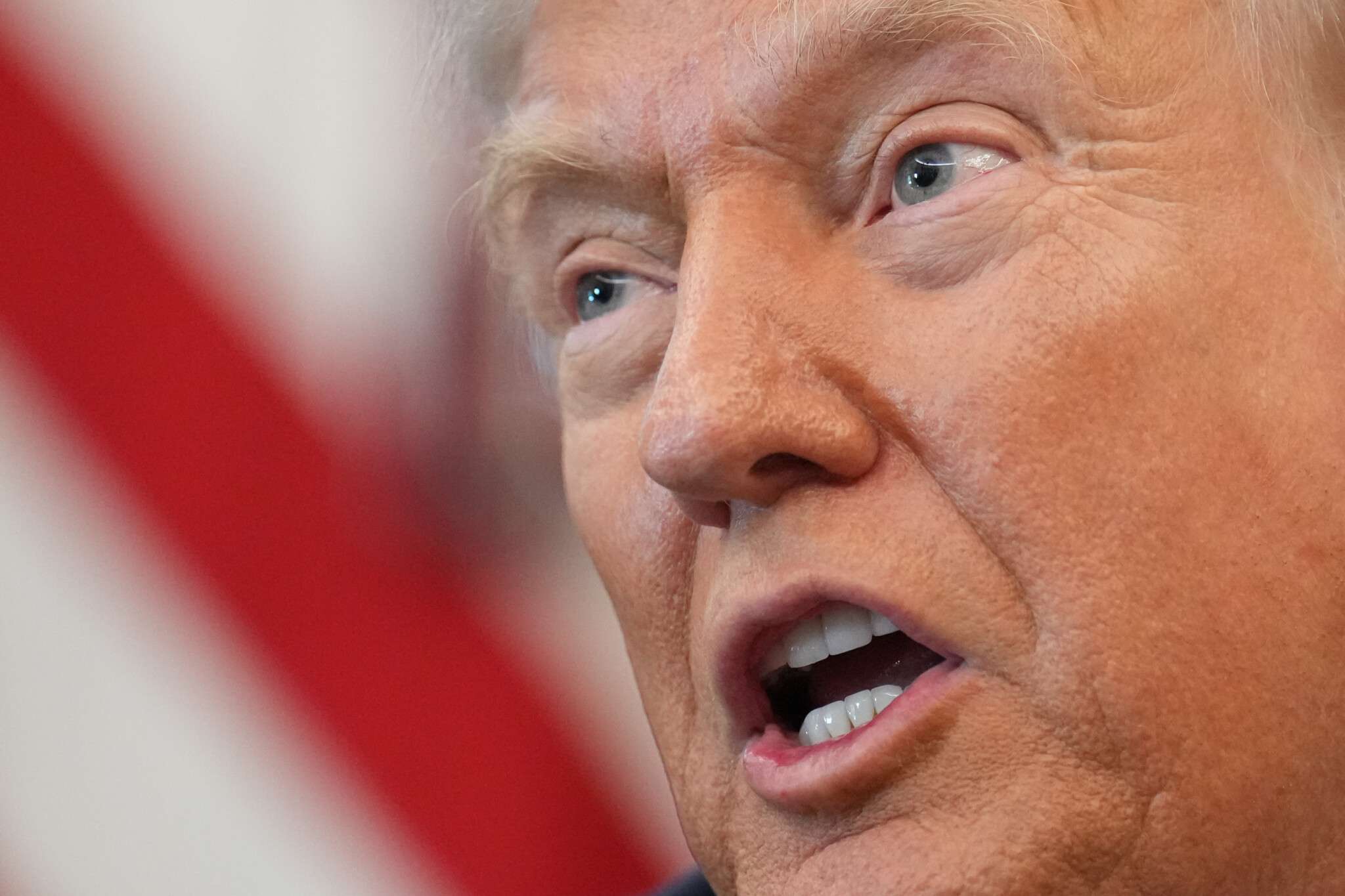
‘Dangerous for Canada’: What to make of Trump’s tariff tantrum
Rudyard Griffiths and Sean Speer discuss President Trump’s abrupt termination of trade negotiations with Canada following his reaction to the Ontario government’s recent advertisement featuring a speech from Ronald Reagan. They explore how Trump’s sensitivity to the ad may be related to an upcoming Supreme Court hearing on November 5th that could challenge his emergency tariff powers, potentially making Canada a scapegoat if the ruling goes against him.
They also examine the differing political incentives between Prime Minister Carney’s focus on securing an economic deal and Premier Doug Ford’s positioning as a “fighter” against Trump, as well as Canada’s retaliatory measures against Stellantis and General Motors.
You can listen to this episode on Amazon, Apple, and Spotify.

Program Transcript
This is an automated transcript. Please check against delivery.
RUDYARD GRIFFITHS: Trump tariff tantrum, Truth Social has been busy for the President the last 12 hours. Broadsides @ Canada calling off trade negotiations, all because of an Ontario ad. To help break it all down, explain what it means, I’m joined by Sean Speier, co founder, editor, large of the Hub and Ronald Reagan aficionado. Sean, I’m always glad when I can draw on your deep knowledge of the Gipper to help explain when he surfaces front and center here in a major cross border event.
SEAN SPEER: Yeah, I’d much rather be talking about Ronald Reagan than what’s transpired over the past 12 hours. Listeners and viewers know, because we’ve talked about it a lot recently, that there’s been growing anticipation that next week when Prime Minister Carney and President Trump are in Asia, that we were going to see at least a nod towards a reduction in sectoral tariffs from the administration onto Canada, to say nothing of broader progress towards some kind of resolution of the ongoing tariffs. And yet, well, some of us were asleep. President Trump poured cold water all over that and announced, of course, that he is terminating negotiations effective immediately. It’s a big deal economically and it’s a big deal politically, too. I suspect we’ll get into some of that today.
RUDYARD GRIFFITHS: Yeah, let’s, in service of our listeners and viewers, try to go a little bit deeper here than the mainstream press to get at maybe what was the irritant for Trump in this ad. Probably not so much Ronald Reagan, Sean, as his reference to the Supreme Court hearing on his tariffs coming up on November 5th. And my sense here is that his focus on the ad in Canada in conjunction with the, with the courts taking up the legality of his tariffs for listeners and viewers of the show.
They know that that’s something that has worried Sean and I for a while, that if his emergency tariff powers are struck down, it’s quite possible that the president would then turn to something like Kuzma, where he does have a wounded mouse here pinned on the board, and start playing, you know, with us, you know, with the same cruelty as my cat in the backyard with a set of wounded pigeons. I’m stretching my analogies here, Sean, but the point is this is the president linking, I think, a series of things that’s dangerous for Canada. The ad, yes, but the Supreme Court ruling or taking up the case on the 5th of November, Kuzma and the future of trade negotiations with Canada?
SEAN SPEER: Yeah, I think that’s right. The administration, as our listeners and viewers know, has relied on these extraordinary powers granted to the executive branch for the imposition of tariffs that has been the subject of legal contestation. And I think a straightforward reading of the legislation, probably one reaches the conclusion that the administration is stretching here. And so this is ultimately a dance between the judiciary and the executive branch and how far the judiciary is prepared to go to kind of clip the proverbial wings of the administration. And I think in light of those impending judicial processes, the administration is hypersensitive to anything that can influence or shape public opinion. And in turn, the adjudication of the judges on this fundamental question looming over the administration’s tariffs, which I think it’s fair to say is its signature policy. And so in light of that, we’ve seen this pushback from the president and as a result, more uncertainty looming over Canada’s economy.
RUDYARD GRIFFITHS: Yeah, Sean. And look, this was a $75 million ad buy. I don’t know how far they’re through that ad buy, but it’s not a small ad buy. It supposedly was airing in the D.C. region as recently as Game 7 of the Mariners and the Jays. So I’m not saying that the president has a point here. It’s just an ad, after all. But this is a president who loves to scapegoat. And what I worry is if the Supreme Court goes against him, he is now in his little feral brain going to be thinking back to this ad, looking for a scapegoat and looking for Canada to blame, in part why this decision went against him if the Supreme Court does rule against him.
So I just park that for our listeners and viewers. This is not just a little blow up Friday morning about an ad. We could be, all of us stepping on a landmine here that could go off in two, three to four weeks or whenever we get the ruling from the court. Just in our remaining moments, let’s come back to Canada because two interesting developments this morning which I think warrant our attention. One, Doug Ford is standing by the ad. So it’s an Ontario government ad. He seems to indicate he is not pulling the ad and he stands behind the content of the ad. Now, I want you to reflect on that and what that might mean politically. But we’re also hearing from the prime minister this morning a somewhat terse message, a message that we’re ready to pick up the conversation around trade negotiations when the Americans, the president and the White House are also. So no big olive branch going across from the Rideau river to the Potomac.
SEAN SPEER: Yeah. This question, Rudyard, of the role of the provinces in trade negotiations and trade policy dates back some time. And Premier Ford has been front and center in large part because you’ll recall when these issues first blew up, we essentially had a lame duck prime minister in Justin Trudeau, and people like Doug Ford and Daniel Smith quickly filled the void. Since Prime Minister Carney has this room responsibility, it’s been difficult, I think, for the premier to step out of the breach. And that’s in large part, it must be said, because the politics are so good for him. We had David Coletto on yesterday on our podcast, Hub Politics. Premier Ford has, you know, something approaching Saddam Hussein levels of support in the province. And a large part of that is because he’s positioned himself as a quote, unquote, fighter vis a vis the Trump administration. I worry a lot, Rudyard, that Premier Prime Minister Carney is focused on. On making the types of trade offs and, and choices that he has to in order to secure a deal, albeit a suboptimal one, because it’s in the country’s economic interests. And that Doug Ford is more motivated by the politics of positioning himself as a fighter. There’s a one gets the sense that there may be a disconnect here when it comes to the incentives for these different political actors. And that’s why Ford continues to kind of beat the drum, even if it’s not necessarily in the interest of ultimately getting a deal.
RUDYARD GRIFFITHS: Yeah. Flurry of trade news, really, in the last 36 hours with the prime minister coming out after his primetime television address, which we covered on the Hub here. I think charitably, as a little bit of a nothing burger. But making some news afterwards, Sean, on two fronts, saying, in effect, the media was getting ahead of itself, predicting an imminent deal on sectoral tariffs. Number one, Number two, that a comprehensive agreement with the United States was, in a sense, off the books, not in the realm of reality in the short and midterm. And it wasn’t even necessarily clear that he was indicating that a comprehensive agreement would flow out of the Kuzma negotiation. And then finally this morning, we have reports that the government here in Canada is hitting Stellantis and GM with, in a sense, a kind of reciprocal tariff related to quotas and the production and number of vehicles that they can sell in Canada.
This is part of a punishment reaction to Stellantis, indicating it would be moving its Brampton Jeep plant to Illinois and similarly, you know, GM pledging to increase auto production in the United States. I’m gonna last word here, Sean, but I put this all together and I feel like we are in a bit of a dip, maybe to call it mildly. It might more be like a slough of despond here on the trade talks where just a few days ago even people were prognosticating and indicating that we would have a big breakthrough. Michael Sabia, Clerk of the privy council, Carney’s 2IC was in Washington I believe, as recently as last week. I don’t think you send your principals down there to talk about the weather and the World Series. What do you make of this? I mean, are we in a. Is something happening here along multiple vectors here that suggests that the Canada U.S. trade relationship is kind of going off the rails?
SEAN SPEER: Yeah, one gets that. Increasingly gets that sense. And then again, I don’t mean to sound cynical or crass. I just don’t think you can separate out the politics that one can’t help but think that Prime Minister Carney and the industry minister Melanie Jolie, who’s been the front person on the Stellantis and GM issue, is seeing the politics for the Ford government of, as I said earlier, being a quote, unquote fighter. And that becomes a temptation that’s hard to resist. One can understand that impulse. But at the end of the day, as we’ve talked about for so long, we have to be trying to kind of minimize the extent to which we are provoking this president, recognizing that he is erratic and unpredictable, but also responsible at the end of the day for determining whether Canadian goods can continue to you enter the US Market at a relatively low cost. And the net effect of everything that’s just played out in recent hours suggests that we are not going to have a resolution one way or the other for the foreseeable future, which is ultimately bad for Canada’s economy.
RUDYARD GRIFFITHS: Yeah, okay, Sean, I’m going to flag to listeners and viewers to stay tuned for the Roundtable, our weekly show that Sean and I do that digs into the big issues that have been driving the public conversation in the previous seven days. This trade spat, the latest spat, will be the centerpiece of this week’s Roundtable, and we’re gonna try to take it in some new directions, explore the politics of this a bit more and just explore what in a sense has happened here to the larger trade conversation. There’s been so many twists and turns along the way. Where do we find ourselves fully eight or so months after our federal election, bearing down on the CUSMA renegotiation. So keep an eye out for the roundtable in your YouTube and podcast feeds. We’ll be dropping that later today. Until then, hub friends on YouTube and podcasts. Thanks for listening. Thanks for watching back to you soon. Bye. Bye.
Could Trump's tariff actions be a strategic move related to an upcoming Supreme Court ruling?
How do the political incentives of Prime Minister Carney and Premier Ford differ regarding trade negotiations?
What are Canada's retaliatory measures against Stellantis and General Motors, and why?

Comments (1)
While I respect the rhetoric and arguments of the ad, the way it has apparently gone down with the US administration leads to a couple of questions:
-Is anyone else running ads in the US right now? Are there trade with Mexico/China/UK or what have you ads? If not, why are Canadian governments running them? Our strategy has been non-optimal up to now, shouldn’t we be taking more cues from other countries that have had more success.
-Again, while the arguments the ad makes is fair, at what point are we engaging in foreign interference? Imagine the exact same ad and exact same website, but this time it is the government of the People’s Republic of China telling you to contact your congressman on its behalf. How would that go down? Trying to set aside own emotional attachment to the outcome of the ad puts it in a different light, makes our foreignness in this situation stand out and the blow-back a bit easier to understand.
-Boy, does this ever underline the absolute cluster-**** of Canada’s trade approach. Ford has committed multiple unforced errors, but he hasn’t been benched. Smith has be our strongest diplomat and she remains on the periphery. Its the federal governments job to manage this and they aren’t managing it. Which isn’t to say we need more of Carney’s hyper-centralizing “black-box” approach to trade. How many much trumpeted breakthrough deadlines have we blown through now? That hasn’t yielded positive results on the file or anywhere else in the economy for that matter. He needs to step up and be a “leader” instead of a “governor” and take a more flexible team forward approach. That should probably include reaching out to an opposition that has a front bench MP who is friends with the god**** VP. Too many of our best assets are left on the sidelines.