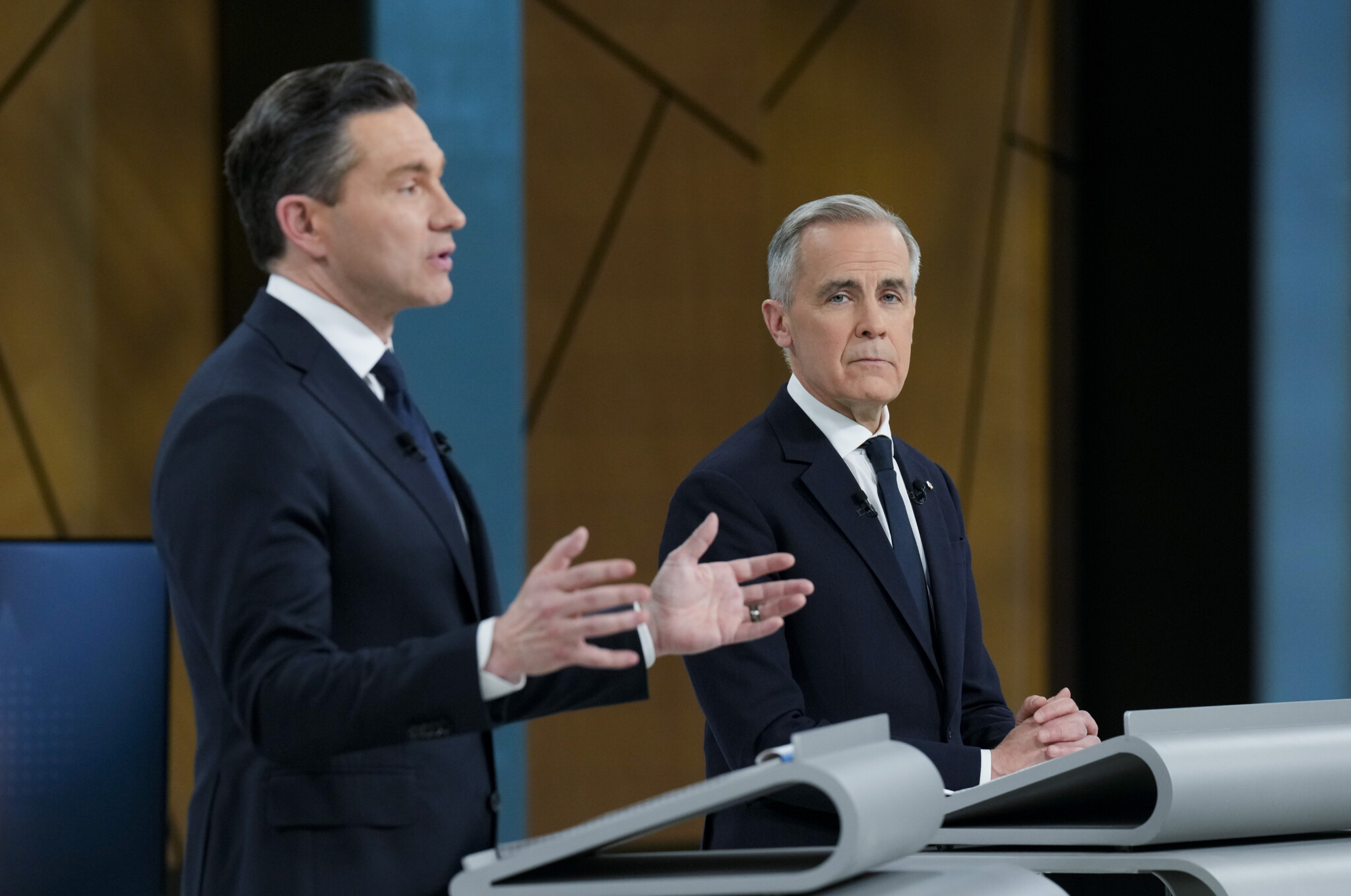
‘Election fever?’: Hub Politics on if Canadians will be headed to the polls this spring
You can listen to this episode on Amazon, Apple, and Spotify.
Episode Description
In this episode of Hub Politics, Sean Speer is joined by Amanda Galbraith, co-founder and president of Oyster Group, and David Coletto, founder and CEO of Abacus Data, to discuss the possibility of an early federal election amid shifting dynamics in the Liberal and Conservative parties. They examine how Donald Trump’s renewed focus on Canada is shaping the political landscape, creating challenges for Conservative leader Pierre Poilievre’s messaging strategy.
Episode Summary
Canada’s political landscape appears to be shifting as speculation mounts about a potential early federal election, driven by changing dynamics in both domestic politics and international relations. The timing of any election call remains uncertain, though various factors are converging to create an environment where political parties must recalibrate their strategies and messaging.
The resurgence of tensions with the United States has emerged as a dominant issue in Canadian politics. Recent disputes over infrastructure projects have captured public attention due to their accessibility and ease of understanding for average voters. These conflicts have provided the governing party with opportunities to demonstrate leadership on the international stage, responding to provocations with measured, fact-based communications rather than emotional reactions. This approach has allowed the government to position itself as a steady hand during uncertain times.
For the opposition Conservatives, the challenge lies in navigating criticism of American policies while maintaining focus on domestic priorities. The party faces pressure to address international tensions more directly, particularly as these issues increasingly affect Canadian economic interests. Conservative strategists recognize that while their party convention was not necessarily the appropriate venue for aggressive international positioning, a pivot toward more assertive messaging may be necessary as circumstances evolve.
The potential collapse or significant disruption of major trade agreements looms as a scenario that could fundamentally alter the political conversation. Such developments would likely create a period of national crisis mentality, similar to previous moments when economic uncertainty caused businesses and consumers to pause spending decisions. This environment could last weeks or months, fundamentally reshaping the issues that dominate political discourse and voter concerns.
Parliamentary cooperation has become another strategic consideration. Opposition parties are exploring more collaborative approaches in legislative proceedings, potentially removing ammunition from government arguments about obstruction. This positioning could prove valuable if economic or trade crises intensify, allowing opposition parties to demonstrate national unity during challenging times while still maintaining their distinct policy positions.
The mechanics of parliamentary operations themselves have become subjects of debate. Questions about virtual versus in-person participation reflect broader tensions between modernizing democratic institutions and maintaining traditional practices that facilitate cross-party dialogue and negotiation. The effectiveness of parliamentary work depends significantly on informal interactions and relationship-building that occur outside formal proceedings, though accommodations for diverse circumstances among elected officials remain important considerations.
Timing considerations favor opposition parties that can afford to wait for government missteps while repositioning themselves on emerging issues. The political calculus suggests patience may yield better electoral outcomes than rushing into campaigns under current conditions. However, this strategy requires careful management as circumstances evolve rapidly.
Public understanding of parliamentary procedures remains limited, creating opportunities for political messaging that may not fully reflect legislative realities. All parties engage in strategic positioning around parliamentary effectiveness, making it challenging for voters to assess responsibility for legislative progress or gridlock. This dynamic gives governing parties particular advantages in controlling narratives about parliamentary function, though opposition parties can counter by demonstrating cooperation and constructive engagement.
This summary was prepared by NewsBox AI. Please check against delivery.

Comments (1)
I am presently listening to your discussion….. What do you think of the idea that Carney intentionally gave his speech at Davos, because he wanted to send Trump off the deep end, so that Trump could again become the most “important/manufactured” crisis that Canadians faced?
As a lifelong Albertan, watching our federal and provincial situations from a 10,000 ft view, there is no doubt that this present referendum momentum is directly related to the election of another Liberal government, one year ago. If there is a federal election this spring, or summer, I think you could almost guarantee that the referendum question would pass easily. Does Carney want to cement his legacy that under his mandate, Canada as we presently know it, ceased to exist?
I am writing this assuming that present polling is correct, and that Carney would win a majority.
Alberta would vote to form a independent republic, to protect ourselves from both ROC and US.
(my opinion only)