‘Literally backslapping each other’: What the chummy meeting of Xi, Modi, and Putin means for geopolitics
Sean Speer joins Rudyard Griffiths to analyze what they describe as one of the most consequential weekends in recent geopolitics—a summit in China where leaders Xi Jinping, Vladimir Putin, and Narendra Modi were photographed in a symbolic embrace. They examine how this moment could represent the world fracturing into two major power blocs, with India’s participation marking a significant shift away from decades of U.S. efforts to pull New Delhi from Russia’s orbit.
You can listen to this episode on Amazon, Apple, and Spotify.
Program Transcript
This is an automated transcript. Please check against delivery.
RUDYARD GRIFFITHS: Did we just have one of the most consequential weekends in geopolitics in the last decade or more? Well, we think so. Here at the Hub, let’s break it down with Sean Speer, co founder and editor at large. Sean, great to be with you.
SEAN SPEER: Hey, Rudyard, great to connect.
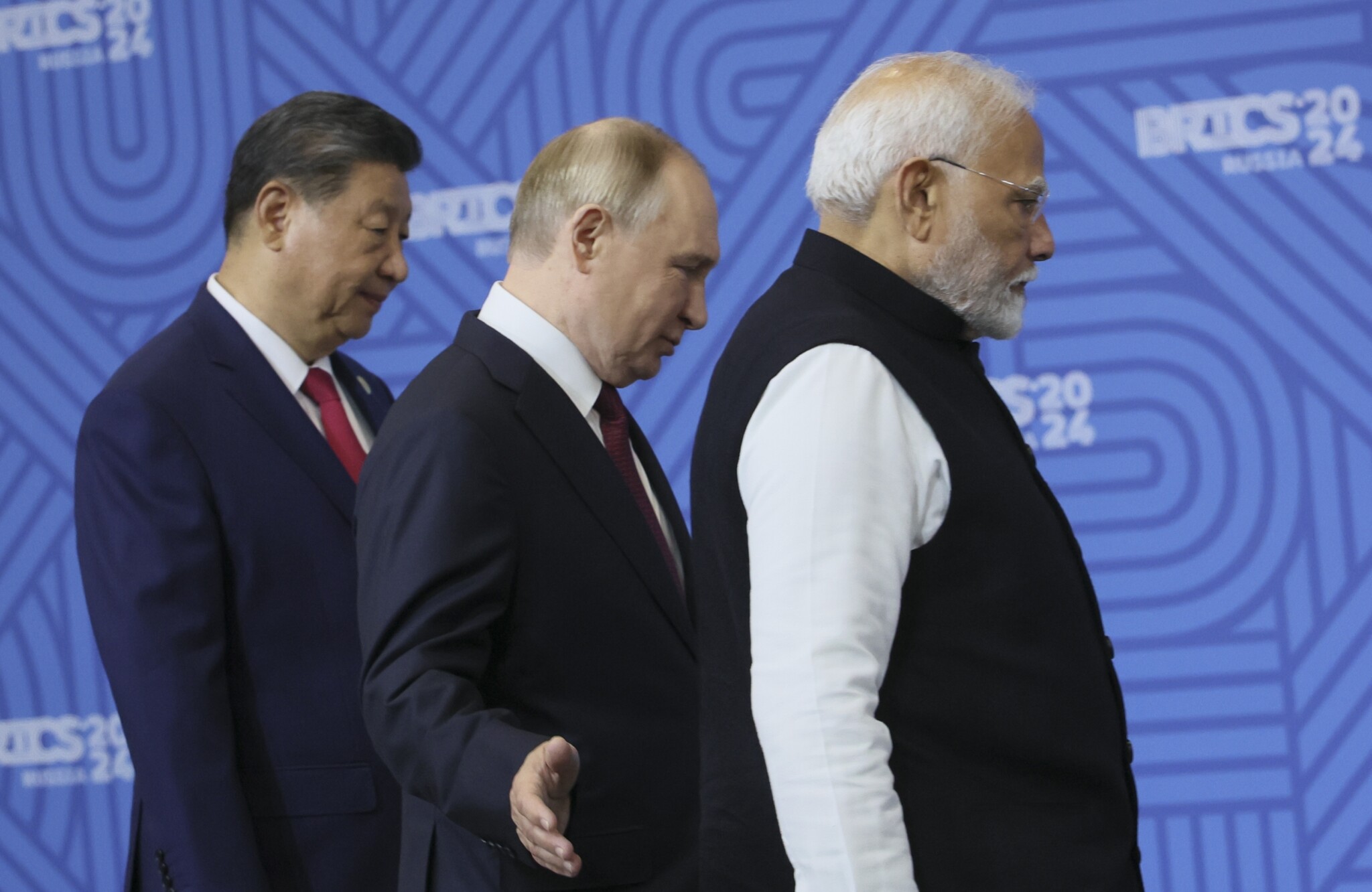
RUDYARD GRIFFITHS: Sean, I think you and I both woke up today, Tuesday morning after the Labour Day weekend and thought, wow, that was quite a meeting in China between the leaders of Russia, India and Xi Jinping. To help set the scene, give a bit of a feel to our listeners and viewers, let’s play a quick video segment of what was the crucial image that these three leaders want coming out of the summit. Here we have Modi and Putin walking on to the stage to greet Xi, literally holding hands, the three of them. Then, greetings, grasp each other’s hands in a kind of circle together. Sean, laughing, smiling. Wow, what a moment for Putin. But more importantly, maybe, Sean, have you reflect on this. What a moment for Donald Trump and the west to see these three leaders suddenly united, Best of friends, literally backslapping each other.
SEAN SPEER: Yeah. The steel man version of what the Trump administration has been doing over the past several months is preparing for the inevitability of an increasingly bipolar, multipolar world and aiming to strengthen the US in an orbit with like minded countries trading and sharing in insecurity. The alternative argument, Rudyard, is the steps that the Trump administration has taken, including provoking fights with its allies, acting erratically and unreliably with international organizations and others, has essentially precipitated the imagery that you just showed, that mere years ago, Putin was treated as Persona non grata at this precise conference. And yet here in 2025, we see him embracing these others in what increasingly looks, Rudyard, like a alternative to American power in the realm of economics, geopolitics and security.
RUDYARD GRIFFITHS: Yeah, I think you hit the nail on the head. What we’re seeing here is basically the world fracturing into two major blocks. On one hand, Donald Trump, the Western powers, Europe, Japan, and on the other side, not surprising possibly to see Putin and Xi together, who have had this so called exuberant, special kind of relationship really, that began in some ways with Putin’s invasion of Ukraine. But to see Modi there, that the head of the world’s largest country by population, a country that up to this point, up until the Trump administration, the United States had done decades of spade work to pull away from Russia because India was buying so much of its military equipment from Russia and was no friend of China because of, you know, persistent you know, border skirmishes and a war fought in the 1970s between China and India. So India was, in a sense, the linchpin for multiple administrations in the United States to kind of drive a wedge between Chinese supremacy in Asia and to move Russia away from India to again denude the Russian threat. And here, after 50% tariffs have been levied and are in effect now on India as a result of Donald Trump’s tariff policies, we have this picture, this picture of a new power center emerging in the open enthusiastically for all the world to see. What do you make of that?
SEAN SPEER: Yeah, I just go back, Rudyard. I wonder if, in hindsight, one of the most significant foreign policy decisions taken by the Trump administration, actually it hasn’t occurred since the 2024 election. You have to go back to post 2016 and the ultimate rejection of then, the Trans Pacific Partnership, which was designed as a opt in free trade arrangement with democratic capitalistic countries that excluded, of course, China. And the idea was that this, in a way, was going to become an alternative to the global trading system under the wto, which, of course, China had become a part and for all intents and purposes, had come to erode. I think if you took Donald Trump’s views on China seriously, you’d argue something like the Trans Pacific Partnership is precisely what his administration ought to have been pursuing.
Unfortunately, because the agreement was associated with the Obama administration and Hillary Clinton, who was then Secretary of State, the administration scuppered it. It’s continued on without American participation, I think, to the detriment of America and to the detriment of the world. And I wonder if we look back, Rudyard, is that as a kind of crucial moment where the US could have built a coalition of countries that would have shared in its interest in marginalizing and isolating China? And instead, what we’ve seen over the past decade is China find new entry points into different parts of the world, increasingly those ones who see the US in general and the Trump administration in particular as unreliable partners.

RUDYARD GRIFFITHS: Yeah. Again, I just, I can’t convey enough to our listeners and viewers just how important it is that Donald Trump is now looking at Modi and India in literally a physical embrace with Russia and China. This is a major setback. But I want to pivot with you, Sean, to what this means for Canada, because it paints, Sean, I think, in bolder terms, the degree to which we’re now seeing a world cleave into two blocks. And it creates, I think, a much more unfortunate but clear picture for Prime Minister Mark Carney, that there are two worlds that you can be a part of.
You can be in that circle with Xi, Putin and Modi holding hands, or you can be going down to the gilt covered Oval Office in the White House and making a deal with President Trump as the Europeans and the Japanese have done, who are both members in this imperfect and right now highly contested US led global order. So, Sean, I just don’t see China and Russia and India opening their arms to welcome little old Canada into that embrace. And I’m not sure we want to be with in that club. I mean, these are all regimes that have real problems, real authoritarian tendencies, state surveillance, Russia’s waging an illegal war. I mean, I could go on and on.
SEAN SPEER: Yeah. The crucial point you make, Rudyard, is the extent to which it should be understood as a binary choice. I know people don’t like to hear that one wants to believe that there is some third alternative where we adopt a position of so called non alignment. But I think it’s increasingly clear from the US and it’s no doubt the case with the three powers we just, we’ve been talking about that non alignment is not a plausible scenario for a country like Canada. And so then you just have to look at this as dispassionately as you can. We published really interesting analysis last week, Rudyard, that looked at Canadian export flows around the world in the month of June.
In that month alone, Rudyard, trade with Texas exceeded trade with China, trade with Minnesota exceeded trade with Japan, trade with Oklahoma exceeded trade with exports to Mexico, Germany or South Korea. It gives you a sense of how significant the US Market is to Canada’s economy. And so with that in mind, I think we have to kind of reconcile ourselves to the fact that if the world is indeed factoring as you set off this conversation with, we need to be part of US orbit and recognize that that may involve some trade offs that’ll be painful. But I think ultimately in the Canadian interest.
RUDYARD GRIFFITHS: Yeah, such an interesting weekend because we’re getting pushed and pulled, right? We’re getting pulled by the Americans in the Trump administration into their upside down funhouse world of tariffs. Let’s go back to the 1930s and the smoot Hawley Act. It worked out so well that thing called the Great Depression. But look, I just only in part because we’re also getting pushed, we’re getting pushed now by India, by China, by Russia into that American fold. And wow, Sean, these are consequential days, consequential moments. You just have a sense of the world kind of cleaving into power blocks and I don’t think straddling, like it or not, optionality is always great to have. I just don’t think that is an option anymore. Any last words?
SEAN SPEER: Yeah, yeah, I want to, I want to put a question to you, if you permit me, because I started the conversation, Rudyard, saying that, you know, that the Trump administration, the people around it would argue that the steps that it’s taken in recent months is merely recognizing what it amounts, what effectively it already happened, that uniplarity was over and that it needed to prepare for a world of bipolarity or multipolarity. I think critics would argue in a way that the administration has hastened that trend, that unipolarity need not have ended. But the US is, is in a sense surrendering its unipolarity and, and, and setting out this kind of breaking up of the geopolitical world. How, how do you think about that question?
RUDYARD GRIFFITHS: Yeah, well, look, Russia and China cop probably always would, would have found each other as, you know, the two last countries being, you know, offered off the wall to dance. So I see the two of them together. I don’t know what America or Trump could have done to try to try to rescue either of those relationships. But India, Sean, I mean, whatever it is, 1.3 billion people, it’s a democracy, okay, There’s a lot of things that are imperfect about India, but it is a democracy and it has a long democratic tradition. A massive economy, English speaking, the entrance of India into a coalition of countries, however defined the brics.
I don’t know, maybe we need a new analogy that includes India with Russia in China is just a massive, massive own goal for the Trump administration and frankly for the struggle that lies ahead between a so called league of democracies in the west plus Japan against this emerging power block. But we’re gonna continue to cover this at the Hub. This is exactly the kind of big geopolitical trends we enjoy unpacking for our audience. And thanks Sean, for coming on the program today. Much appreciated, of course.
SEAN SPEER: Yeah, you bet.