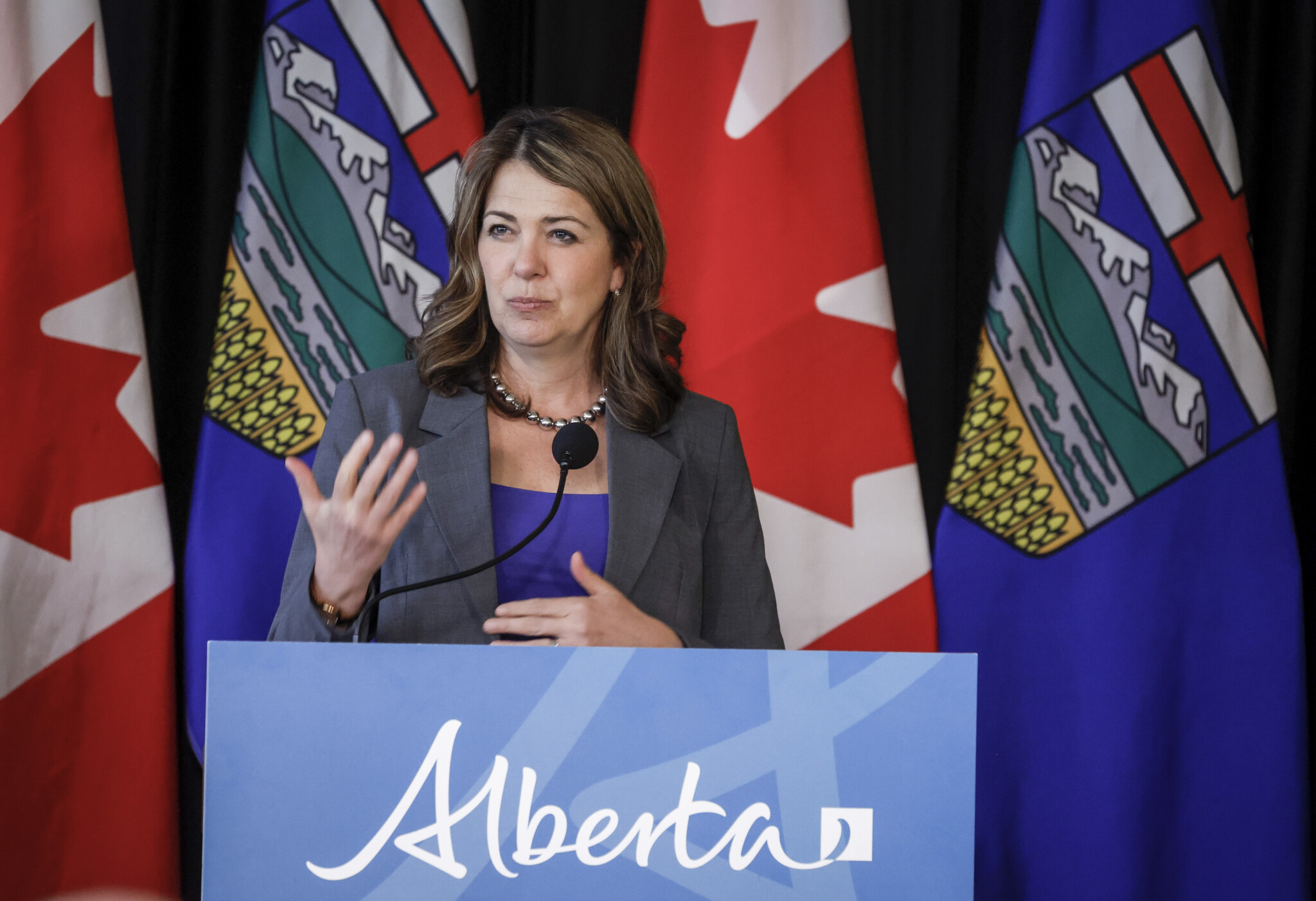
‘Surprisingly bold’: The Roundtable on why Smith and Carney are riding high off this week’s energy agreement
Rudyard Griffiths and Sean Speer discuss the political implications of Prime Minister Mark Carney’s pipeline deal with Alberta Premier Danielle Smith. They debate whether Carney’s leadership represents a fundamental shift in Liberal politics or simply a “new personality cult” in light of his reversal of various Trudeau-era policies.
They also cover what his centre-right positioning on different issues is a challenge for Pierre Poilievre and the Conservatives. In the second half, they explore the complex conditions embedded in the Carney-Smith pipeline agreement, including whether a private sector proponent will step forward and and industrial carbon pricing’s future impact on Canadian competitiveness.
You can listen to free versions of this episode on Amazon, Apple, and Spotify.
If you liked what you heard in the first half of the program and wish to subscribe to full-length editions of The Roundtable, please consider becoming a Hub Hero. Hub Heroes also get access to all our paid content on TheHub.ca. All these benefits are conferred for one year. Sign up now!

Program Summary
This is an automated summary. Please check against delivery.
A new political dynamic is emerging in Canada, following the announcement of a memorandum of understanding between the federal government and the province of Alberta to advance a pipeline project to the West Coast. This development in energy policy has initiated a significant shift in the political landscape, altering conventional alliances and prompting a reassessment of the ideological positions of the major parties.
The immediate beneficiaries of the agreement appear to be the federal Prime Minister and the Premier of Alberta. The Premier can present the deal as a successful outcome of a strategy of negotiation, which has resulted in the federal government stepping back from several climate policies enacted under the previous administration. The agreement, coupled with other ambitious provincial reforms tabled the same week, strengthens the Premier’s position considerably.
The more far-reaching implications, however, concern the direction of the federal Liberal Party under its new leadership. In a short period, the government has moved to reverse or modify a number of policies that were hallmarks of the preceding government. These include the carbon tax, a capital gains tax increase, immigration targets, and electric vehicle mandates. The speed of this reversal has led to observations that the political agenda of the last decade has been substantially altered.
This policy shift has raised questions about the Prime Minister’s political alignment. The current platform, which includes tax cuts, support for resource development, and a foreign policy stance that departs from recent precedents, appears to have more in common with the historical policy set of centrist conservative governments than with the Liberal party of the recent past. This has prompted discussion about whether the government’s orientation is now fundamentally different.
The analysis suggests a more complex picture. While the government’s economic and environmental policies have narrowed the gap with the official opposition, the Prime Minister’s positions on certain social and cultural issues are seen as remaining within the mainstream of the centre-left. This is perceived as granting the government latitude to pursue its new economic direction without facing substantial internal party resistance, as evidenced by only minimal public dissent from its ranks.
This repositioning presents a strategic challenge for the Conservative opposition. The government’s actions on issues such as fiscal policy, defence spending, immigration, and now pipelines, have occupied policy areas traditionally associated with the Conservatives. This forces the opposition to seek differentiation on other grounds, potentially pushing the debate toward social and cultural issues where the political calculus is less certain. There is a view that the opposition’s room to manoeuvre is being constrained as the government consolidates its position in the political centre.
The pipeline agreement exemplifies this strategic challenge. By securing a deal with a Conservative premier from a province that is a base of support for the federal Conservative leader, the government has created a difficult situation for the opposition. The federal Conservatives’ response was to offer measured criticism while attempting to avoid direct conflict with the popular premier, highlighting the risk of alienating their own supporters.
For the present, the political initiative seems to lie with the government. Its use of incumbency to redefine the political debate is seen as effective for the current climate, appealing to a broad coalition of centrist and centre-right voters. The opposition’s path to regaining momentum is viewed as difficult, contingent on the government facing a credible challenge from its left flank. At the moment, with other parties in a state of transition and internal Liberal dissent being minimal, such a challenge does not appear to be materializing.

Comments (2)
Wow…I hate to rain on anyone’s parade…but, I believe that this is a complete sham….READ CARNEY’S BOOK…he got what he wanted. I view the announcements of this past week as a continuation of smart Liberal politics.. They know how to rule. And I mean rule…the manipulations they have done in past 11 months to keep power and buy off Canadians with what looks like a “reasoned move to the centre”is nothing more than a buying time control the message….I am hoping I am wrong but that pipeline will never be built with Carney in power….investors will have to come from outside Canada…they and their embassies will consult with the feds and do many checks to see if the atmosphere is now good in Canada to invest….they will hear from Carney and his people high volumes of word salad which will cause them to stay away…..IF, he really believed in this venture he would use powers he already has to get it going and would back it with federal money. Instead, he is putting his federal money mouth behind his low carbon investments etc……ITS ALL OUT OF HIS BOOK WHAT HE IS DOING…next July he will look sad faced and say to Canadians (after he calls an election and gets a majority)…that he tried..but the world and Canadians don’t want what we have…. People who view this situation have to decide on one thing and one thing only in order to interpret what we have witnessed……Is Carney’s book and life’s work a lie? OR is what he has said he going to do in the past 11months a lie? After all, has he REALLY undone the legislation that he has to walk the talk or he is just saying he will address the issues with new legislation…yet strangely , other than a tax cut nothing else has been brought it….