
This is The Week in Polling, your Saturday dose of interesting numbers from top pollsters in Canada and around the world, curated by The Hub. Here’s what we’re looking at this week.
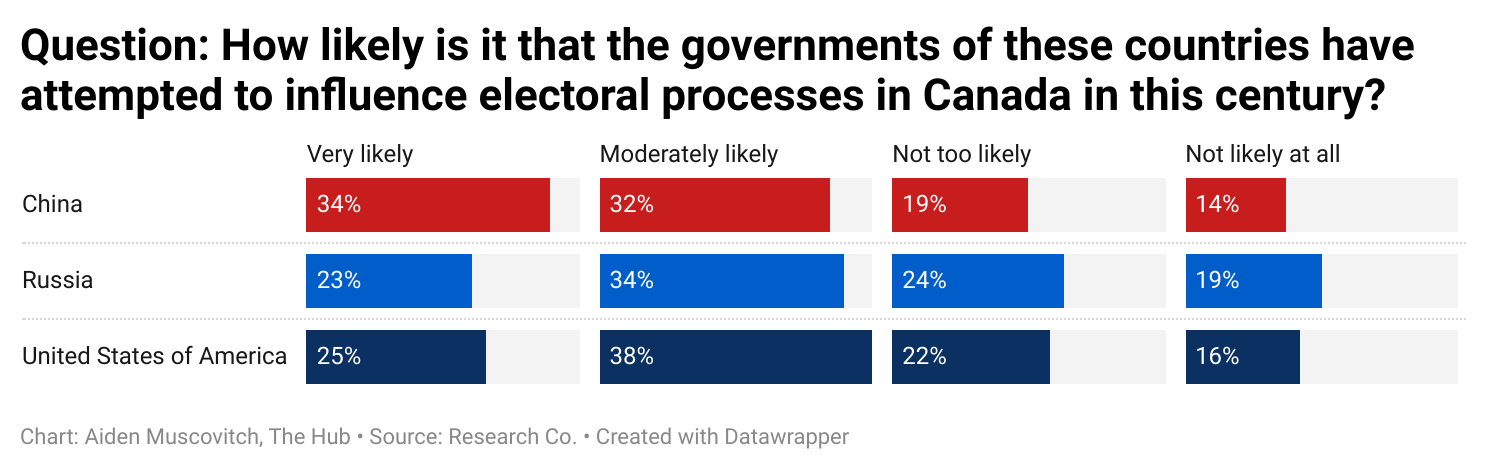
A majority of Canadians think the Chinese, Russian and U.S. governments have interfered in Canada’s elections
Source: Research Co.
The security of Canada’s electoral processes from foreign interference, particularly regarding the nomination campaigns of Liberal MP Han Dong and former Conservative MP Kenny Chiu, has become a hot-button issue in Canada’s public discourse.
The preliminary report of the Public Inquiry into Foreign Interference in Federal Electoral Processes and Democratic Institutions, led by Justice Marie-Josée Hogue, uncovered that foreign interference did, in fact, occur in Canada and, in at least one case, “affected who was elected to Parliament.”
Polling now suggests the majority of Canadians agree with the findings of the preliminary report, believing that it is likely that China, Russia, and even the United States of America have interfered in Canadian electoral processes in this century.
Furthermore, nearly two-thirds of Canadians think there has been “definite” or “probable” foreign interference in federal elections. More than 50 percent say the same about federal nomination races.
This week marked the beginning of the second round of the public inquiry, which looks at whether Ottawa will be able to protect elections from foreign interference in the future.
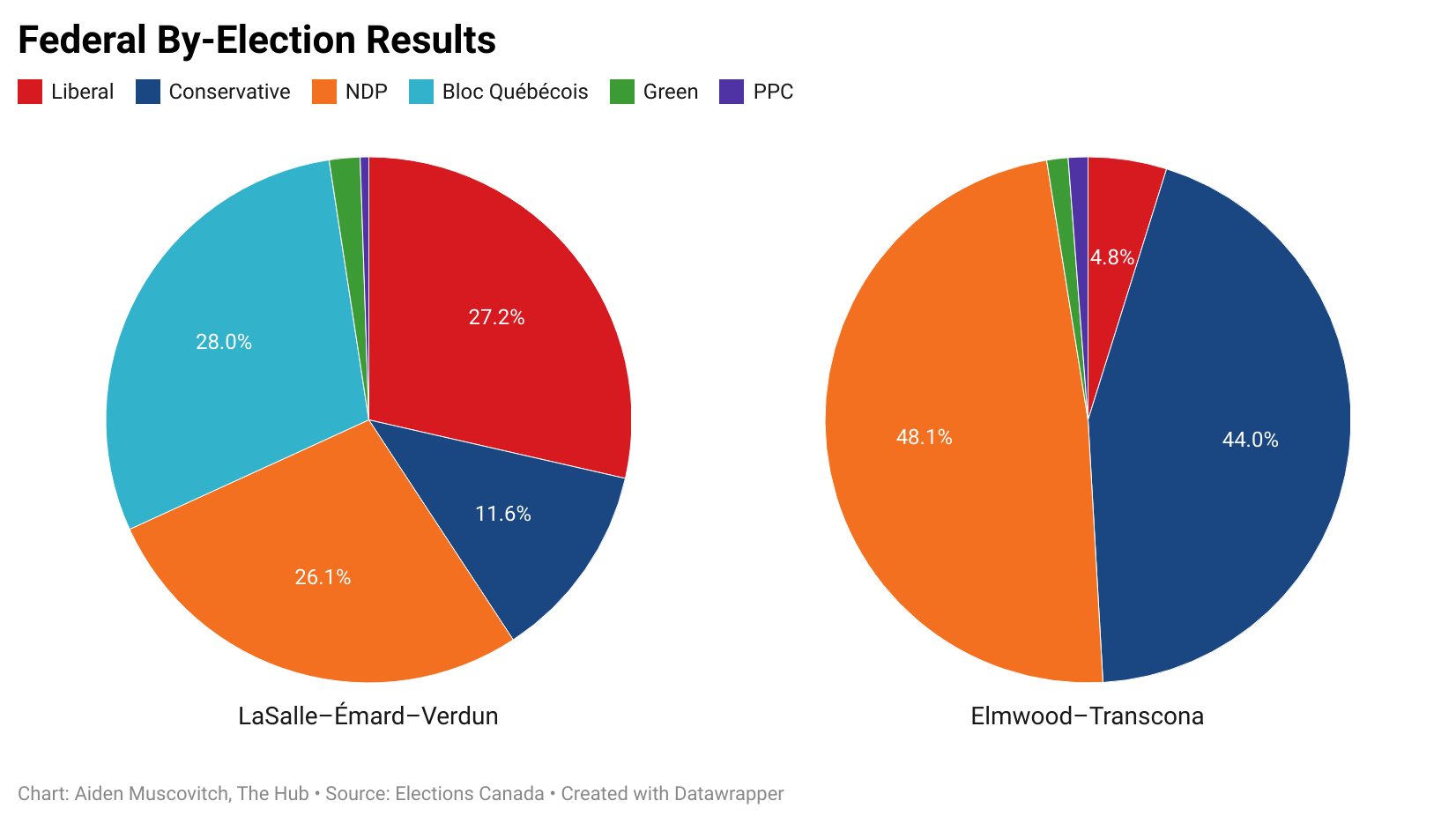
Bloc Québécois and NDP win byelection races, the Liberals suffer big losses
Source: Elections Canada
This Monday byelections were held in the Winnipeg riding of Elmwood–Transcona and the Montreal riding of LaSalle–Émard–Verdun.
LaSalle–Émard–Verdun has been a Liberal seat since 2015. The riding was represented by former Attorney General and Minister of Justice David Lametti, who stepped away from politics earlier this year. The Bloc Québécois won this former Liberal stronghold by a narrow margin of just 0.8 percent. In the 2021 election, the Liberals won LaSalle–Émard–Verdun with about 43 percent of the vote, almost double what they amassed in the byelection.
Elmwood–Transcona, an NDP seat since 2015, remained orange despite a close contest with the Conservatives. The Liberal candidate won just under five percent of the vote share—one of the worst byelection showings in Canadian history for a governing party. In the 2021 election, the Liberals amassed 14.88 percent, marking a ten-point decrease in vote share in the byelection.
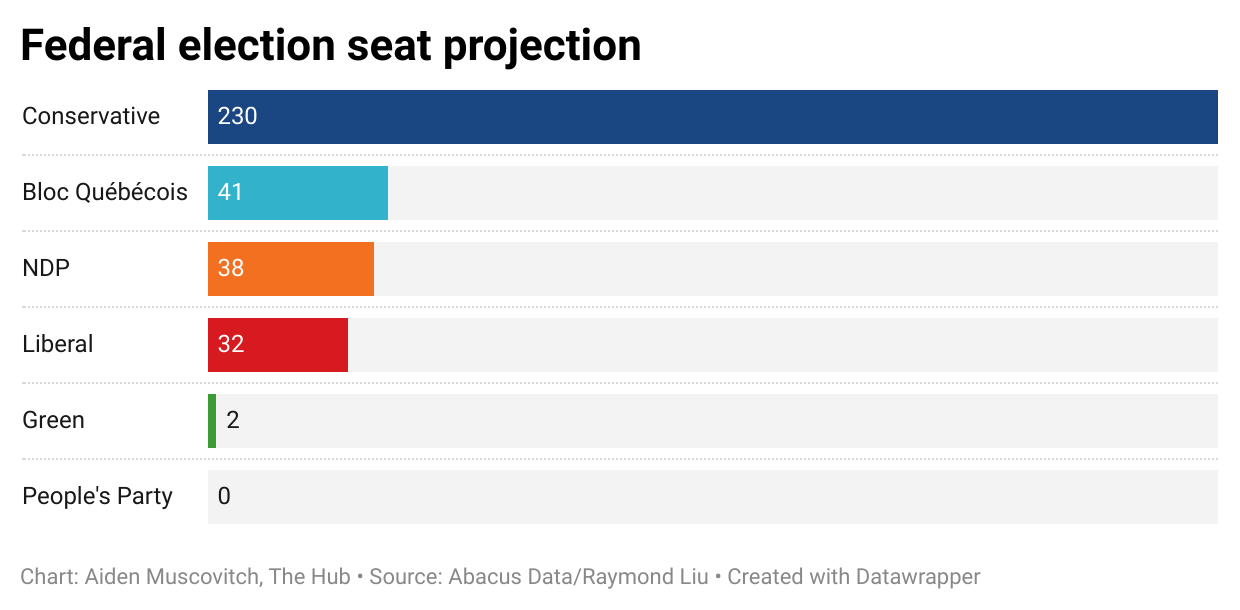
While the Conservatives head towards a majority, the Liberals are projected to be in fourth place in the next election
Source: Abacus Data/Raymond Liu
According to a mapped-out version of the latest Abacus Data election projections, the Conservatives could be looking at a substantial majority, and the currently governing Liberals could be moved to fourth place behind the New Democrats and the Bloc.
If these projections are accurate, the Liberals could suffer a historically devastating defeat, even worse than the 2011 election under Michael Ignatieff, where the party was reduced to 34 seats from 77.
With 230 out of 342 seats (67.8 percent), the Conservatives are projected to win a seat count almost on par with Brian Mulroney’s 1984 super-majority, where the Tories won 211 seats out of the then-282-seat House of Commons (74.8 percent).
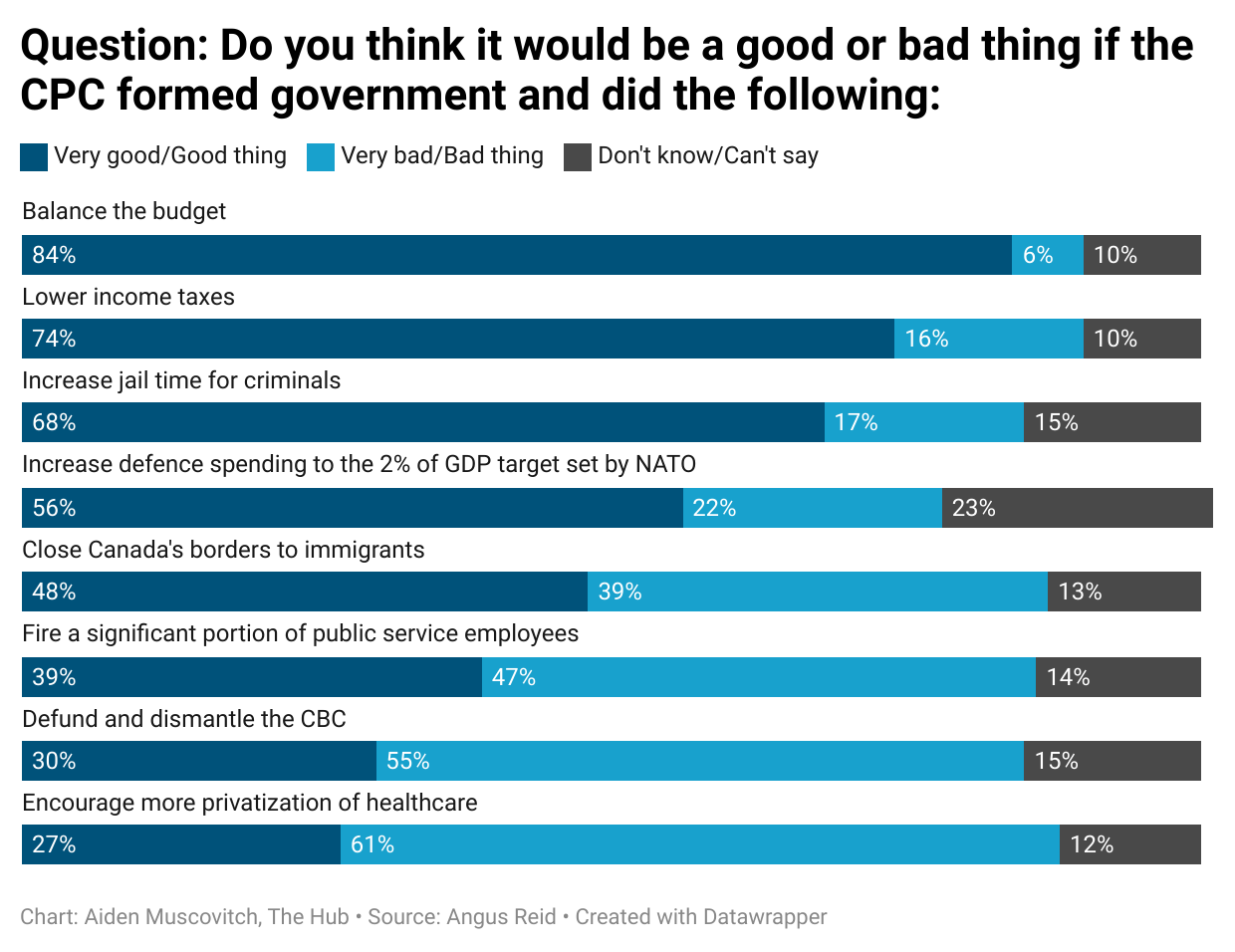
Canadians agree with several Conservative policy ideas
Source: Angus Reid
More than 50 percent of Canadians think it would be a good thing if a future Conservative government were to implement policies designed to balance the budget, lower income taxes, increase jail time for criminals, and increase defence spending to the 2 percent of GDP target set by NATO. Additionally, just under 50 percent believe that closing Canada’s borders to immigrants would be a good thing, though this is well beyond any policy proposal made by the Conservatives.
Fewer Canadians thought that the CPC firing a significant portion of public service employees, defunding and dismantling the CBC, and encouraging more privatization of healthcare were good things, with each proposal attaining about 30 percent of Canadians’ support.

Aiden Muscovitch is a student at the University of Toronto studying Ethics, Society and Law. He is The Hub's Assistant Editor. He…