

Grit—a term once synonymous with the work ethic—made a comeback nearly a decade ago thanks to Angela Duckworth’s best seller Grit: The Power of Passion and Perseverance. For a brief moment, it captured public attention with its focus on perseverance, tenacity, and ambition—all traits closely tied to conscientiousness. It was the psychologist’s “Grit Scale” which posited that adolescents and young adults who were high in grit were primed for life success.
Today, grit is back in the spotlight following a striking recent Financial Times column by journalist John Burn-Murdoch, highlighting the sharp decline in conscientiousness among Americans aged 16 to 39. A chart accompanying the piece—based on updated findings from the 2022 Understanding America Study (UAS)—revealed a marked drop in this personality trait among younger adults. It reinforced what many already suspected: the next generation appears less focused, more distracted, and increasingly less likely to follow through.
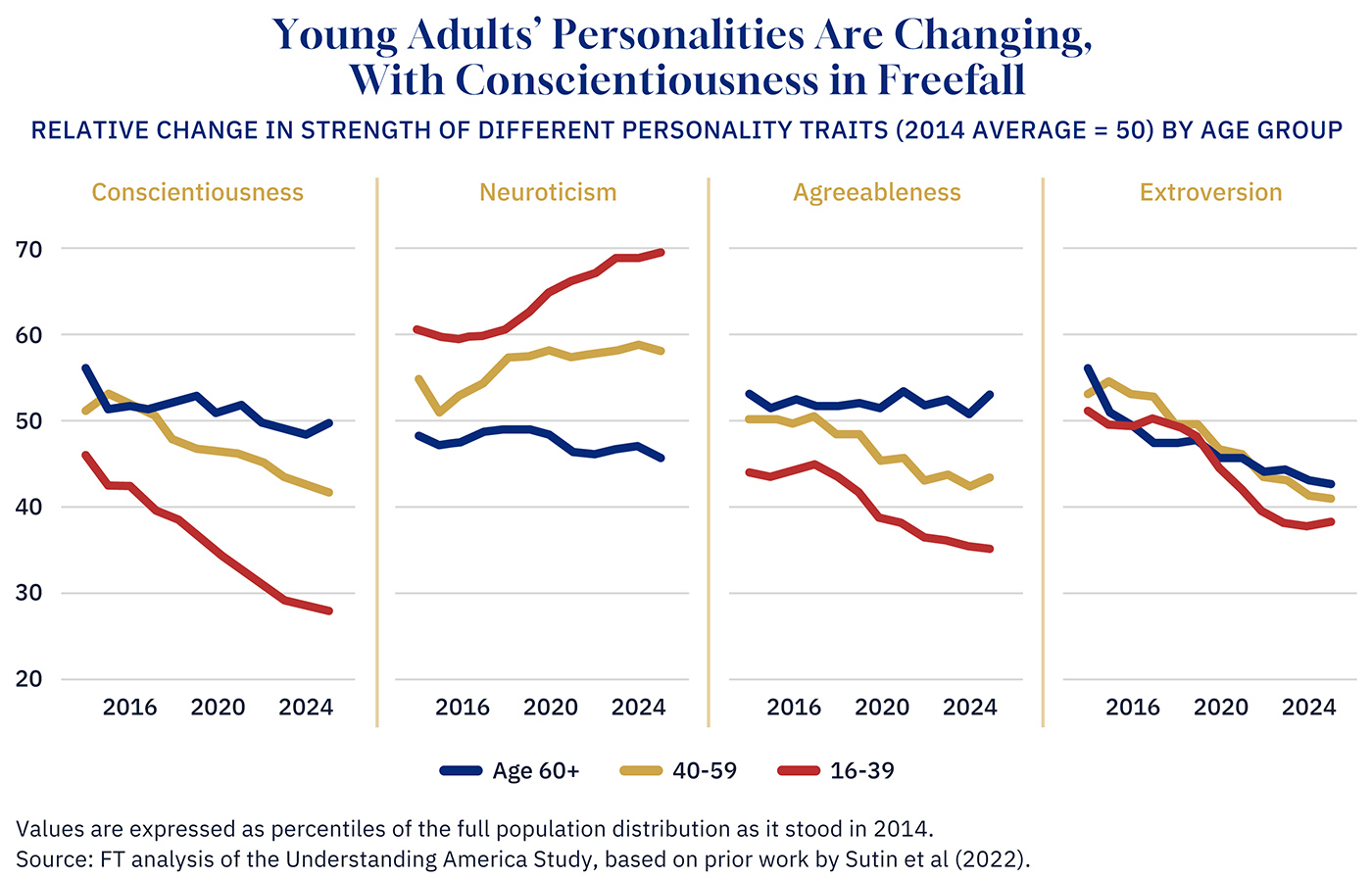
Graphic credit: Janice Nelson
The age bracket in question actually spans two generations—Millennials (born 1980-1994) and Generation Z (born 1995-2012)—and the numbers are cause for worry. Young adults reported being less diligent, more careless, and far more prone to abandoning commitments. Yet before diving headlong into the usual generational blame game, it’s worth stepping back and unpacking the data to examine the deeper forces at play.
The rush to judgment
Predictably, instant analysts and social commentators pointed fingers at smartphones and digital media. Burn-Murdoch echoed the rising chorus shaped by Jonathan Haidt’s The Anxious Generation and other critiques of social media addiction, including my own Weapons of Mass Distraction. “Ubiquitous and hyper-engaging digital media,” Burn-Murdoch wrote, are encouraging distraction and making it easier than ever to abandon plans or avoid commitments altogether.
Indeed, the architecture of the online world undermines persistence. Instant access to information, entertainment, and social validation shortens attention spans and discourages sustained effort. Face-to-face interactions have been supplanted by ghosting, flaking, and fleeting digital ties—substitutes that diminish the value of consistency, follow-through, and grit.

The bigger picture
The decline in conscientiousness is not occurring in isolation. Psychographic researchers studying the “Big Five” personality traits—openness, conscientiousness, extroversion, agreeableness, and neuroticism (OCEAN)—have documented a range of shifts. Notably, neuroticism has risen sharply, likely fueled by the pandemic and the digital era’s mental health toll. Openness and extroversion have dipped, and young adults—once the most gregarious cohort—now report lower sociability than their elders.