In The Weekly Wrap, Sean Speer, our editor-at-large, analyses for Hub subscribers the big stories shaping politics, policy, and the economy in the week that was.
Perhaps the Conservative coalition is more durable than we thought
As I recently wrote for The Hub, one of the big questions after the 2025 federal election was whether the Conservative Party’s showing represented a new baseline of support or a high-water mark.
Was it something to build on or merely an aberration shaped by extraordinary circumstances? I warned that, notwithstanding what Pierre Poilievre and the Conservatives have said since the election, the latter was a real possibility.
After all, the party’s support leading up to and during the election campaign seemed highly contingent. The political mood was still defined by the extraordinary pandemic experience and the reckless run-up of immigration that followed it. The Liberal government’s competence came under question on multiple files, and Justin Trudeau had become one of the least popular prime ministers in Canadian history. The conditions, in other words, seemed to favour the Conservatives almost by default.

Yet new polling from Abacus Data suggests that I may have been wrong. As Abacus’s vice-president for Data Insights, Eddie Shepherd, told me this week, their findings show 93 percent of 2025 Conservative voters say they would vote the same way today. That compares with just 86 percent of Liberal voters.
If these numbers persist, they could have significant implications, including for Poilievre’s own future as Conservative leader. Not only did he manage to push Conservative support to its highest level since Brian Mulroney’s majority in 1988, but so far at least, Abacus’s polling suggests that it’s mostly holding steady. Maybe, in other words, it is a new baseline for the Conservatives.
It would mean that the 2025 election was less a fluke of circumstances and more the start of a genuine realignment. The image of Poilievre as merely a “protest vote” leader would give way to the possibility that he’s built something larger and more sustainable.
That would be a powerful message for Poilievre to take into his leadership review in January. Especially if, by then, Liberal support among traditional NDP voters starts to falter. If the NDP begins to climb out of its political hole and return to something closer to its historic norm, the Liberals could find themselves squeezed in the middle. And a future Poilievre government may yet still be possible.
Will Mark Carney put his money where his mouth is?
We learned this week that a communications staffer to the environment minister, Julie Dabrusin, accidentally texted internal deliberations about the department’s efforts to identify spending reductions to an unsuspecting reporter. The inadvertent gaffe sheds some revealing yet worrying light on the Carney government’s ongoing spending review.
First, the staffer’s lament that “there’s nowhere else to cut” is hardly confidence-inspiring, given that government-wide program spending has doubled over the past decade and her own portfolio saw its budget grow even more over the same period. Claiming that the department is stripped to the bone just isn’t credible.
Second, we learned that ministers’ proposed spending reductions are due to the Treasury Board later this week, even though the budget is scheduled for October. Even recognizing the government has had to account for an election, new cabinet appointments, and staffing up, that timeline is hugely compressed.
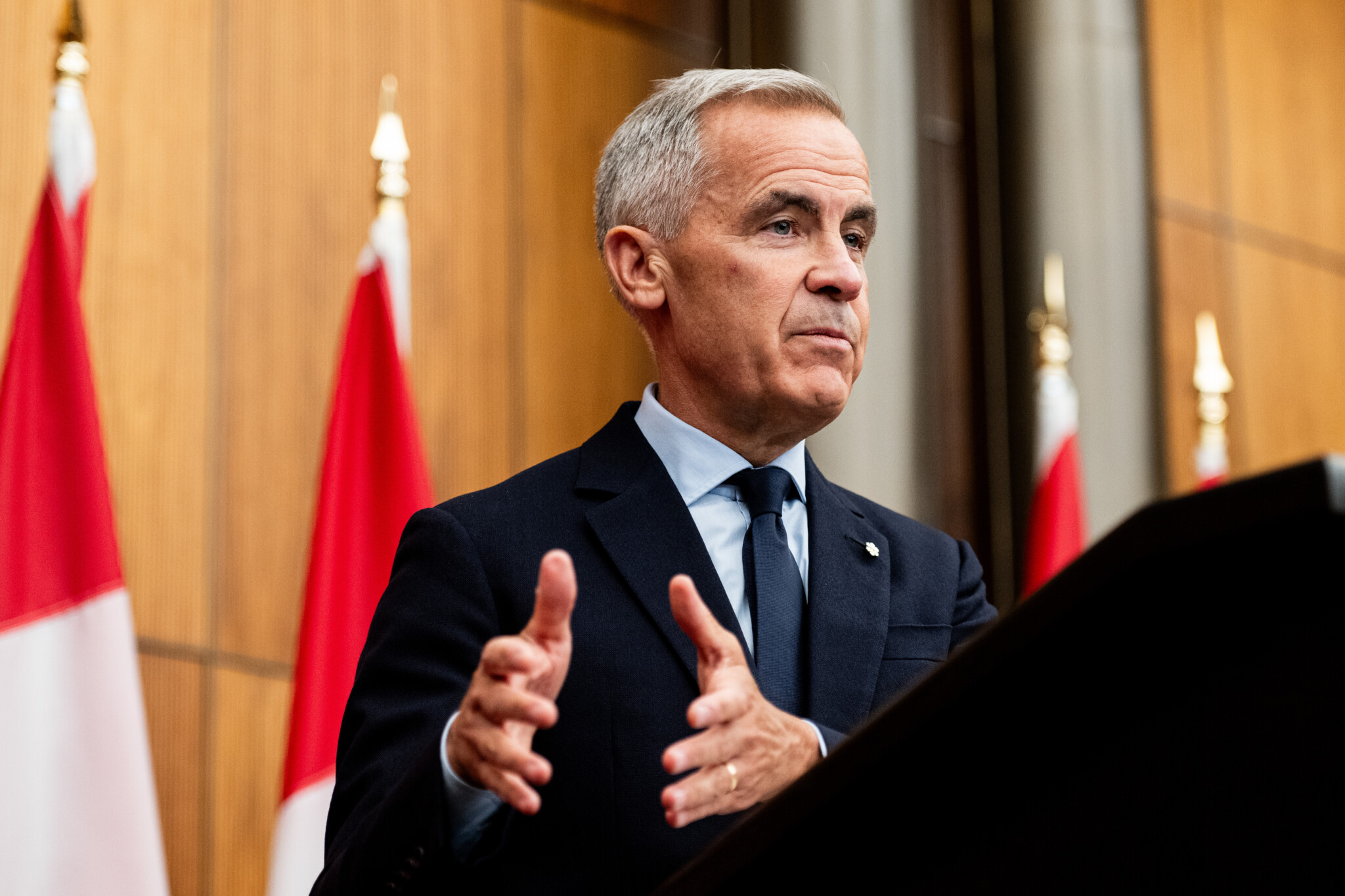
Prime Minister Mark Carney speaks during a press conference at the National Press Theatre in Ottawa on Friday, Aug. 22, 2025. Spencer Colby/The Canadian Press.
Having been involved in the Harper-era spending cuts—including the 2011–12 government-wide review, which ran for more than six months—I can attest to how challenging it will be. There will necessarily be big tradeoffs.
Treasury Board Ministers are now faced with the task of scrutinizing what could amount to hundreds, if not thousands, of spending reduction proposals over a truncated period. It’s fair to assume that they won’t be able to fully scrutinize all of the submissions. They’ll presumably need to triage the proposals somehow. Perhaps by the magnitude of the fiscal savings, or an assessment of the political sensitivities, or something else altogether.
One risk is that ministers err on the side of caution and reject any proposals that carry political challenges. If that happens, it will undermine the exercise’s fiscal upside. Alternatively, they could just rubber-stamp every proposal that’s been submitted. If so, it risks political surprises that could create big problems for the government.
Either way, these errant text messages only reinforce that October’s budget is going to be a defining moment for the government. Is it free spending or budget cutting? Is it progressive or centrist? And depending on the answer to those questions, what does it mean for Prime Minister Carney’s political coalition and his government’s future agenda?
It’s often said that budgets are about values. In the coming weeks, we’ll finally learn who and what the Carney government is.

The immigration issue is not going to just go away
Immigration is becoming a political issue that just won’t go away. It has been “repoliticized” to borrow a word from European scholar Cas Mudde—which is to say, a mix of public sentiments and enterprising politicians has put it back on the agenda after years of elite efforts to insulate the issue from politics.
The number of temporary residents remains persistently high as a share of the labour force and overall population. Rising asylum claims—including a surprising number from U.S. citizens—are straining the system. And high-profile cases in Canada, the United States, and elsewhere have raised heightened questions about the integration of newcomers, including the ongoing tensions over the Israel-Hamas war and cross-cultural differences involving sexual norms and women’s rights.
Taken together, these developments suggest that immigration may soon move from being a mostly technocratic conversation to something broader and more contested.
For much of the past two decades, Canada had something approaching a generalized immigration consensus. Political leaders broadly agreed that high levels of immigration were positive for the economy and society. The main questions were about managing the flow and matching it to labour market needs.
That consensus now seems less stable. One quarter of voters say it’s the biggest issue. Six in 10 believe that Canada is admitting too many immigrants. And even a majority of immigrants think that the numbers need to be reined in.
We’ve seen previous moments in history when societies chose to significantly curtail immigration flows—the “great pause” in the United States during the mid-20th century is the most famous example. We aren’t there today. But one does get the sense that the political and social constraints around debating immigration are loosening, and that mainstream politicians may soon feel pressure to broaden the conversation.
So far, most challenges to Canadian immigration policy have focused on supply and demand: too few houses, overstretched public services, or mismatched skills. Those arguments remain important. Yet the Overton window seems to be expanding. We may be on the verge of a more fundamental discussion about identity, pluralism, and culture—subjects that until now have mostly been avoided in mainstream politics.
It’s possible, of course, that governments will try to keep immigration framed as a question of numbers and targets. But the pressures we see building suggest that won’t last. Canadians appear ready to debate not just how many newcomers we admit, but what it means to bring them into the country. That debate may be uncomfortable, but it seems increasingly unavoidable.

Sean Speer is The Hub's Editor-at-Large. He is also a university lecturer at the University of Toronto and Carleton University, as well…